12 Best Retell AI Alternatives in 2026: Features, Pricing, and Fit Compared
:quality(80))
Quick Summary
Callers is the strongest Retell AI alternative for teams that want scalable conversational AI agents (voice and chat) without developer setup. Vapi and Bland suit engineering-led builds. Thoughtly and JustCall fit sales teams. PolyAI, Decagon, Cognigy, and Cresta serve enterprise CX.
We compared 12 options below.
# | Tool | Key features | Best for | Pricing |
|---|---|---|---|---|
1 | Callers | Script Builder, Workflow Orchestration, model-agnostic LLM optimization, step-level analytics, dedicated CSM, 610+ integrations | CX and ops teams running inbound and outbound at scale | Custom, usage-based per minute |
2 | Vapi | Provider orchestration, bring-your-own STT/LLM/TTS, developer SDK | Engineering teams wanting maximum flexibility | Usage-based, $0.05/min + model costs |
3 | Bland | Owned models, dedicated infrastructure, high concurrency | Enterprises wanting control at massive scale | $0 to $499/mo, ~$0.11 to $0.14/min |
4 | Synthflow | No-code OS, own telephony network, agency tiers | Agencies and no-code teams needing white-label | Enterprise from $30,000/yr |
5 | Thoughtly | Inbound-lead focus, CRM follow-up, omnichannel | SMB sales teams converting inbound leads | Flex from $500/mo |
6 | JustCall | Full dialer, AI voice add-on, coaching, SMS | Sales and support teams wanting a phone suite | Seats $29 to $89/user/mo + AI add-on |
7 | PolyAI | Voice-native, contact-center containment, managed delivery | Enterprise inbound customer service | Custom (contact sales) |
8 | Decagon | AI concierge, natural-language AOPs, chat plus voice | Digital-native brands scaling CX | Custom (contact sales) |
9 | Cognigy | 100+ integrations, agentic platform, analyst-recognized | Large enterprises with deep CCaaS needs | Custom (contact sales) |
10 | Anyreach | White-label agency model, memory across channels | Agencies wanting an omnichannel AI employee | $0 to $1,250/mo + usage |
11 | Voiceflow | Design-led canvas, model-agnostic, team collaboration | Product teams prototyping and building agents | Free tier, paid from ~$60/mo* |
12 | Cresta | Human agent assist, Ocean-1 model, real-time coaching | Enterprise contact centers augmenting live agents | Custom (contact sales) |
*Voiceflow no longer lists prices publicly; its paid figures here come from independent trackers.
Looking for a Retell AI Alternative?
Retell AI gives developers fast, natural-sounding voice agents, and it does that well. The trouble usually starts when someone outside engineering needs to make a change. Because the agent lives in code, a CX or sales lead can't just jump in and edit it.
If that's the wall you keep hitting, the Retell AI alternatives below give you similar voice quality with a lot less engineering lift. Several run as a no-code AI voice agent platform, so the people closest to the customer own the work.
This guide compares 12 tools on features, pricing, and best-fit use case.
Why Listen to Us?
Callers runs live AI conversations across voice, chat, and messaging for high-volume B2C teams at companies like DoorDash, Einride, and PadSplit. Working with Google Cloud, Callers grew 30X and now handles hundreds of thousands of live AI conversations a day.

Customers see it in the numbers that matter to them. One team cut its call-center load by 65% and grew outreach tenfold with better results. Another cut outbound time by 46%, then had to expand its sales team to keep up with the demand that followed.
We work in this category every day, so the comparisons here reflect how these tools actually behave in production.
Why Look for Retell AI Alternatives?
Retell has earned its reputation for low-latency, natural voice. The reasons buyers start shopping around sit elsewhere, and they come up again and again in reviews and hands-on use.
It assumes you have developers on hand
Retell expects you to build call flows in a developer-first, JSON-heavy environment, and there's no real drag-and-drop builder for non-technical users.

If you have engineering time to spare, that's fine. If you don't, every script tweak turns into a ticket, and reviewers regularly point out that getting value really depends on having a developer in the loop.
Dedicated support only comes with the top plan
A named CSM and account team show up on the Enterprise tier, which usually means around $3K a month in usage. On the lower plans you're mostly working from docs and standard tickets. If you want a real person walking you through onboarding and optimization from day one, that isn't what you get by default.
Outbound campaigns take extra plumbing
There's no campaign builder in the UI, so running drips, retries, and sequenced outbound means triggering calls through the API or wiring up Zapier. For a team that lives on outbound volume, that's engineering work you have to do before the first campaign even dials.
The pricing adds up in layers
Retell's rate is built from parts. You pay a base voice-engine fee, then language-model costs, then telephony, then knowledge base charges once you're past the free allowance.

That usually lands somewhere between $0.13 and $0.31 a minute, and the knowledge base is billed on its own, so forecasting spend takes real effort.
Analytics stay shallow and setup stays manual
Post-call insight is mostly summaries and raw transcripts, with no step-by-step funnel view, so working out where a script loses people is guesswork. Scripting is manual too. There's no AI help writing them and no built-in spam-flag detection, which leaves more of the build and upkeep on your plate.
The 12 Best Retell AI Alternatives
1. Callers
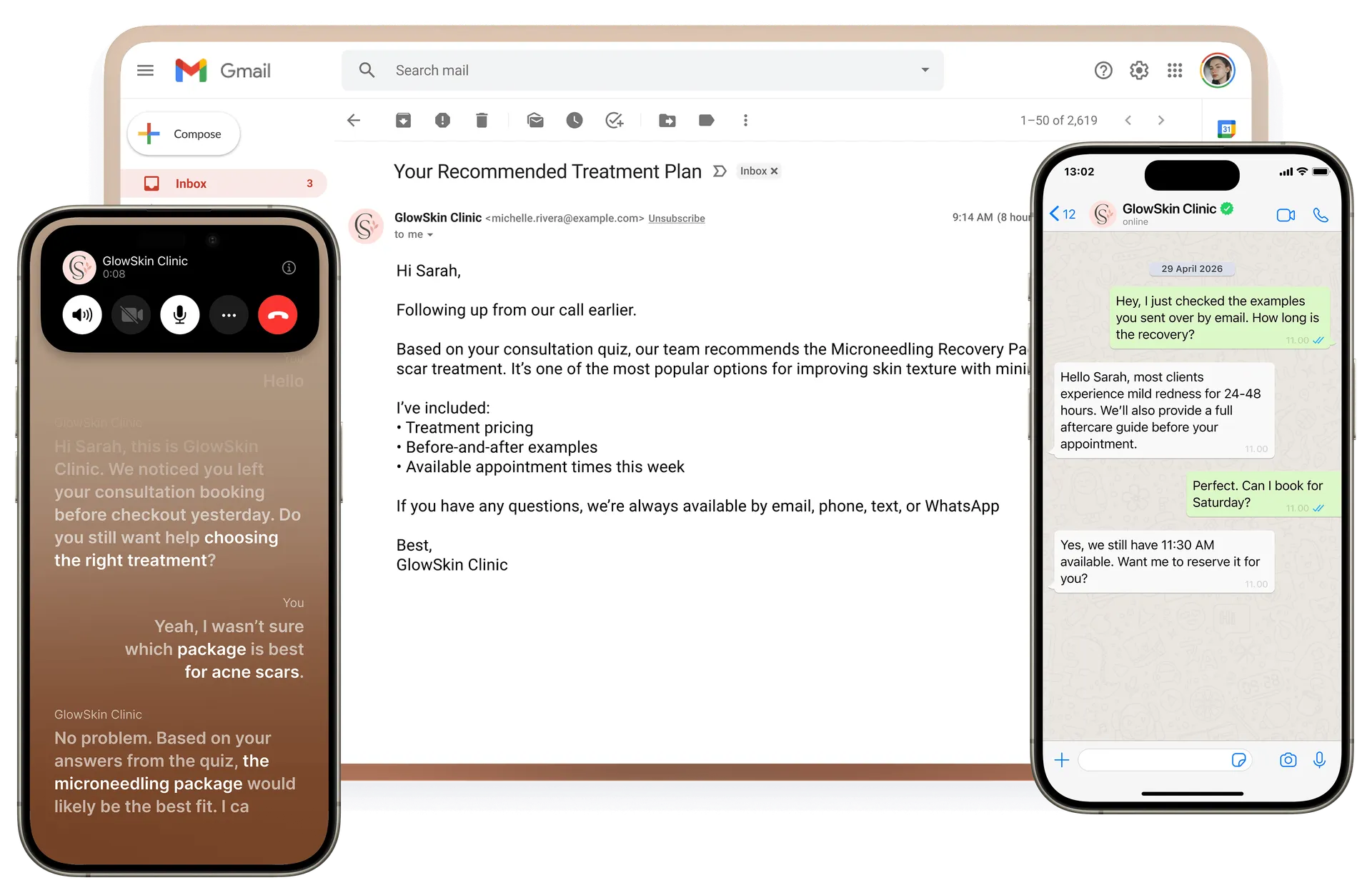
Callers is an omnichannel AI platform that automates inbound and outbound conversations across the whole customer lifecycle. It runs one agent across calls, SMS, WhatsApp, email, and chat, all sharing the same context, so a customer never has to repeat themselves. And unlike with Retell, your CX and RevOps teams build and edit those agents themselves, without touching code.
Callers is built for high-volume B2C teams where each conversation ties straight to revenue, from lead generation and lending through to insurance and contact-center operations. The AI takes the routine calls and routes anything high-stakes to your people, so you can scale coverage without growing headcount at the same pace.
Most teams run a POC within days, go live within weeks, and see measurable results inside the first month.
Key features
Script Builder: no-code, drag-and-drop flows with AI-assisted scripting that operators own
Workflow Orchestration: multi-step sequences, conditional retries, and post-call actioning in the console, across inbound and outbound
Model-agnostic LLM optimization: matches the right model to each task rather than locking you to one
Step-level analytics: see exactly where each script gains or loses people
Emotionally intelligent, multilingual voices: natural delivery with automatic mid-call language switching across 26+ languages
AI and human routing: the AI handles routine calls and hands high-stakes ones to your team with live warm transfer
Dedicated CSM and AE: named support on every paid plan, not only Enterprise
Built-in compliance: SOC 2, HIPAA, GDPR, CCPA, and PCI DSS
610+ native integrations: Salesforce, HubSpot, Shopify, Stripe, Zendesk, and more
Pricing
Usage-based and priced per minute, scoped to your volume, with a dedicated CSM included on every plan.
Pros
Operators launch and edit agents without waiting on developers
One agent covers inbound and outbound across every channel
White-glove onboarding comes with every tier
A POC in days and live in weeks, not a quarters-long rollout
Cons
There's no free self-serve tier, so you start with a demo
Best for
CX and operations teams that want carrier-grade voice, full campaign logic, and analytics they can act on, without leaning on engineering to get there.
Why choose Callers over Retell
Retell hands you a voice engine and leaves the building to your developers. Callers gives operators a no-code Script Builder, full Workflow Orchestration, and step-level analytics, so the people running the calls can launch and tune agents without joining a ticket queue.
You also get AI-assisted scripts, built-in spam-flag detection, and live warm transfer that Retell leaves you to solve on your own, plus a named CSM on every plan rather than only at the Enterprise tier.
2. Vapi
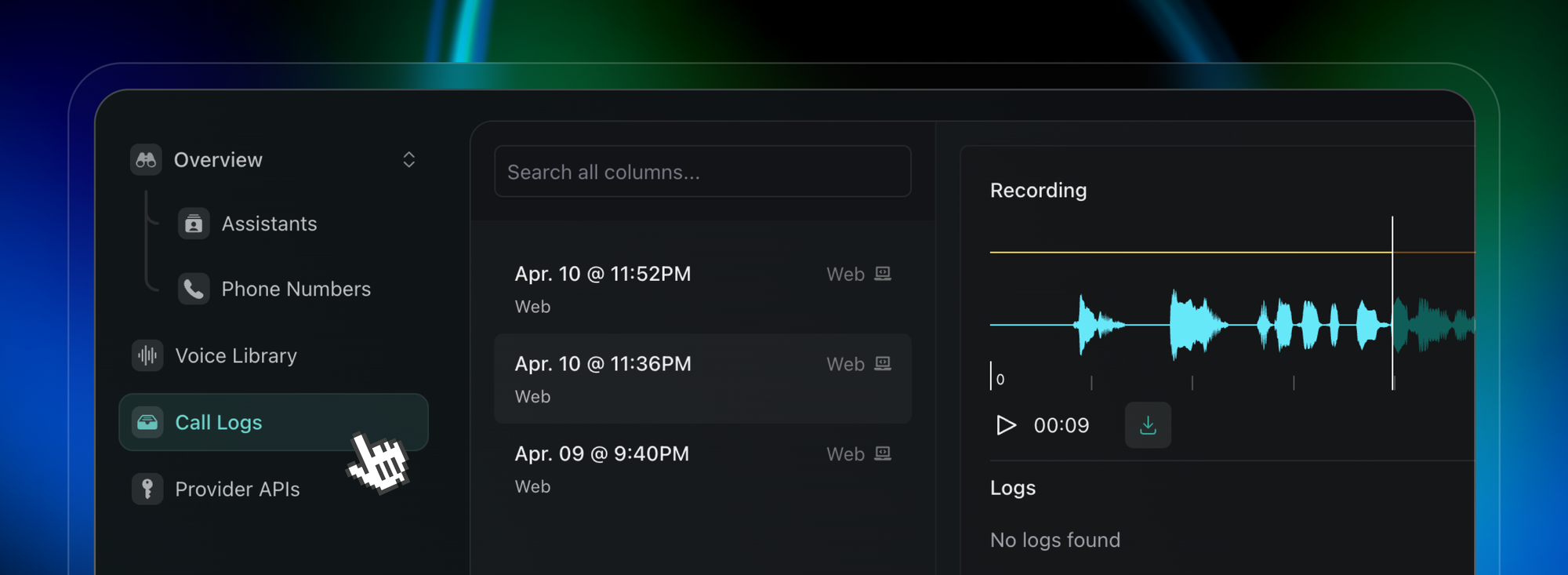
Vapi handles the infrastructure behind voice agents and leaves the choices to you. You pick your own speech-to-text, language model, and text-to-speech providers, then orchestrate them through Vapi. It's a strong fit for teams that want their hands on every layer of the stack.
Key features
Provider orchestration: mix and match STT, LLM, and TTS vendors
Web and phone SDKs: embed voice into your own apps and flows
Assistants and squads: single-agent and multi-agent workflows
Enterprise controls: SSO, RBAC, and zero-retention options higher up
Pricing
The usage-based Build plan charges $0.05 a minute for orchestration, and you pay for STT, the language model, TTS, and telephony separately on top. The Scale tier is custom, and a HIPAA add-on runs $2,000 a month.
Pros
Total flexibility over models and voices
Bring your own API keys to keep model spend in check
Genuinely good developer tooling and docs
Cons
Wiring the providers together takes real engineering time
The $0.05 headline rate hides the model fees stacked on top
Not much in the way of managed onboarding
Best for
Engineering teams that want to build a bespoke voice stack and are happy owning the pieces.
Why choose Vapi over Retell
Both are developer-first, so this really comes down to how much of the stack you want to control. Retell packages its voice engine and models for you, while Vapi lets you bring your own speech-to-text, language model, and text-to-speech, and swap any layer out whenever you like.
If you want to sidestep model lock-in, tune each piece, and keep model spend on your own API keys, Vapi gives you more room to work than Retell does.
3. Bland
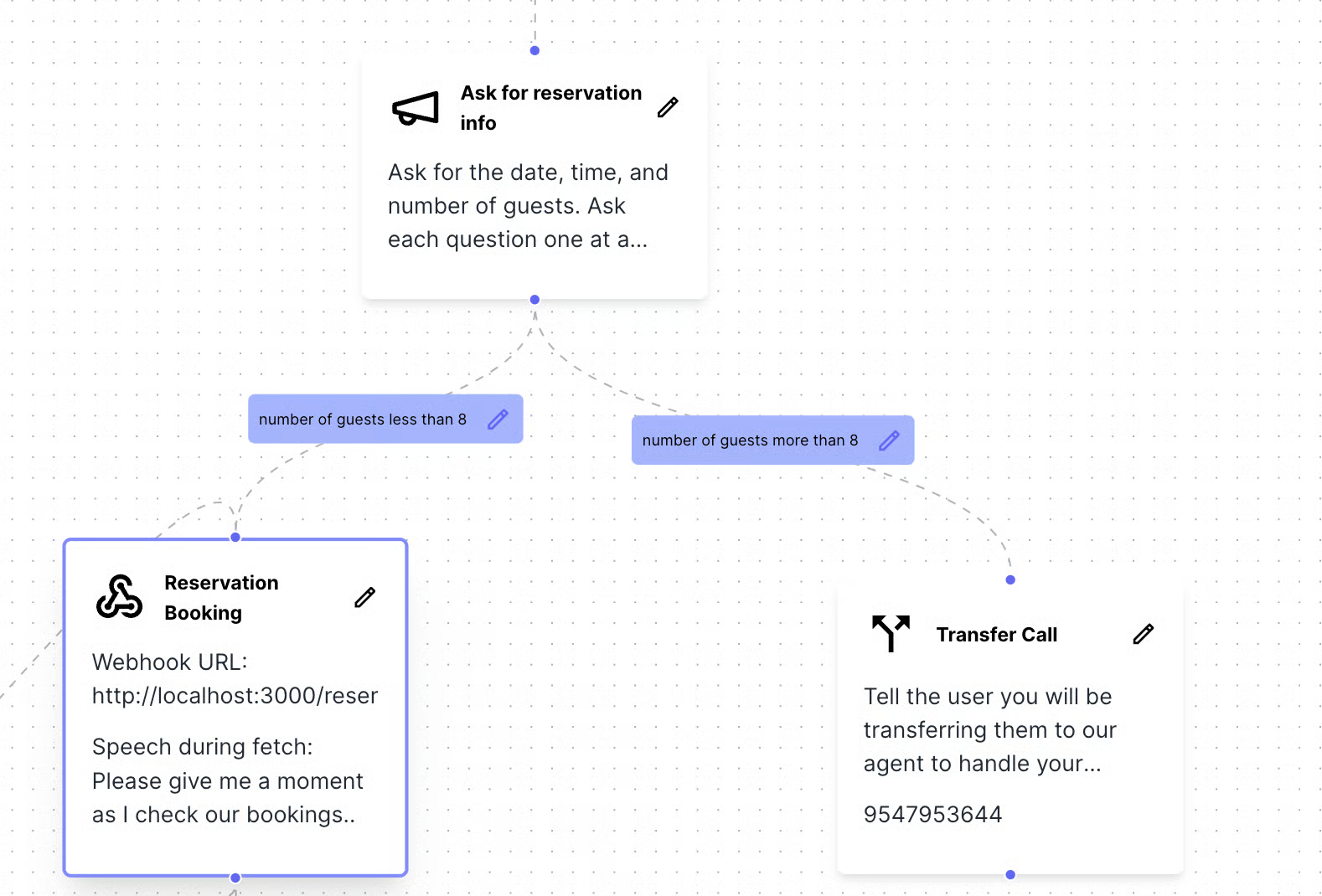
Bland is aimed at enterprises that want to own their voice AI rather than rent it. It runs on dedicated infrastructure with custom-trained models and handles very high call concurrency, which is why data-sensitive teams tend to shortlist it.
Key features
Owned model stack: custom-trained models on dedicated infrastructure
High concurrency: built for very large call volumes
Guardrails: controls that keep agents on script
Pathways: built-in conversation flows for common journeys
Pricing
The Start plan is free, with two credits and an inbound number to get going. Build is $299 a month and Scale is $499 a month. Talk time runs from about $0.11 to $0.14 a minute, and that single rate covers the language model, speech-to-text, and text-to-speech. Enterprise is custom.
Pros
Clean per-minute rate that folds in model costs
Dedicated infrastructure for data-sensitive work
Scales comfortably to enterprise volumes
Cons
The interface is technical and takes a while to learn
No live human transfer, which limits complex handoffs
Managed onboarding is thin outside Enterprise
Best for
Large enterprises that care most about model ownership, data control, and concurrency.
Why choose Bland over Retell
Retell's pricing stacks a voice-engine fee, model costs, and telephony into a rate that can climb toward $0.31 a minute. Bland folds the language model, speech-to-text, and text-to-speech into one clean per-minute figure, which makes spend far easier to forecast.
It also runs on dedicated infrastructure with custom-trained models and very high concurrency, so data-sensitive enterprises that want to own the stack often prefer it to a hosted engine.
4. Synthflow
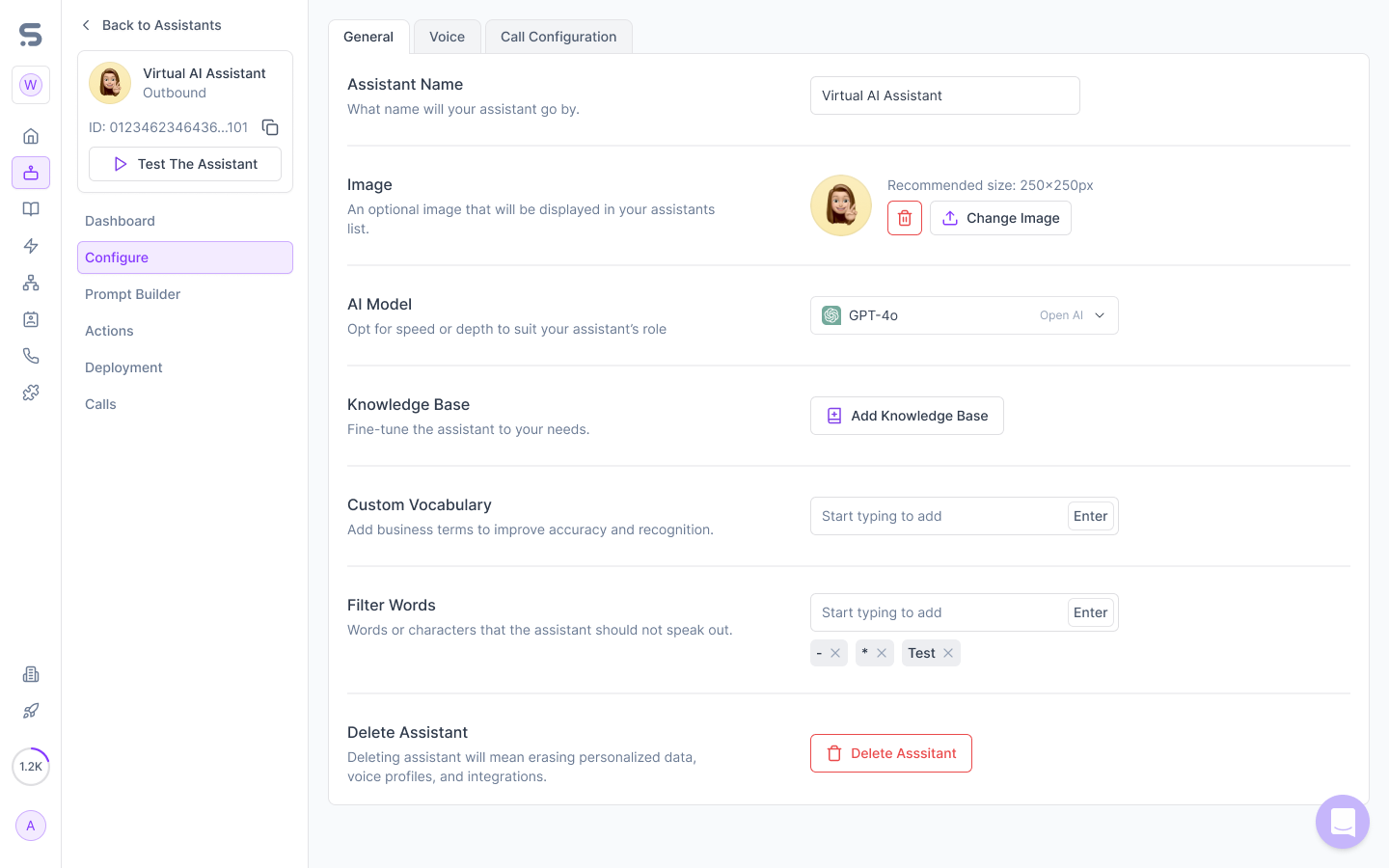
Synthflow bills itself as a complete voice AI operating system, with a no-code builder and its own telephony network. It's long been popular with agencies thanks to white-label options and packaged tiers, and it covers build, launch, and monitoring in one place.
Key features
No-code flow builder: visual design with packaged templates
Own telephony network: low-latency calling with carrier-grade reliability
Testing and QA: sandbox, versioning, and monitoring
Agency and white-label options: resell under your own brand
Pricing
Synthflow now sells mainly into enterprise, with contracts starting around $30,000 a year and final pricing scoped to your volume and setup. It used to offer cheaper self-serve plans in the $29 to $99 a month range, and those still surface on review sites, though they've since dropped off Synthflow's own page, so it's worth confirming before you count on them.
Pros
A genuinely no-code build experience
Own telephony network keeps latency low
Strong fit for agencies and resellers
Cons
Affordable self-serve pricing is no longer front and center
Scripts are written by hand with little AI help
Analytics stay fairly basic
Best for
Agencies and no-code teams that want white-label voice agents on one platform.
Why choose Synthflow over Retell
Retell expects JSON and a developer to author its flows. Synthflow is genuinely no-code, with a visual builder, packaged campaign presets, and its own telephony network, so a non-technical team can get an agent live without engineering support. For agencies, the white-label options seal it, since you can resell the whole thing under your own brand in a way Retell was never built for.
5. Thoughtly
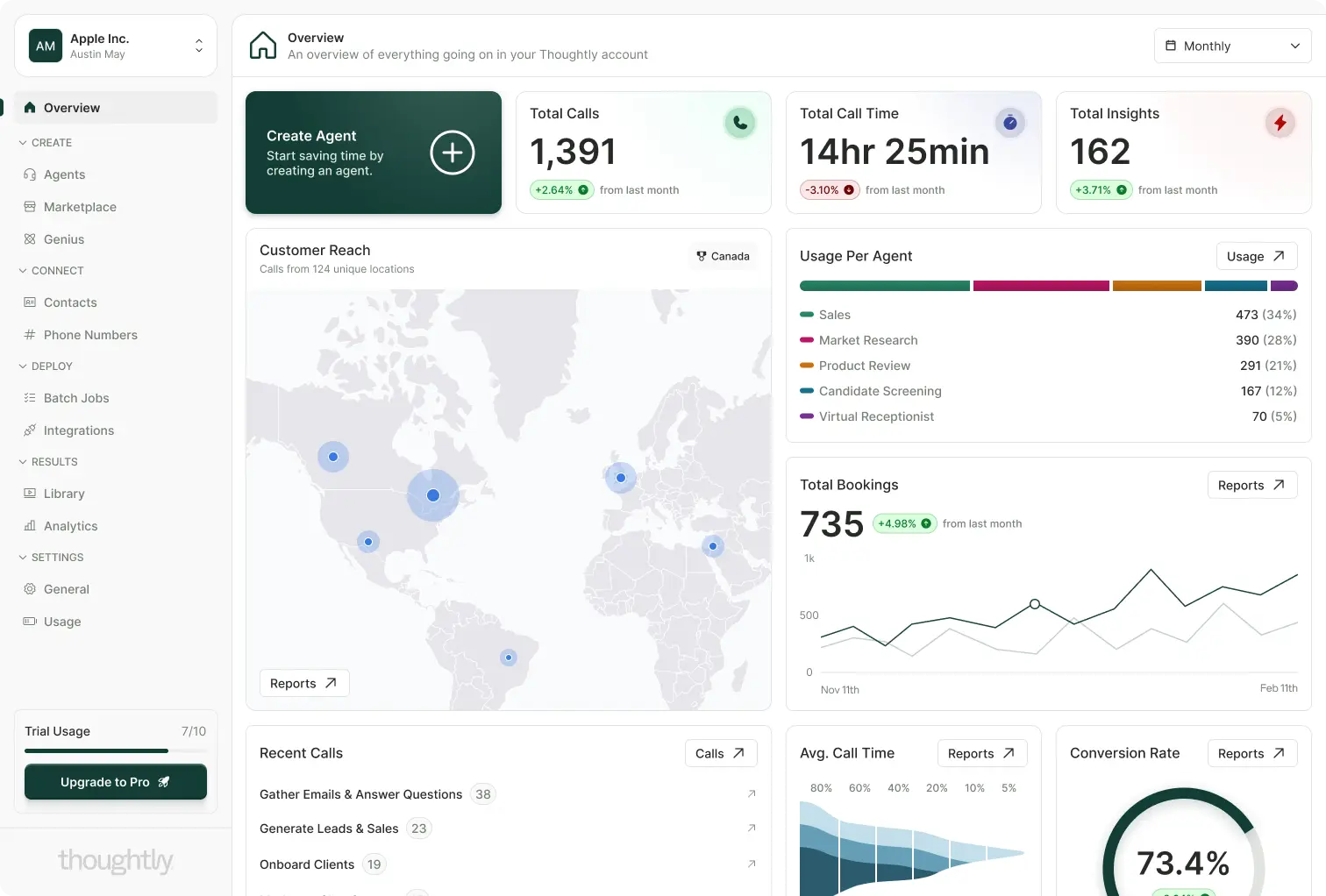
Thoughtly is built around inbound leads a sales team can't afford to miss. Its agents call, text, email, and sync outcomes back to the CRM, chasing every lead across channels until someone picks up, and the builder is visual and aimed at operators rather than developers.
Key features
Inbound-lead focus: built to convert leads quickly
Omnichannel follow-up: voice, SMS, WhatsApp, and email in one workflow
CRM sync: every conversation lands in your CRM
No-code builder: a visual editor for non-technical teams
Pricing
The Flex plan starts at $500 a month, with roughly 10 concurrent calls and channels bundled in. Scale and Enterprise are custom and handled through sales.
Pros
A clear focus on inbound lead conversion
Channels are bundled with no per-channel surcharge
Approachable for sales teams
Cons
$500 a month is steep for a very small team
There's limited depth beyond inbound follow-up
No public per-minute rate to forecast against
Best for
SMB sales teams that want to convert inbound leads across channels without heavy setup.
Why choose Thoughtly over Retell
Retell hands you infrastructure to build on; Thoughtly hands a sales team a working inbound-lead workflow. Its agents call, text, and email every lead, then sync the outcome straight into your CRM, all from a no-code editor. If your goal is converting inbound leads rather than assembling a voice stack, Thoughtly gets you there with far less setup.
6. JustCall
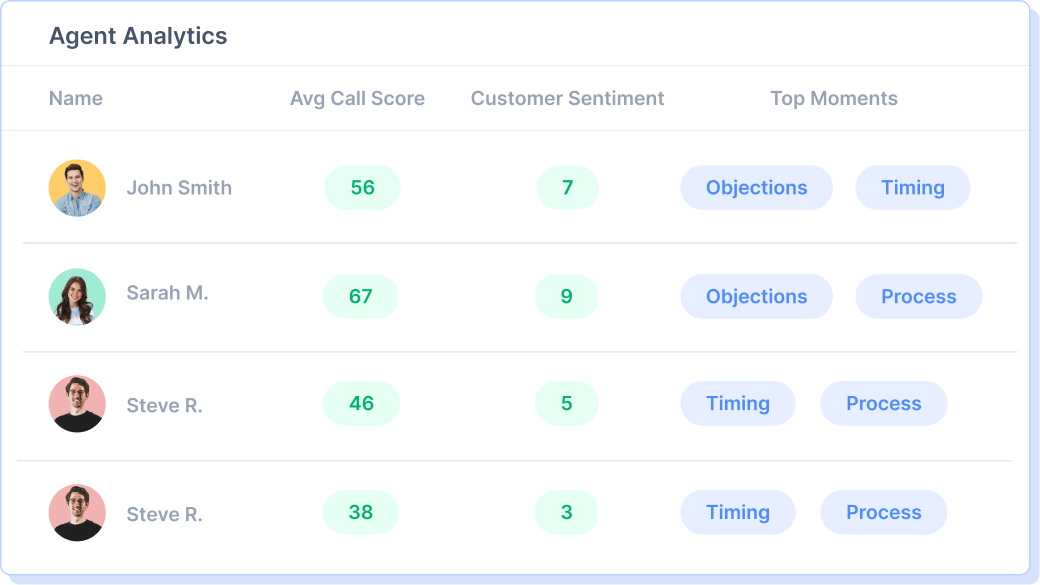
JustCall is a broader communication platform for sales and support teams, with an AI Voice Agent offered as an add-on. Alongside the AI you get dialers, SMS, coaching, and workflow automation, which makes it a fit for teams that want a full phone system with AI layered in.
Key features
Full phone suite: dialers, SMS, and voice in one place
AI Voice Agent add-on: automate calls with no-code agents
Coaching and scoring: AI moment analysis and sentiment
100+ integrations: CRM and helpdesk connectors
Pricing
Seat plans run from $29 to $89 per user a month, with a two-user minimum and a custom Business tier. The AI Voice Agent is a separate add-on at $0.99 a minute pay-as-you-go, or $99 a month for 100 minutes and $249 a month for 300.
Pros
Combines human calling and AI voice under one roof
Transparent, published seat pricing
Solid coaching and analytics for reps
Cons
The AI Voice Agent rate is among the highest in the category
The value depends on buying into the wider suite
AI depth trails purpose-built voice platforms
Best for
Sales and support teams that want AI voice inside a full-featured phone system.
Why choose JustCall over Retell
Retell focuses on AI voice alone. JustCall wraps AI voice into a full phone system, so your reps get dialers, SMS, coaching, and scoring right alongside the automation. Teams that still run plenty of human calling, and want the AI to sit in the same platform rather than a separate build, get more out of JustCall, and its seat pricing is published upfront.
7. PolyAI
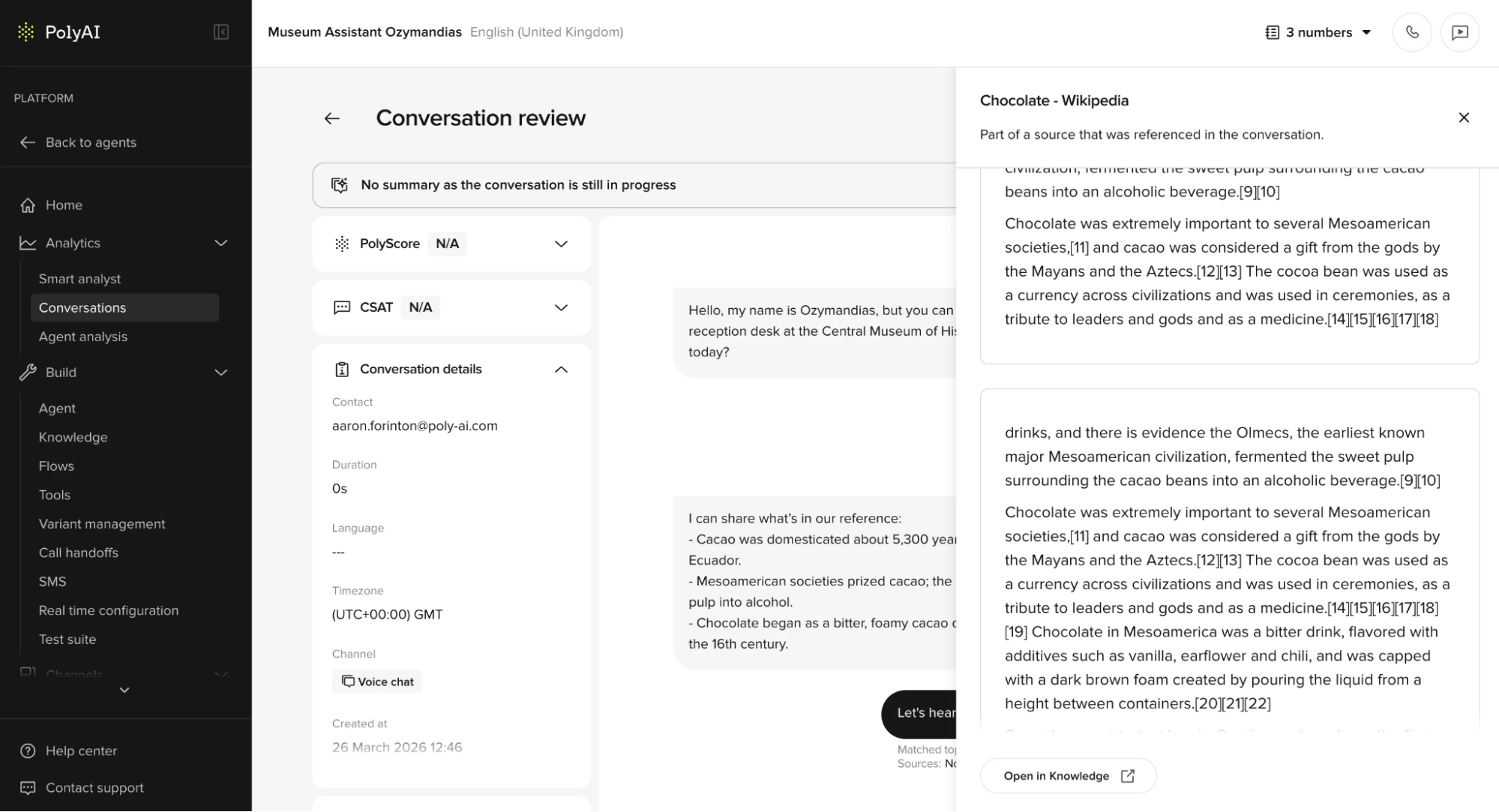
PolyAI builds voice-native customer service AI for enterprise inbound. Its agents resolve complex calls end to end and hold up well against interruptions, accents, and noisy lines. Delivery has traditionally run through PolyAI's own team, with a self-serve builder added more recently.
Key features
Voice-native models: built for spoken customer service
Contact-center containment: resolve more, transfer less
CX integrations: connectors for the major contact-center platforms
Measurement-led delivery: optimization by PolyAI's own experts
Pricing
PolyAI doesn't publish its prices and bills the voice agent per minute under a custom enterprise contract. Independent analyses put base contracts somewhere around $150,000 a year plus usage, so treat that as a ballpark rather than a quote.
Pros
Excellent inbound voice quality in tough conditions
Deep contact-center integrations
Strong references in regulated industries
Cons
No public pricing and a higher barrier to entry
Historically managed rather than self-serve
Outbound needs the account team to switch it on
Best for
Enterprises that need high-quality inbound voice containment in the contact center.
Why choose PolyAI over Retell
For high-stakes inbound, PolyAI's voice-native models are tuned to handle interruptions, accents, and noisy lines, and its team optimizes the deployment with you. Retell gives you the tools and expects you to reach that quality yourself. Enterprises that want measured, managed inbound containment in the contact center, rather than a self-build, tend to lean toward PolyAI.
8. Decagon
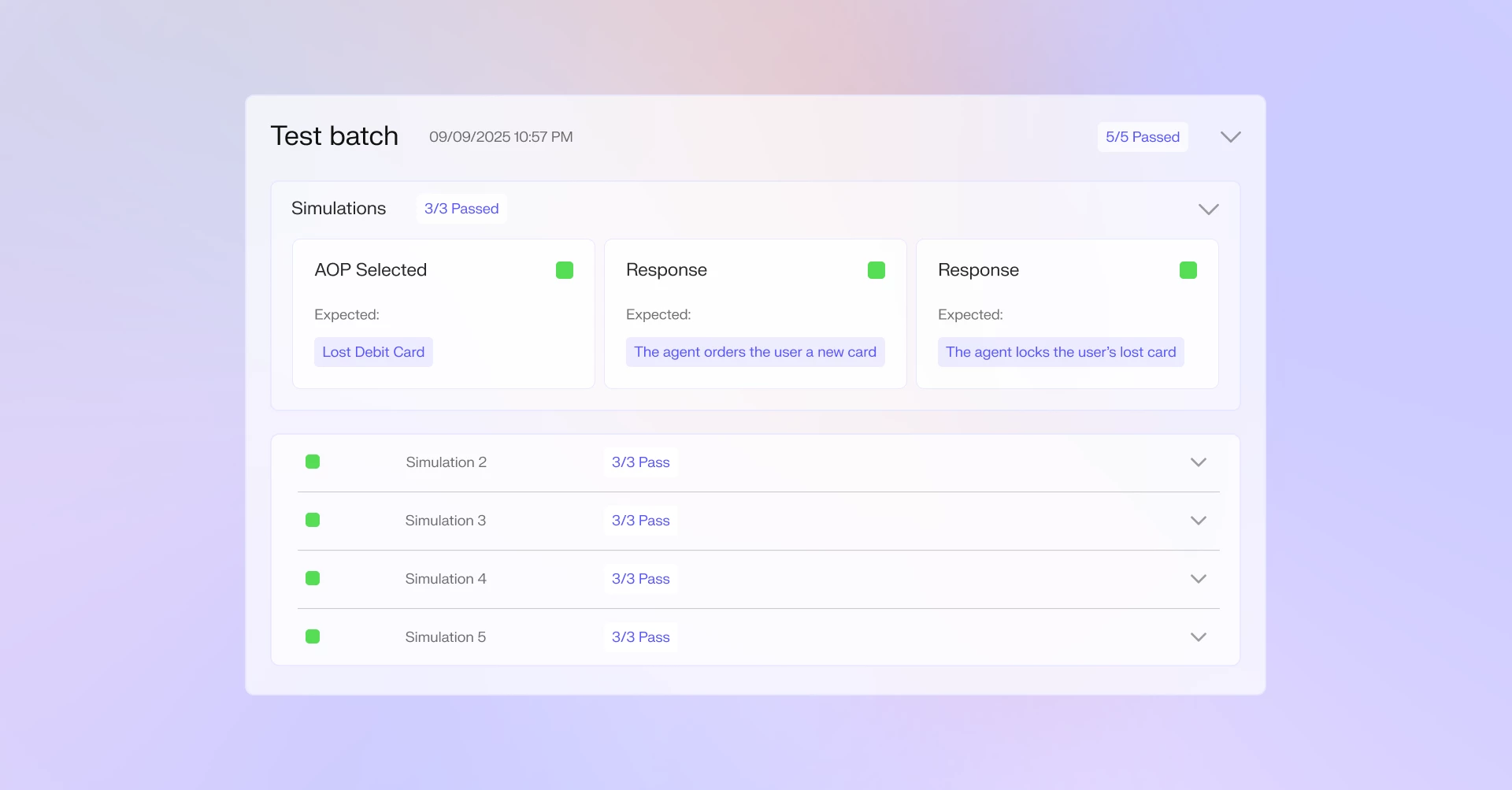
Decagon offers an AI concierge for customer experience, built on natural-language Agent Operating Procedures. Teams describe their workflows in plain language, then deploy across chat, email, and voice, and it has grown quickly among digital-native brands.
Key features
Agent Operating Procedures: define workflows in natural language
Omnichannel deployment: chat, email, and voice from one build
Concierge experience: personalized, always-on support
Enterprise security: SSO, RBAC, and encryption throughout
Pricing
Decagon doesn't publish pricing and charges per conversation or per resolution under a custom contract. Independent write-ups suggest deals land in the six figures, which gives you a rough sense of the tier it plays in.
Pros
Natural-language workflow authoring
A unified experience across channels
Rapid adoption among enterprise brands
Cons
Pricing is opaque and enterprise-scale
Writing AOPs still comes with a learning curve
Newer to outbound voice
Best for
Digital-native brands scaling concierge-style CX across channels.
Why choose Decagon over Retell
Where Retell wants JSON and code, Decagon lets you describe workflows in plain language through its Agent Operating Procedures, then run them across chat, email, and voice from a single build. For CX teams that would rather define behavior in words than in a developer console, Decagon is the more natural fit, especially digital-native brands scaling concierge-style support.
9. Cognigy
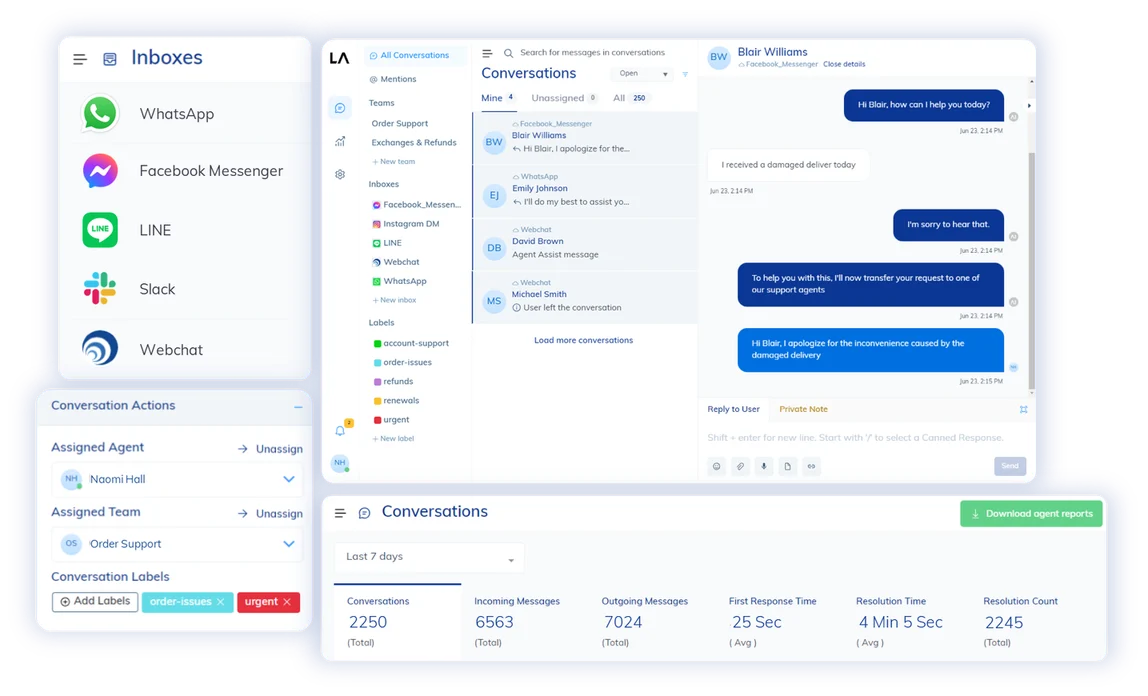
Cognigy is an enterprise agentic AI platform for customer service, recognized by industry analysts and known for deep contact-center integration. It orchestrates autonomous agents across voice and digital channels with strong governance, and large, complex organizations are its core audience.
Key features
100+ integrations: broad CCaaS and CRM connectivity
Voice gateway: turnkey connectivity to contact centers
Agentic platform: autonomous agents plus human agent assist
Analytics suite: omnichannel conversation insights
Pricing
Cognigy doesn't publish pricing; it's an enterprise platform sold through a sales conversation, with contracts scoped to your volume and the modules you turn on.
Pros
An analyst-recognized enterprise platform
A very deep integration ecosystem
Handles both autonomous and assisted models
Cons
No public pricing to work from
Enterprise rollouts often take two to four months
Modules are licensed separately
Best for
Large enterprises that need deep CCaaS integration and formal governance.
Why choose Cognigy over Retell
Retell is a focused voice tool; Cognigy is a full enterprise platform. It brings 100+ integrations, turnkey contact-center connectivity, formal governance, and both autonomous agents and human agent assist. Large organizations with complex stacks and compliance requirements get depth and analyst-backed credibility from Cognigy that a lighter voice tool like Retell isn't trying to offer.
10. Anyreach
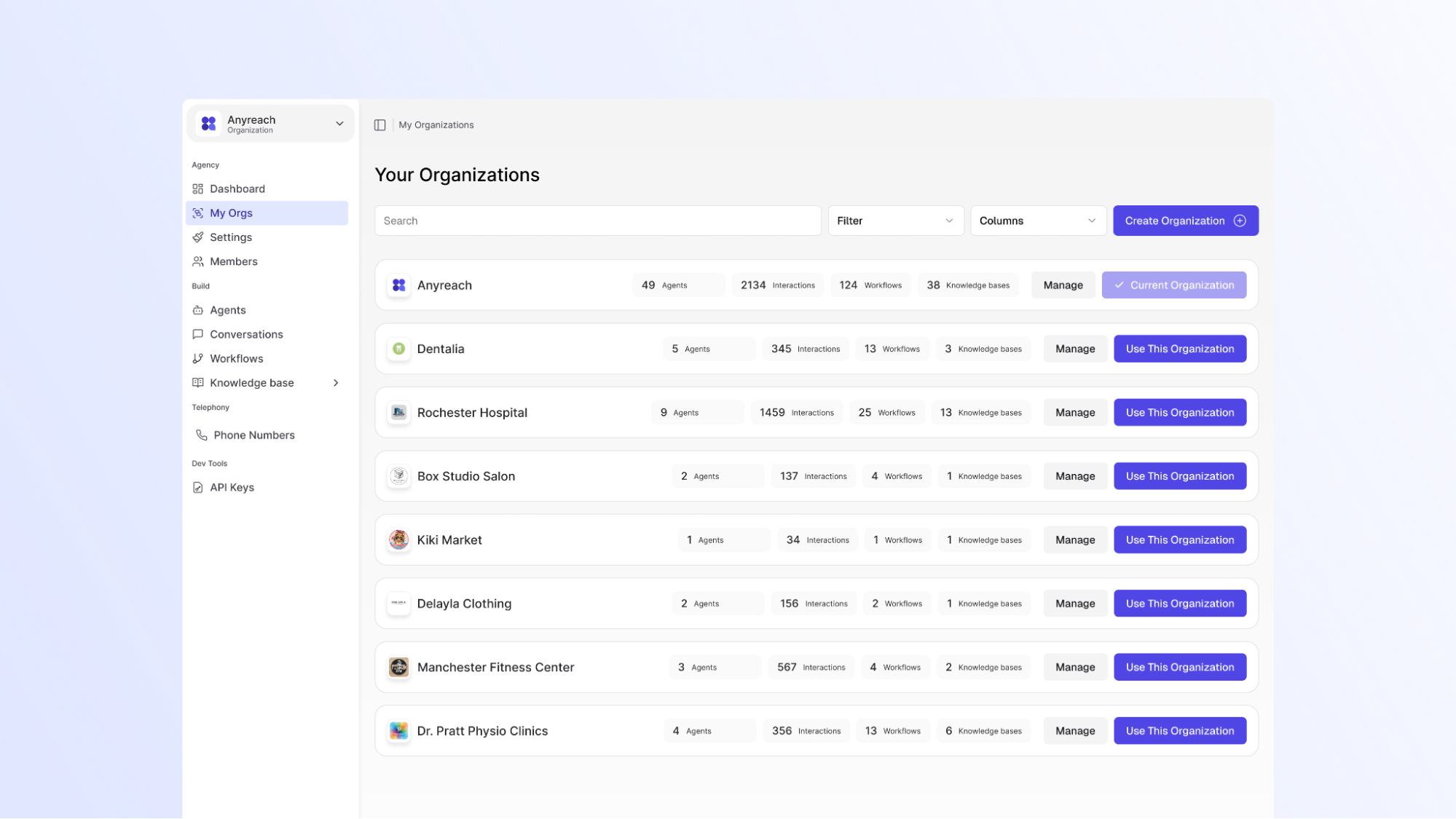
Anyreach markets a single AI employee that answers calls, messages, chats, and emails, then follows up across channels. It carries persistent memory between conversations and leans hard into a white-label agency model, which pushes its reach beyond direct enterprise sales.
Key features
Omnichannel scope: voice, email, SMS, chat, and WhatsApp
Persistent memory: context carries across channels
White-label model: resell under your own brand
Enterprise framing: SLAs, audit trails, and permissions
Pricing
The SMB plan is free plus usage, with AI voice starting at $0.19 a minute, and the Agency plan adds white-label resale at $1,250 a month plus usage. Enterprise is custom, add-ons like phone numbers and knowledge base are billed on top, and there's a 14-day free trial to test it.
Pros
Broad omnichannel coverage in one workspace
Memory-driven continuity across channels
A clear white-label path for agencies
Cons
Voice starts higher, at $0.19 a minute
Add-ons stack on top of the base
A younger platform with a shorter track record
Best for
Agencies that want a white-label, memory-driven omnichannel agent.
Why choose Anyreach over Retell
Retell centers on voice. Anyreach spreads one AI employee across voice, email, SMS, chat, and WhatsApp, with memory that carries context between them. Add the white-label agency model, and it becomes a way to resell omnichannel agents under your own brand, a route that Retell's voice-focused infrastructure doesn't really open up.
11. Voiceflow
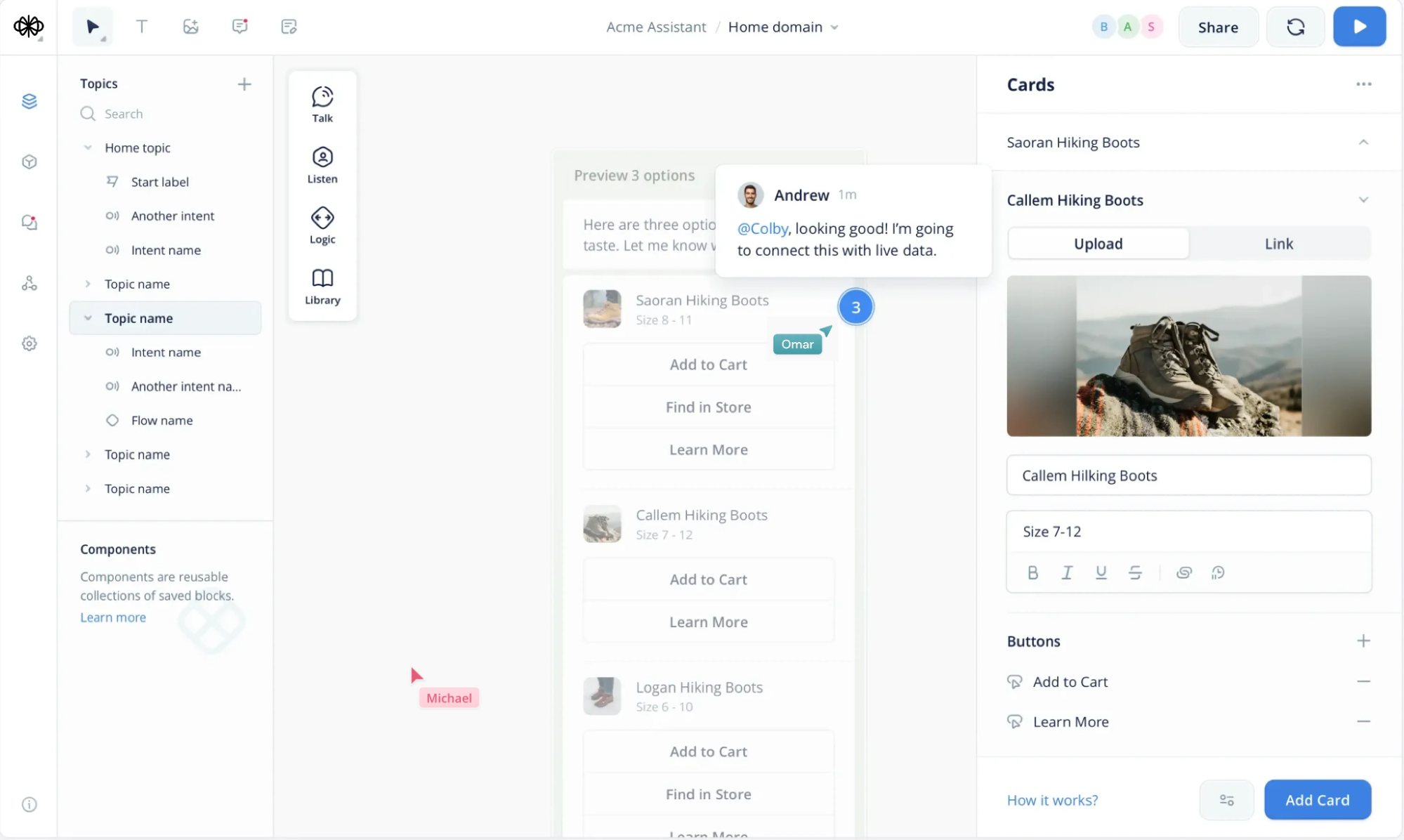
Voiceflow is an agent platform aimed at builders, pairing a design-led visual canvas with a developer SDK. Product, design, and engineering teams collaborate on agents across chat and voice, and it stays agnostic about models and channels.
Key features
Visual canvas: a designer-friendly building experience
Model-agnostic: bring your own language models
Team collaboration: roles, comments, and versioning
Template marketplace: get to a first deployment faster
Pricing
Voiceflow no longer lists its prices publicly. Independent trackers point to a free Sandbox tier and paid plans from around $60 a month that scale by usage credits, with Enterprise custom, so you'll want to confirm the current numbers with their team.
Pros
A strong collaboration and design workflow
Flexible across models and channels
A generous free tier for experimenting
Cons
Leans toward prototyping more than production CX
Its own pricing is no longer transparent
Production voice takes integration work
Best for
Product and design teams that want to prototype and build agents together.
Why choose Voiceflow over Retell
Retell is code-first; Voiceflow is design-first. Its visual canvas and collaboration features, including roles, comments, and versioning, let product, design, and engineering shape an agent together, and it stays open about which models and channels you use. For teams that want to prototype quickly and build by consensus rather than in a developer console, Voiceflow is the friendlier starting point.
12. Cresta
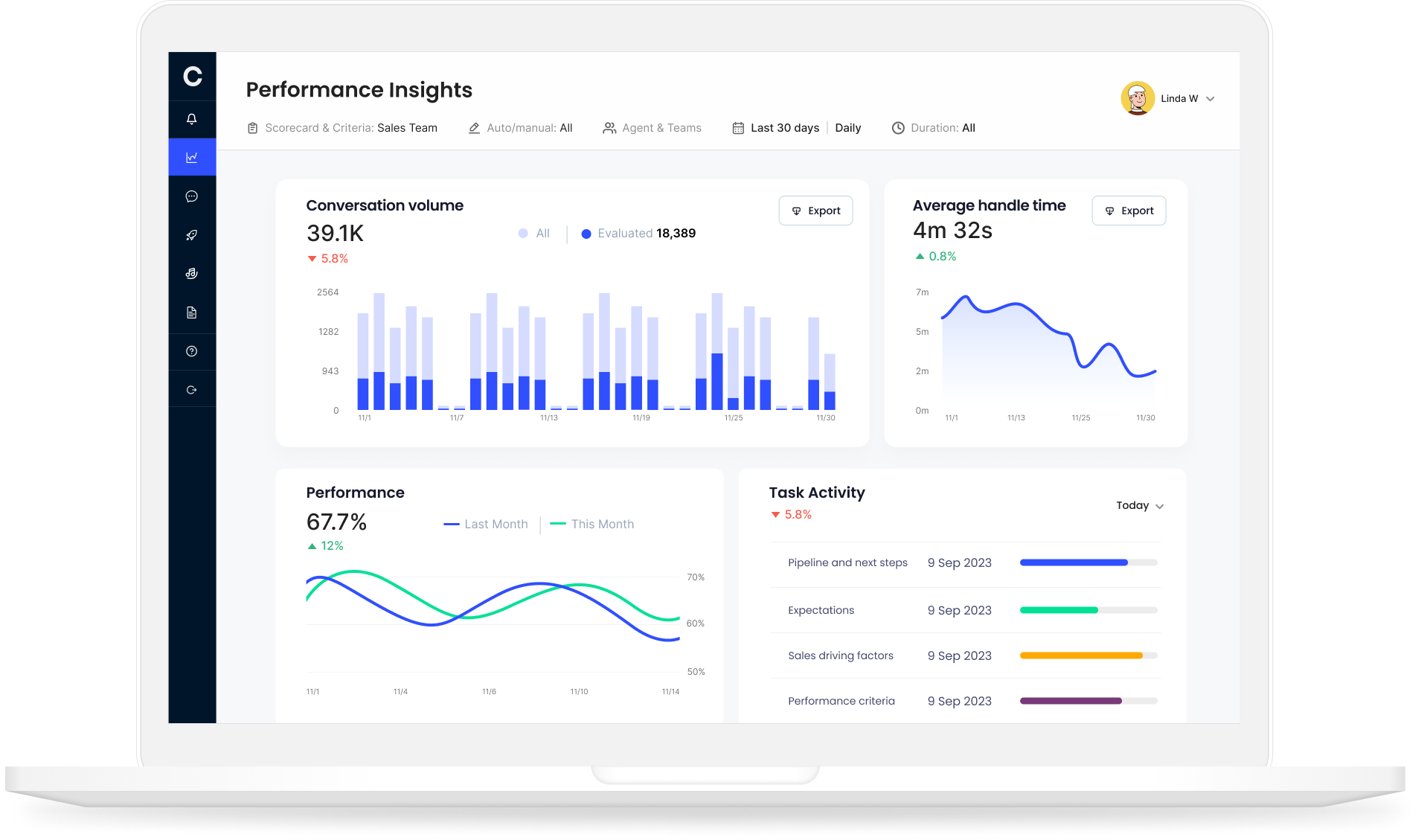
Cresta blends real-time human agent assist with autonomous AI, built on its proprietary Ocean-1 model. It centers on making live agents better through coaching, quality management, and conversation intelligence, and large contact centers are its home turf.
Key features
Human agent assist: real-time in-call coaching
Ocean-1 model: a domain model trained on contact-center data
Autonomous AI agents: automate the conversations that suit it
QM and coaching: quality management across interactions
Pricing
Cresta doesn't publish pricing and licenses per seat, plus volume and feature tiers, on annual contracts. Independent estimates put the range somewhere around $60,000 to $150,000 a year, which points to the tier without pinning down a quote.
Pros
Deep human-plus-AI augmentation
A proprietary domain model
A very strong enterprise compliance stack
Cons
A professional-services-led implementation
Quote-only pricing with a high floor
Centered on assisting humans more than full automation
Best for
Enterprise contact centers that want to augment live agents alongside autonomous AI.
Why choose Cresta over Retell
Retell automates calls; Cresta also makes your human agents better. Its real-time coaching, quality management, and conversation intelligence run on a domain model trained on contact-center data, so live reps get guidance mid-call alongside the autonomous agents. Contact centers that want to lift human performance, not only deflect calls, get something from Cresta that Retell doesn't set out to do.
Choose the Right Retell AI Alternative
Retell is still a solid pick for developers who want low-latency voice and are happy building in code. The real question is whether that suits the team who has to run the calls once they're built.
If you have engineering time and want a hand on every layer, Vapi and Bland reward it. If you need a full phone suite, JustCall fits. For enterprise inbound or formal governance, PolyAI, Cognigy, and Cresta earn their place on the list.
For most teams that want carrier-grade voice, full campaign logic, and analytics they can act on without waiting on developers, Callers is the one to trial first. You can run a POC in days, keep operators in control, and see step-level results inside the first month.