
How to Improve CSAT: A Practical Guide for Call Center Leaders
:quality(80))
:quality(80))
Quick Summary
CSAT drops because of structural issues, not agent effort. Problems include bad measurement, slow queues, low first contact resolution, repetition across channels, and self-service that fails silently. This guide covers seven evidence-backed fixes. It ranges from correcting survey math to routing calls by stakes instead of availability, plus recovering unhappy customers fast and coaching from real call transcripts.
Not Sure What’s Stopping Your CSAT Score From Improving?
Your CSAT dashboard says 74%, and every quarter you promise leadership it'll climb. Then it doesn't. Not because your agents aren't trying, but because the real levers, measurement, queue time, first contact resolution, sit outside what a training session can fix.
In this Callers article, we walk through seven practical, evidence-backed ways to move your CSAT score. We start with the one most teams get wrong before they even collect their first survey response.
But first…
Why Listen to Us?
At Callers, we build AI-driven CX automation for high-volume call centers, working with brands like DoorDash, Einride, PadSplit, and VGM to cut wait times and lift resolution rates. That work, across millions of real customer conversations, gives us a ground-level view of what actually moves satisfaction scores. This guide draws directly on those results.
What is CSAT?
CSAT stands for customer satisfaction score. It measures how a customer felt about one specific interaction, not their overall relationship with your company. A customer can rate a single call five stars because the agent was helpful, even if they're still angry about a billing error from last month.
Most contact centers ask a post-call CSAT question, typically on a five-point scale from very dissatisfied to very satisfied. Your score is the percentage who pick the top two options or sometimes just the single top box. If you survey 500 customers and 380 pick the top two responses, you're at 76%.
For context, SQM Group's benchmark research puts the call center industry average at 78%, with 75% to 84% counting as a good score.
A single blended score can sit inside that good range while hiding real problems underneath it. That's why we suggest tracking CSAT at more than one level. Look at it overall, by agent, and by resolution status, so a dip points you toward where to look rather than just telling you that something's wrong.
7 Practical Ways to Improve Your CSAT
Most CSAT plans fail at the point of execution, not strategy. The seven moves below are ordered the way you'd actually tackle them.
1. Get Your Measurement Right Before You Try To Move It
A broken measurement setup means every decision that follows is built on bad information, and you may not find out until months later.
Here are three things to consider:
Survey timing: Ask within one business day of the call, while the customer still remembers it clearly. Use a single top-box question on a consistent scale, plus one open-ended "why" to capture the reason behind the rating.
Survey math: Averaging daily CSAT percentages into a weekly or monthly number only works if every day had the same response volume, and it never does. Divide total very satisfied responses by total responses for the whole period instead. If volumes are small, use a rolling three-month window to smooth out noise.
Response bias: Post-call surveys reach a slice of your callers, and that slice skews toward the delighted and the furious. The customer who was mildly annoyed and quietly stopped calling doesn't fill anything in. Your score can hold steady while the real experience gets worse underneath it.
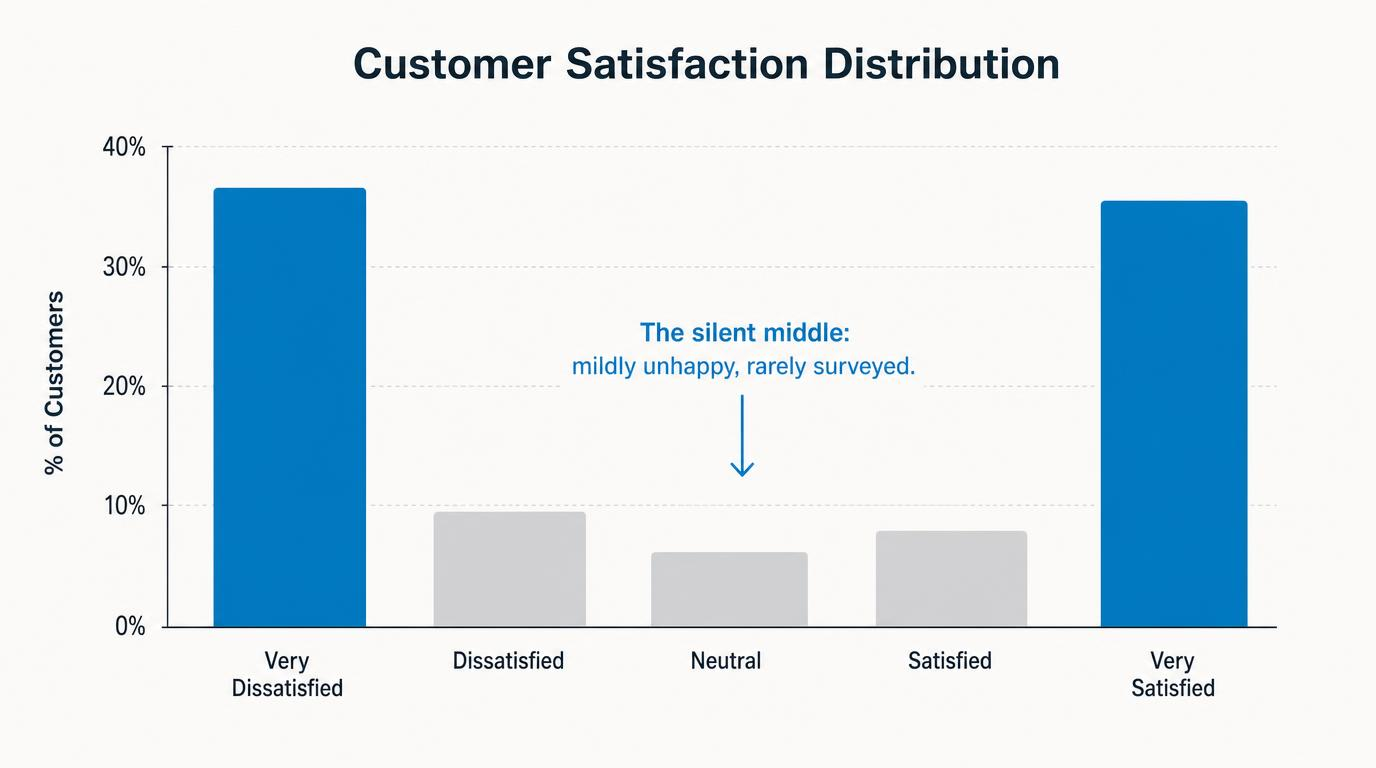
The math error is worth spelling out with numbers, because it's the one leaders catch too late. Say Monday brings 200 responses at 80% very satisfied, and Tuesday brings 50 responses at 60% very satisfied. Averaging the two daily percentages gives you 70%. Dividing total very satisfied responses (160 plus 30) by total responses (250) gives you 76%.
These six points could be the difference between a queue you'd flag for review and one that looks fine on the dashboard.
Response bias can be fixed by adopting predictive CSAT. This is where a model scores satisfaction on every interaction using signals like sentiment and resolution, not just the ones that got surveyed. Calibrate it against the survey responses you do collect to keep it honest.
2. Cut the Time Before the Conversation Even Starts
A customer starts forming an opinion before your agent says a word. Nine minutes in a peak hour queue, or a callback the next morning because you closed at five, puts the agent behind before the call even begins.
Three numbers explain most of a flat CSAT score:
Answer rate: how many calls reach an agent at all
Abandonment rate: SQM Group's benchmark guidance puts a healthy call center average around 5%, with anything meaningfully higher signaling a queue losing customers before an agent ever picks up
After-hours volume: the share of calls arriving when nobody's staffed to take them
The standard levers to pull are better forecasting, staggered shifts, and an overflow partner. All three scale with headcount, and call volume rarely arrives at a convenient, predictable rate.
The other option is automating the repetitive share of the queue. Callers runs AI agents on inbound calls, texts, and email that pick up on the first ring, whether that's 2am or a forty-caller peak. They resolve order status, balance checks, appointment changes, and address updates end to end. The agents connect to your CRM and back office systems mid-call to do it.
3. Treat First Contact Resolution As Your Highest-Leverage Metric
For every 1% improvement in First Contact Resolution (FCR), CSAT moves roughly 1% in the same direction. Nothing else on this list has that kind of direct correlation, which makes FCR the metric worth protecting above the rest.
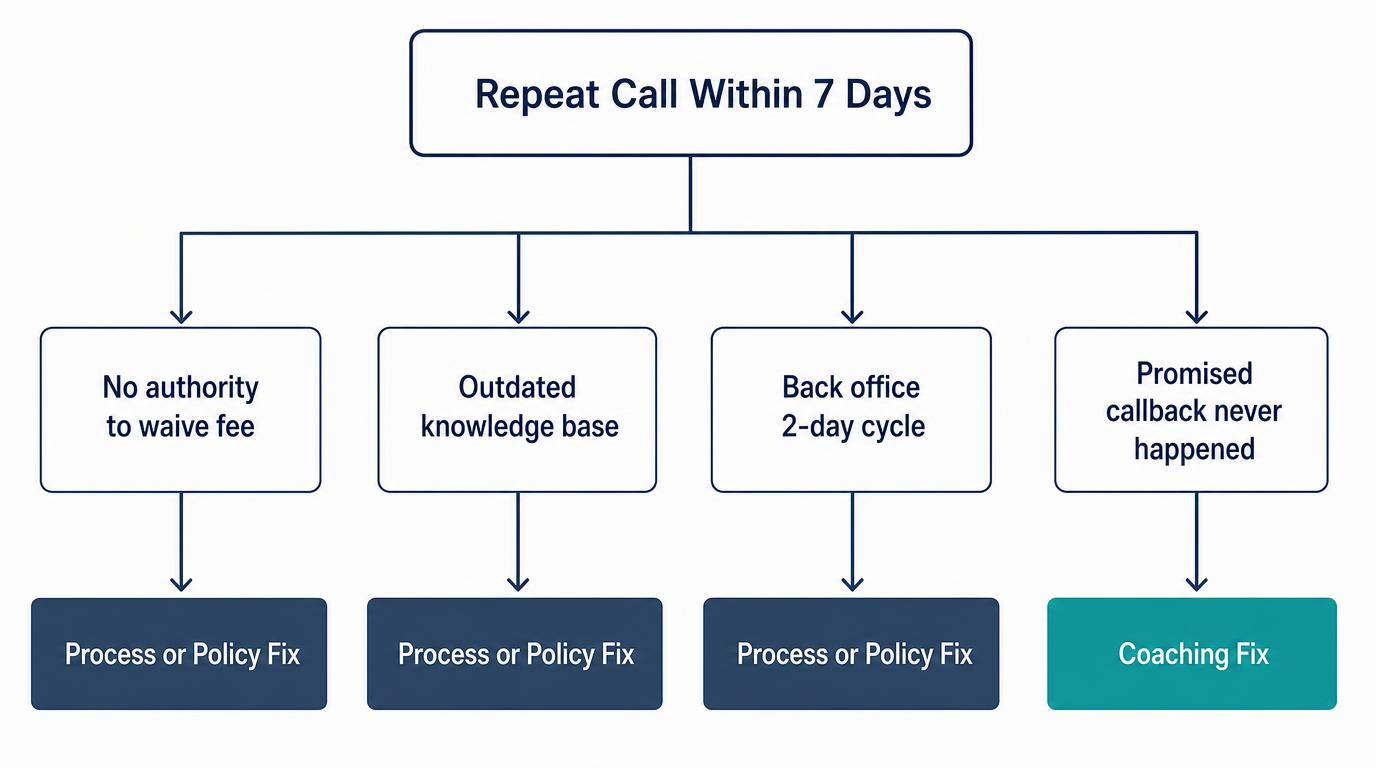
The common mistake is treating FCR as an agent behavior problem. Most repeat calls trace back to something structural instead.
Pull thirty cases where the same customer called twice inside a week and find the actual root cause in each. One or more of the same few themes tend to show up:
The agent lacked authority to issue a credit or waive a fee, so the case went to a supervisor queue.
The knowledge base article was outdated, so the agent gave a confident, wrong answer.
The fix required a back office team running on a two-day cycle.
The customer was told someone would call back, and nobody did.
Only the second one is a coaching issue. The rest are policy and process, which means your FCR plan is really a list of approval limits to raise and handoffs to redesign. Start with authority limits. They're the fastest change to make, and raising them tends to clear a meaningful chunk of the supervisor queue within days rather than quarters.
4. Stop Customers From Repeating Themselves Across Channels and Transfers
Repetition is the fastest way to lose a customer who was fine two minutes earlier. They explain the issue to the menu, then to the first agent, then again after a transfer. By the third time, they remember the hassle more than the fix.
Research on customer effort backs this up directly. CEB's Effortless Experience research found that 96% of customers who report a high effort interaction say they become more disloyal to the company, against just 9% of customers with a low effort interaction.
The fix is very simple. Every transfer should carry its context, so the receiving agent already has the account, the reason for the call, and whatever's already been tried. The same applies across channels. A customer who texted yesterday and calls today shouldn't have to start over.
Voyager GM (VGM), a transportation and logistics operator, moved its inbound support onto Callers' shared context layer, where a conversation picks up where the last one left off across calls, texts, and email.
They now automate or triage 25% to 30% of incoming calls, cutting agent workload by roughly 30% and freeing that time for cases that actually need a person. When a call does need a human, the handoff carries the full history with it rather than starting cold.
5. Match the Response to the Stakes of the Request
Not every call deserves the same treatment, and routing everything into one queue by whoever's next available creates friction on both ends. A balance check and a billing dispute are not the same conversation, and treating them the same wastes speed on one and expertise on the other.
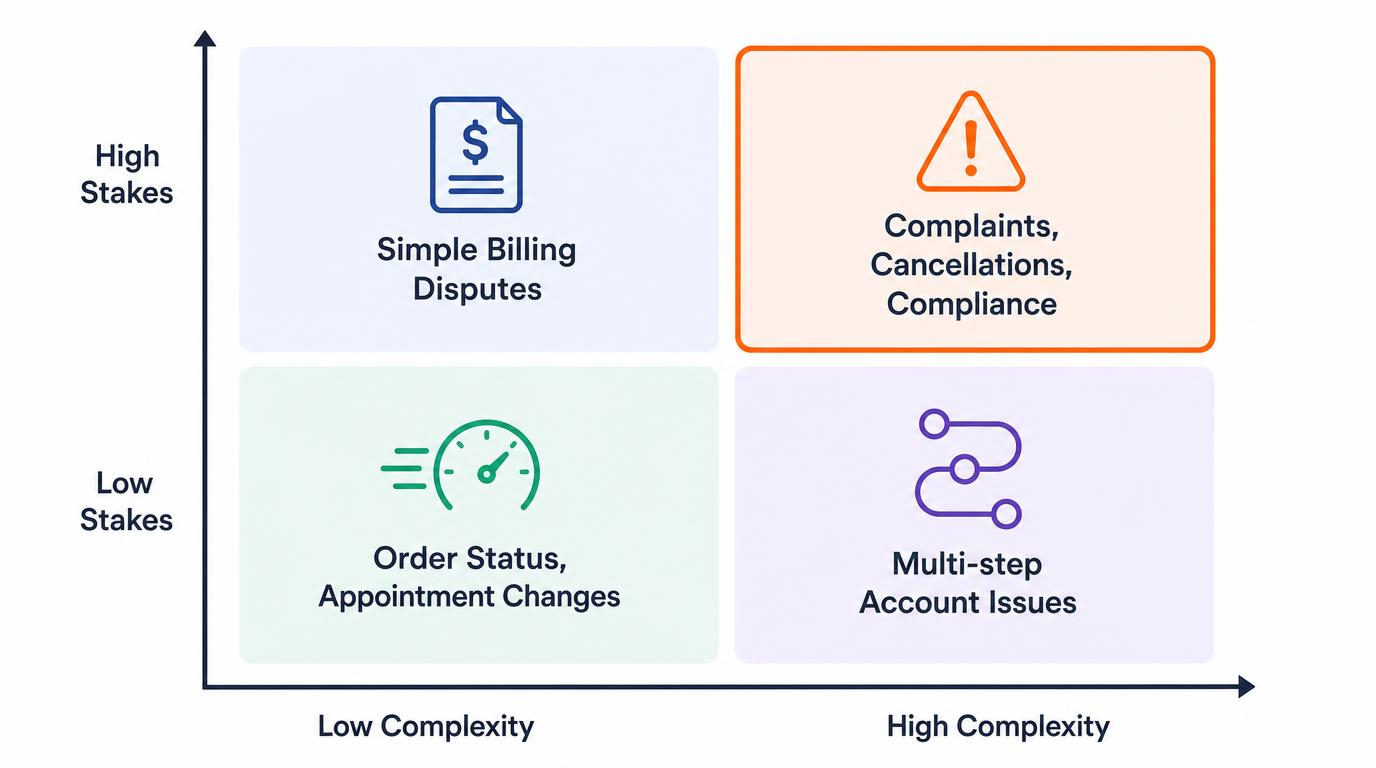
Low stakes, repetitive requests, like order status or appointment changes, should resolve fast regardless of who or what handles them. High-stakes conversations, like a complaint, a cancellation, or anything with legal or compliance weight, need a skilled person immediately, not a queue position.
With Callers, simple, well-defined requests get resolved by AI agents in seconds, while anything that reads as high stakes or emotionally charged gets routed straight to a person, with the context already attached. This frees agents from repetitive volume, meaning the complex calls that do reach them get more attention and shorter handle times.
6. Fix Self-Service Before You Expand It
Gartner surveyed 5,728 customers and found that only 14% of service issues get fully resolved in self-service. Meanwhile, 73% of customers try self-service at some point, so the channel isn't being ignored, it's failing people who show up willing to use it.
Patience for the automated alternative is thinning too. AnswerConnect's study of 6,000 people across the US, UK, and Canada tracked attitudes between October 2025 and April 2026. Preference for speaking to a person rose from 83% to 85% over that window, and frustration with AI agents climbed from 54% to 59%.
The response isn't to abandon automation. Here's how to make it earn its place instead:
Deploy automation on the specific intents it genuinely resolves, not the full menu
Measure containment and satisfaction separately for each intent
Pull anything that fails more often than it succeeds
Give every remaining path a fast, obvious route to a person, with context attached
7. Recover Unhappy Customers Fast, and Give Feedback Using the Real Calls
Start by flagging every interaction where the customer was unhappy and the issue is still open and get someone to call them back the same day. These are your cancellations in waiting, and a call from someone empowered to actually fix the problem can change the outcome.
Next, pull the calls that scored badly and sort the root cause of each one. This could be an unresolved issue, missing empathy, a poor explanation, or a policy barrier the agent had no control over.
Give agents direct feedback on the ones that are genuinely about how they handled the call, and escalate the rest to whoever owns the policy. Letting agents review their own scored calls before a one-to-one tends to change behavior faster than being told about it secondhand.
Callers' AI-powered analytics does something similar on the automated side. It surfaces where conversations break down and suggests improvements to lift the success rate, which gives you a version of the same feedback loop for automated calls that a transcript review gives you for human ones.
Frequently Asked Questions (FAQs)
What’s the Difference Between CSAT and NPS?
CSAT asks how satisfied someone was with one specific interaction, so it's a snapshot of that call. NPS asks how likely they are to recommend you, which measures the relationship over time. They move together though. SQM's research shows every 1% improvement in first contact resolution lifts transactional NPS by 1.4 points.
How Many Survey Responses Do I Need for a Reliable CSAT Score?
For a customer base of 50,000, you need roughly 384 responses to hit a 95% confidence level with a 5% margin of error. Smaller programs need less. A 1,000-person base only requires around 278. Response rate matters more than sample size. Below 15% to 20%, you're probably only hearing from the delighted and the furious, not the calm middle of your customer base.
How Do I Get More People To Actually Respond to CSAT Surveys?
Trigger the survey off the interaction itself, not a scheduled batch email sent days later. Someone who just hung up is far more likely to respond than someone reminded about it on Thursday. Keep it to one or two questions, never more. And show customers their feedback leads somewhere. People stop answering surveys the moment they notice nothing ever comes of it.
What Does Closing the Loop on CSAT Feedback Actually Mean, and Why Does It Matter?
Closing the loop means following up with the specific customer who gave you a bad score, not filing it into a report and moving on.
Can Speech Analytics Catch CSAT Problems Before a Survey Ever Comes Back?
Yes. Real-time speech analytics listens to calls as they happen, flagging rising frustration or a conversation going nowhere while an agent can still recover it, rather than waiting days for a survey to confirm what already went wrong. Vendors in this space report contact center cost reductions in the 20% to 30% range once teams act on live signals instead of only reviewing calls after the fact.
Improve Your CSAT Scores with Callers
Every strategy in this guide points to the same conclusion. CSAT improves when the structural issues around measurement, speed, and repetition get closed one by one.
Callers helps resolve several of those issues directly. It answers calls, texts, and emails the moment they arrive and carries context across every channel and transfer. Complex conversations route straight to a person, and it surfaces where automated calls break down so you can fix it fast.
If your CSAT plan needs an operator that can act on it, not just report on it, book a demo with Callers and see what it looks like on your own queue.