
12 Best AI Customer Service Agents in 2026: Features, Pricing, and Fit Compared
:quality(80))
:quality(80))
Quick Summary
Callers tops this list of AI customer service agents because it automates phone, SMS, WhatsApp, email, and chat with one agent, outbound included. Sierra, Decagon, Ada, and Zowie suit enterprise CX teams. Fin, Zendesk, Freddy AI, and Breeze fit helpdesk stacks. Agentforce serves Salesforce shops.
# | Tool | Key features | Best for | Pricing (2026) |
|---|---|---|---|---|
1 | Callers | One agent across phone, SMS, WhatsApp, email, and chat; proactive service campaigns; dedicated CSM on every plan | B2C teams with heavy phone and messaging volume | Custom, usage-based per minute |
2 | Intercom Fin | Per-outcome billing, runs on other helpdesks, Fin Voice | Teams wanting a proven agent on their existing helpdesk | $0.99 per outcome plus seats from $29/mo |
3 | Ada | Automated Resolution metric, Playbooks, ~50 languages | High-volume B2C brands measuring resolutions | Custom (contact sales) |
4 | Sierra | Agent Studio, voice in and out, action-taking integrations | Large enterprises wanting a premium agent partner | Custom, outcome-based (contact sales) |
5 | Zendesk AI Agents | Included in every plan, 80 languages, voice | Teams already committed to Zendesk | Suite from $55/agent/mo plus resolution usage |
6 | Decagon | Agent Operating Procedures, omnichannel voice, QA and simulations | Consumer enterprises where CX teams own agent logic | Custom (per conversation or per resolution) |
7 | Gladly | One customer timeline, AI voice, no tickets | Retail brands blending service and revenue | Custom, seat-based plus usage |
8 | Salesforce Agentforce | CRM-grounded agents, Atlas reasoning, native voice | Service Cloud customers | $0.10 per action; bundles from $550/user/mo |
9 | Forethought | Solve, Triage, Assist, and QA agents; 70+ integrations | Enterprises with deep ticket history | Custom (platform fee plus outcomes) |
10 | Zowie | Deterministic Decision Engine, audit trails, ~175 languages | Regulated and ecommerce brands | Custom (contact sales) |
11 | Freshworks Freddy AI | Bundled AI sessions, Copilot, vertical agents | SMB and mid-market Freshdesk users | From $19/agent/mo; $49 per 100 AI sessions |
12 | HubSpot Breeze | CRM-personalized answers, credit billing, fast setup | HubSpot Professional and Enterprise customers | $0.50 per resolution plus seats from $90/mo |
Looking for an AI Customer Service Agent?
Support volume grows faster than headcount. Every missed call and slow reply costs revenue, and hiring more agents just moves the problem. AI customer service agents now resolve routine conversations end to end, and the strongest platforms cover phone calls as well as chat.
The hard part is choosing. Vendors define "agent," "resolution," and "outcome" differently, and half the market hides its pricing. This guide compares 12 options on features, pricing, and fit so you can build a shortlist without sitting through a dozen demos.
Why Listen to Us?
Callers, the omnichannel AI voice and chat platform behind this guide, handles live customer conversations for DoorDash, Einride, and PadSplit. The platform was built alongside Google Cloud, has scaled 30X, and now carries hundreds of thousands of AI conversations every day.
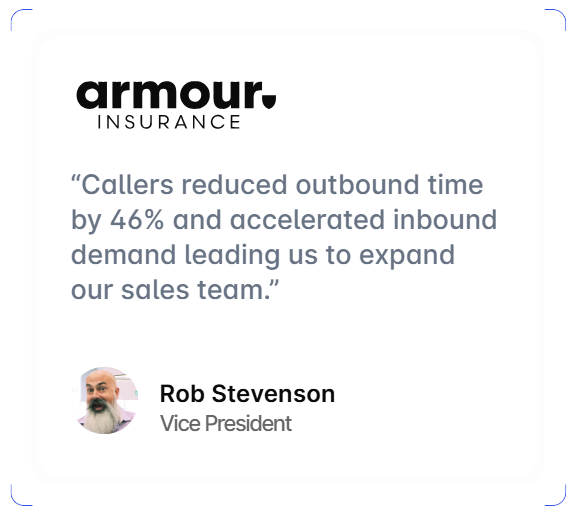
Customers measure the results in their own numbers. One cut call-center load by 65% and grew outreach tenfold. Another reduced outbound handling time by 46% and expanded its sales team to keep up with the demand.
You can read both in the Callers case studies.
What Is an AI Customer Service Agent?
An AI customer service agent is software that takes a customer conversation from hello to resolved. It reads the request, pulls the customer's history, answers in your brand voice, and completes the action behind the question (a refund, a rebooking, an address change). Then it writes the outcome back to your CRM or helpdesk and hands anything sensitive to a human.
That separates it from the tools people confuse it with. ChatGPT and other consumer assistants hold a conversation, yet they can't see your orders or touch your systems. Older scripted chat widgets follow decision trees and break the moment a customer types something unexpected. IVR menus just route callers around; they resolve nothing themselves. A true agent handles inbound support automation the way a trained rep would, with judgment and system access.
The market splits into four platform types, and knowing which one you're buying saves months of evaluation.
Platform type | Tools in this guide | Built for |
|---|---|---|
Omnichannel voice and chat platforms | Callers | B2C teams where phone and messaging carry the volume, and outbound matters as much as answering |
Dedicated CX agent platforms | Sierra, Decagon, Ada, Zowie, Forethought | High-volume brands buying a best-of-breed agent to layer over their existing stack |
Support suites with built-in AI | Intercom Fin, Zendesk AI Agents, Gladly, Freshworks Freddy AI | Teams that want the agent and the support workspace from one vendor |
CRM-native agents | Salesforce Agentforce, HubSpot Breeze | Companies standardizing on one CRM and adding agents inside it |
The 12 Best AI Customer Service Agents
1. Callers
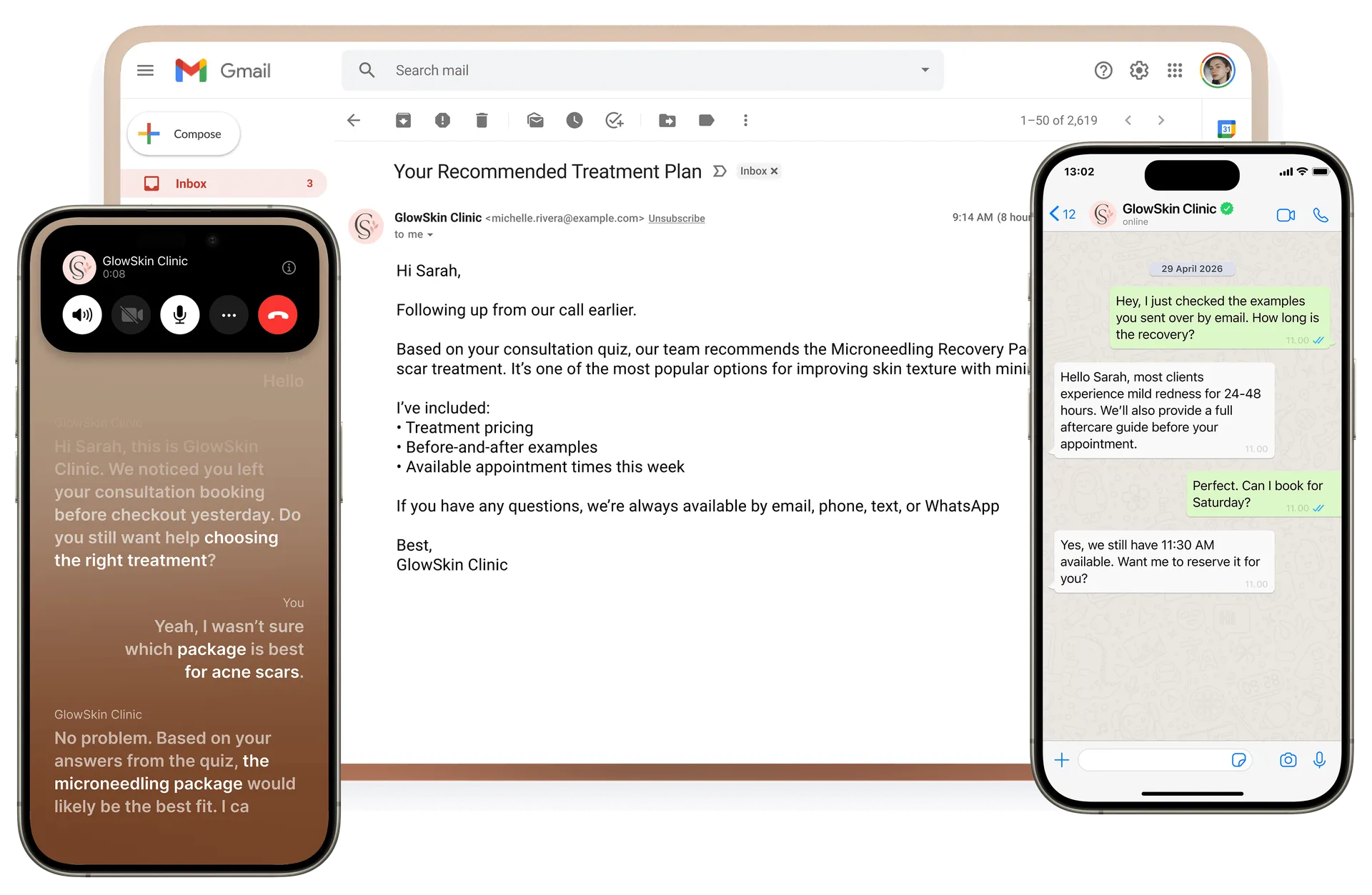
Callers is an omnichannel AI voice and chat platform for high-volume B2C businesses.
One agent works across phone, SMS, WhatsApp, email, and chat with shared context, so a customer who emailed yesterday and calls today never repeats themselves. Operators build and run everything through a no-code builder, without engineering time.
Most tools in this category grew up in chat and email. Callers automates the phone calls and messages those tools leave behind, covers after-hours and overflow so missed calls stop costing revenue, and warm-transfer to your team the moment a conversation gets high stakes.
Teams go live in weeks and handle support, retention saves, and reminder calls from day one.
Key features
One agent, every channel: phone, SMS, WhatsApp, email, and chat share a single context layer
White-glove onboarding: a dedicated CSM on every plan builds your first agents with you, with no pro-services contract
Proactive service campaigns: reminder, confirmation, and follow-up calls with conditional retries
Natural voice agents: 26+ languages with mid-call language switching
AI and human routing: warm handoff sends high-stakes conversations to your team with full context
Step-level analytics: shows exactly where conversations drop off and suggests fixes
Pricing
Callers prices custom plans on a usage basis, billed per minute. You get exact numbers on a demo call, sized to your volume. Every plan includes the dedicated CSM, compliance coverage (SOC 2, HIPAA, GDPR, CCPA, PCI DSS), and access to 610+ native integrations, so there are no separately licensed modules.
Pros
Automates phone and messaging at the depth most rivals reserve for chat
Outbound and inbound run on the same platform and the same agent
Dedicated CSM on every tier, so smaller teams get enterprise-grade service
Live in weeks, and operators make changes without developers
Compliance built in rather than sold as an add-on
Cons
You'll need a demo call to get exact pricing
Built for consumer-facing conversation volume rather than internal IT service desks
Best for
B2C companies with high phone and messaging volume that want one AI agent handling inbound and outbound across every channel.
Why choose Callers
Most AI customer service agents on this list live in chat and email and treat the phone as a roadmap item. If your customers call, text, and message you all day, Callers automates those conversations with the same skill, keeps context across channels, and hands off warmly when a human should take over.
Add the AI call center depth on outbound and the CSM included on every plan, and it covers ground the category specialists leave open.
2. Intercom Fin
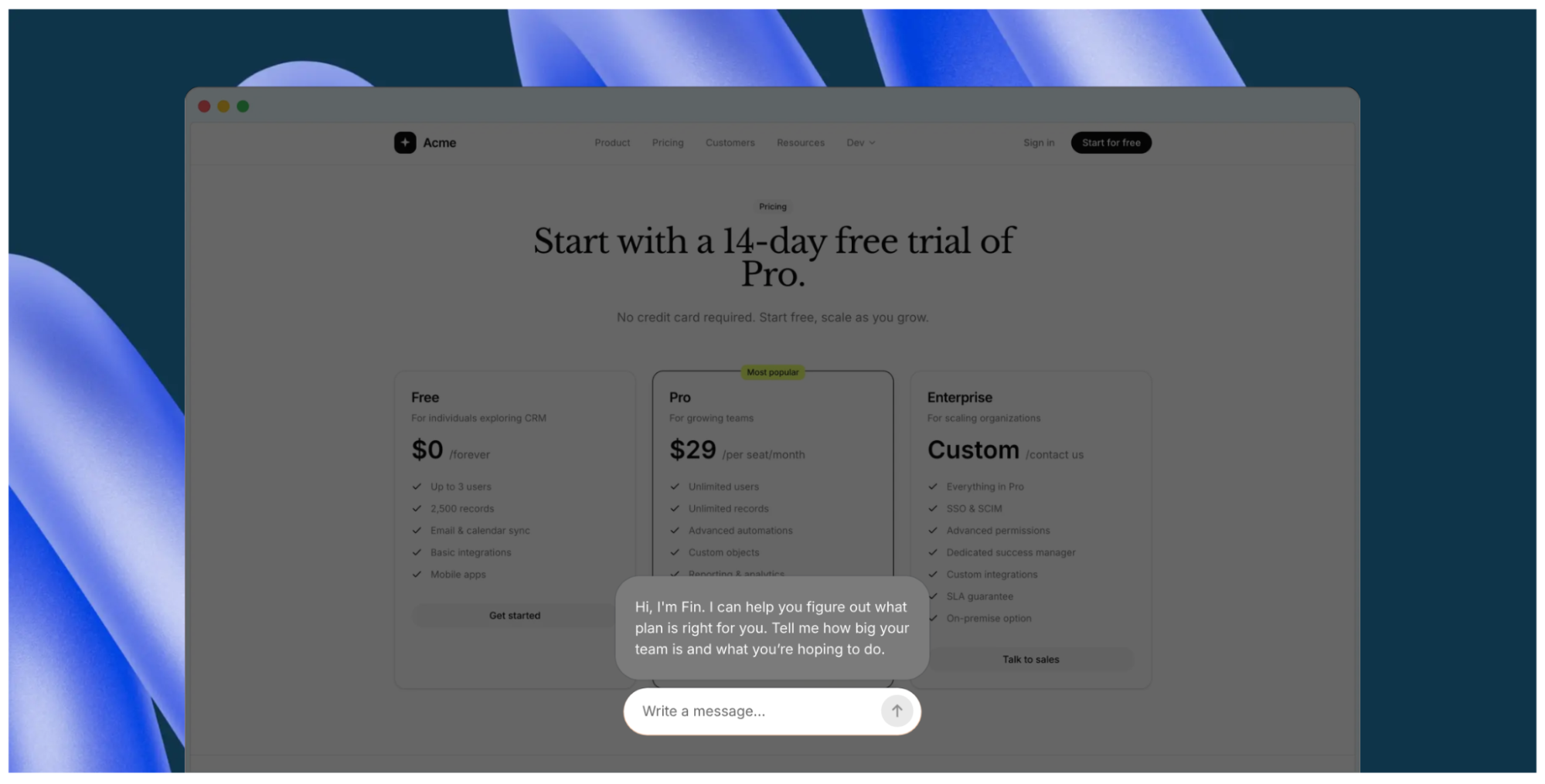
Fin is Intercom's AI agent and the most widely deployed name in the category, with a claimed 76% average resolution rate across thousands of customers. It runs natively on Intercom and also deploys on other helpdesks, with dedicated versions for Zendesk and Salesforce.
Key features
Helpdesk flexibility: works on Intercom, Zendesk, Salesforce, and others without migration
Omnichannel coverage: chat, email, tickets, SMS, WhatsApp, and social in 45+ languages
Fin Voice: an AI phone agent that plugs into existing telephony, currently sales-gated
Procedures: multi-step workflows that process refunds and update subscriptions
Apex models: Intercom's own trained models power responses
QA and insights: observability tooling around every conversation
Pricing
Intercom publishes its model in full. Fin costs $0.99 per outcome (2026), where an outcome is a resolution, a completed procedure handoff, or a qualified prospect, charged once per conversation. Intercom helpdesk seats run $29 (Essential), $85 (Advanced), and $132 (Expert) per seat per month. Non-Intercom helpdesks carry a 50-outcome monthly minimum, and Fin Voice is priced by custom quote.
Pros
Transparent, published per-outcome pricing
Live on your existing helpdesk quickly, with no replatforming
Published resolution benchmark few rivals match
Takes real actions through Procedures rather than answering FAQs only
Mature testing, QA, and analytics stack
Cons
Per-outcome billing gets expensive at high volume
The outcome definition includes conversations where the customer simply stops replying
Voice remains custom-priced and limited in availability
Best for
Support teams that want a proven, transparently priced AI agent layered onto the helpdesk they already run.
Why choose Fin
Fin is the safe, fast pick for chat and email automation. Pricing is public, deployment is quick, and the resolution numbers are documented. Teams whose volume lives on the phone should model per-outcome costs carefully and check Fin Voice availability before committing.
3. Ada
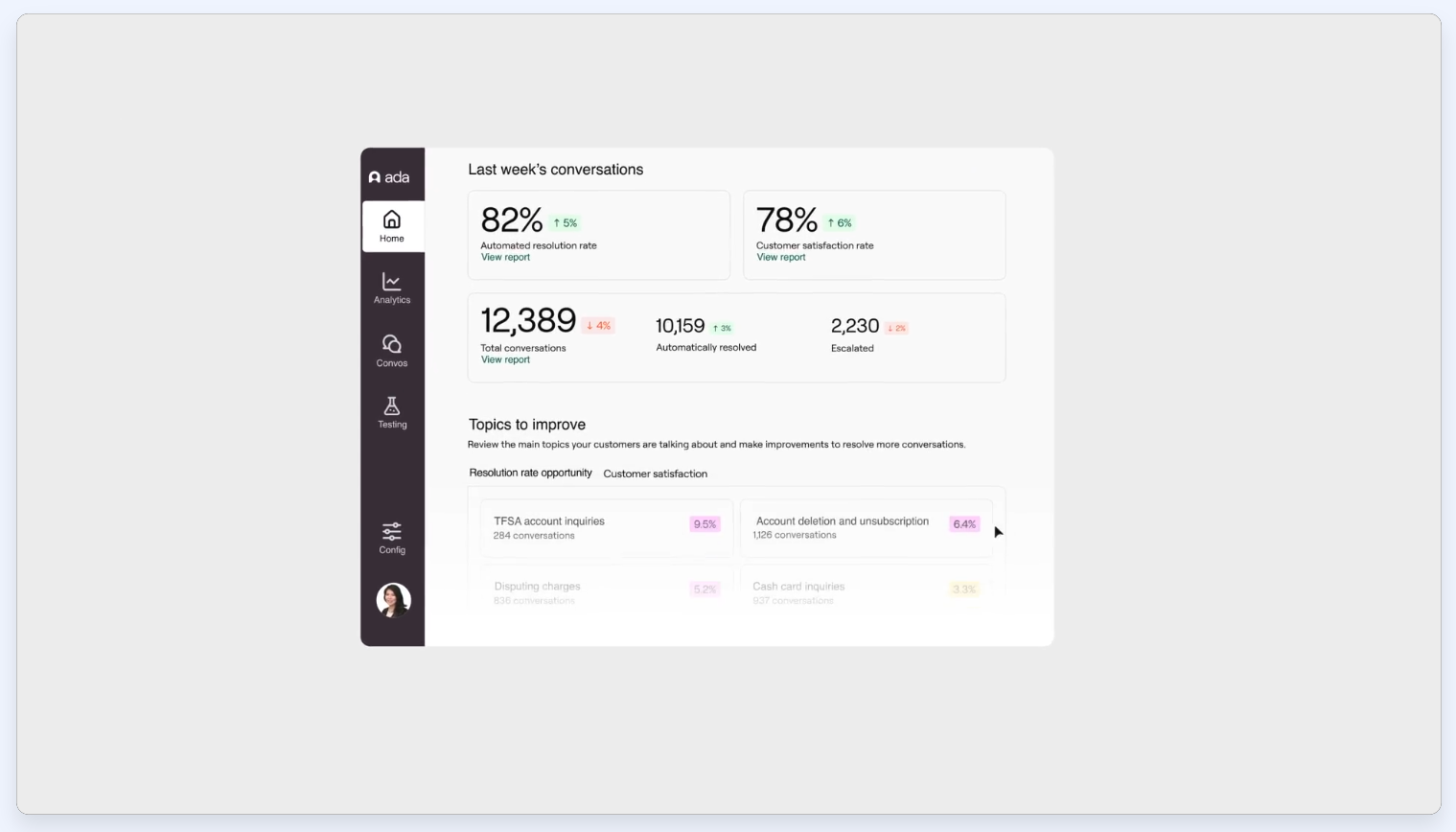
Ada positions its platform around one metric, the Automated Resolution, meaning issues actually resolved end to end rather than deflected. It serves global B2C and SaaS brands including Monday.com, Pinterest, and Ipsy, and reports more than 6.4 billion interactions processed.
Key features
Omnichannel deployment: voice, email, chat, SMS, WhatsApp, Messenger, and in-app
Reasoning Engine: LLM orchestration with multi-layer safeguards against hallucination
Playbooks: multi-step SOP automation that takes real actions through integrations
Coaching and simulations: plain-language feedback that applies to future conversations
Multilingual coverage: knowledge served in roughly 50 languages
Enterprise integrations: Salesforce, Zendesk, ServiceNow, Genesys, and open APIs
Pricing
Ada doesn't publish pricing; you book a consultation to get numbers. The company frames its commercial model around automated resolutions, and its own content discusses per-resolution and per-conversation approaches. Expect a custom enterprise quote.
Pros
Resolution-first measurement keeps the vendor honest about results
Broad channel coverage including voice and email
Highly rated no-code builder and coaching loop
Safeguards and compliance controls suit regulated industries
Proven published results, such as 84% automated resolution rates
Cons
Custom enterprise pricing with a sales-led cycle
Ada states its sweet spot at around 300,000 conversations per year, which rules out smaller teams
Best for
High-volume B2C brands that want automation measured in resolutions rather than deflections, across chat, email, and voice.
Why choose Ada
Choose Ada if you want the buying conversation anchored to one number you can hold the vendor to. Its resolution metric, coaching loop, and analytics make performance visible quarter after quarter. It works best when your volume justifies enterprise pricing.
4. Sierra
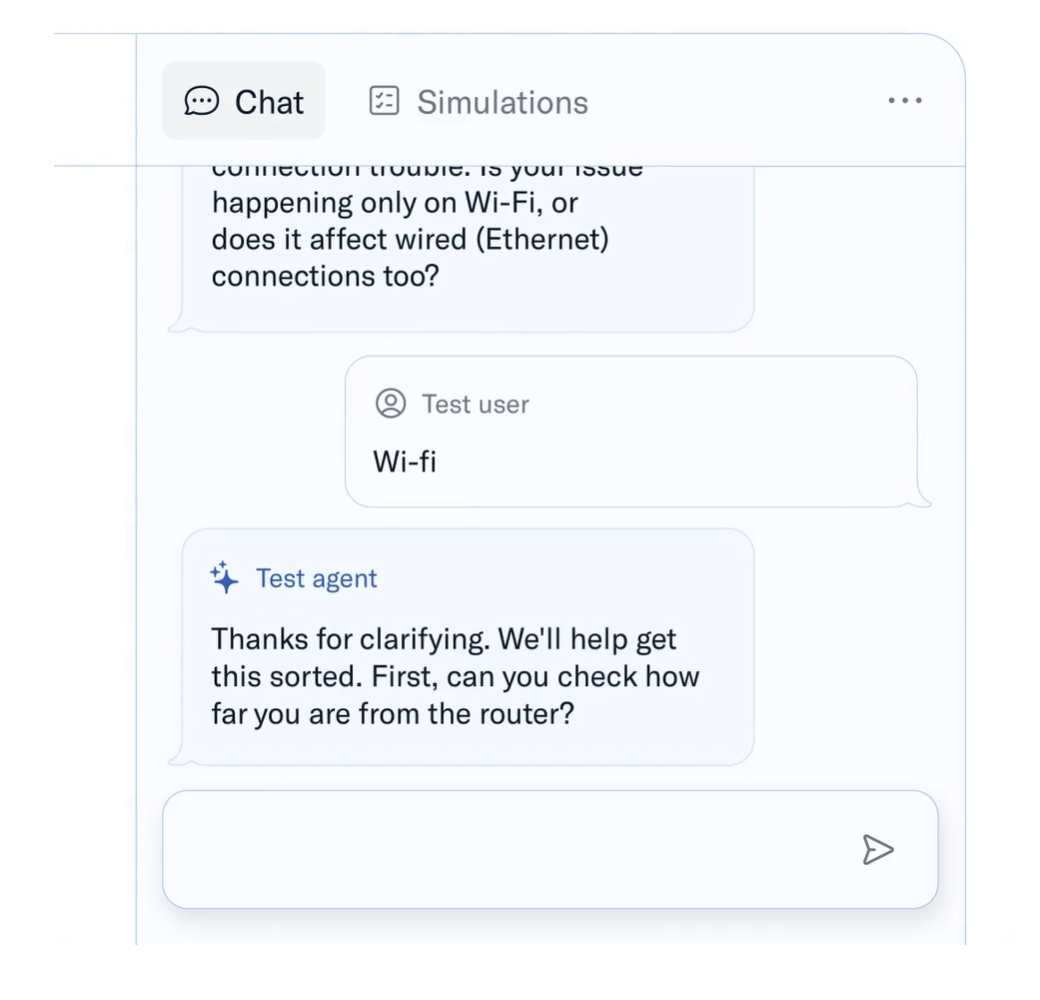
Sierra builds branded AI agents for large enterprises, founded by former Salesforce co-CEO Bret Taylor. Its agents complete tasks end to end, from processing returns to saving cancellations, by connecting to systems of record. Customers named on its site include Rocket Mortgage, Gap Inc., SiriusXM, and Wayfair.
Key features
Agent Studio and Ghostwriter: build agents by describing behavior in plain English or from SOPs
Voice, inbound and outbound: low-latency calls with 55+ languages and mid-call switching
Omnichannel deployment: one agent across voice, chat, email, SMS, WhatsApp, and even ChatGPT
Action-taking integrations: real transactions, including PCI-compliant payment collection
Insights suite: conversation analytics, proactive monitors, and multivariate experiments
Simulation testing: rehearse edge cases in voice and chat before launch
Pricing
Sierra doesn't publish pricing. The company describes its model as outcome-based, meaning you pay for the value the agent delivers rather than per seat or per message. Every contract is custom-quoted through enterprise sales.
Pros
Outcome-based commercials align the vendor with actual resolutions
Strong voice product that covers outbound as well as inbound
Agents act in backend systems rather than deflecting tickets
Proven at Fortune 50 scale across finance, telecom, and retail
Serious testing, monitoring, and experimentation tooling
Cons
Enterprise-only motion with no self-serve tier and no published pricing
Rollout is a consultative project with an assigned agent development team, which takes commitment
Best for
Large B2C enterprises with complex backend workflows that want a premium, partner-led AI agent across voice and chat.
Why choose Sierra
Pick Sierra when you want the deepest enterprise pedigree in the category and a vendor that co-builds your agent with you. The outcome-based model suits buyers who want commercial risk shared, and the logo list makes internal sign-off easier. Just budget for a sales-led process from first call to launch.
5. Zendesk AI Agents
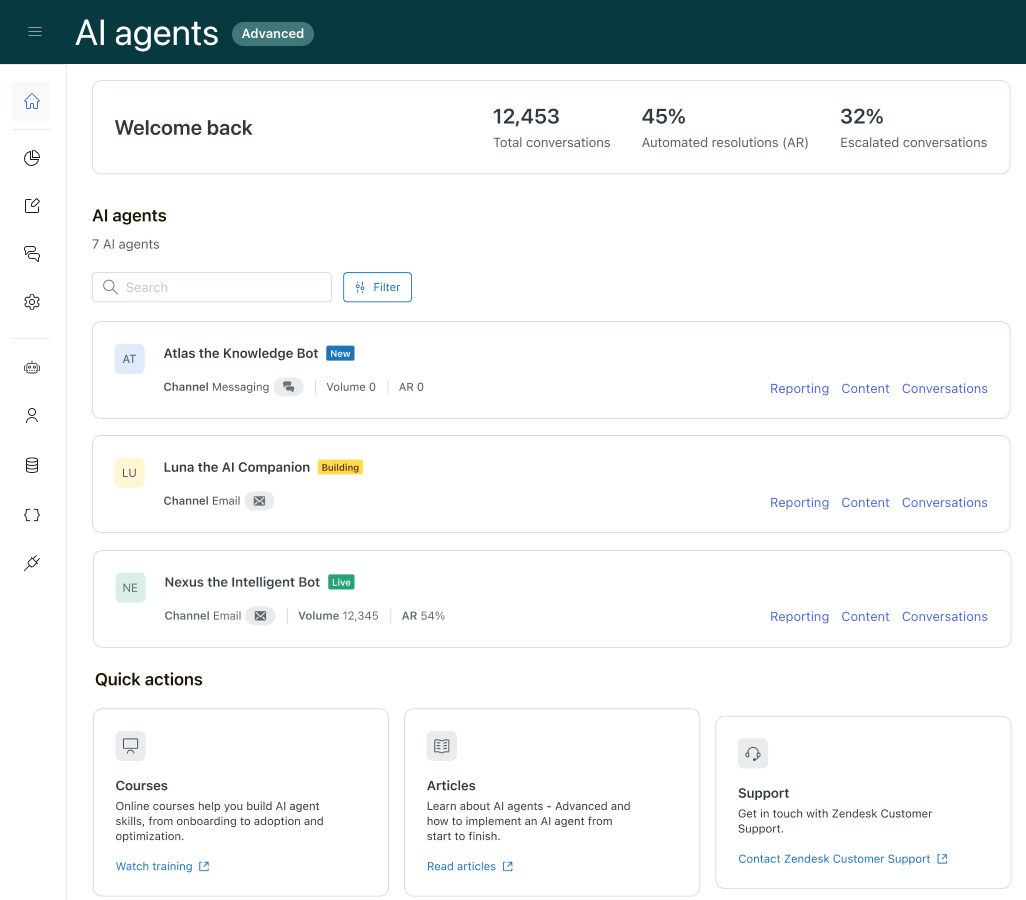
Zendesk folded its Ultimate acquisition into the suite and now includes AI agents in every Zendesk plan, billing for verified automated resolutions. Its 2026 acquisition of Forethought added self-improving agent technology. The agents handle messaging, email, and voice in 80 languages.
Key features
Included with every plan: AI agents come with all Suite and Support tiers
Outcome billing: you pay for LLM-verified resolutions, with escalations excluded
Omnichannel coverage: messaging, email, social, and voice in 80 languages
Workflow reasoning: multi-intent handling from natural-language workflow descriptions
Built-in QA: automated controls audit outcomes and enforce policy
Self-improvement: agents refine knowledge and workflows from past resolutions
Pricing
Zendesk publishes seat pricing: Suite Team at $55 and Suite Professional at $115 per agent per month, billed yearly, with enterprise tiers by quote. AI agents are included in every plan and billed per automated resolution on top, with small monthly allowances (5 to 15 resolutions per agent). Zendesk doesn't publish the per-resolution dollar rate, so budgeting the usage side requires a sales conversation.
Pros
No separate AI license; any Zendesk customer can start automating
LLM-verified resolution billing reduces disputes over what counts
Genuine voice coverage inside the same platform
Deep integration with ticketing, QA, and workforce tools
Strong enterprise pedigree via the Ultimate and Forethought deals
Cons
Only makes sense if Zendesk is your helpdesk
The per-resolution rate isn't published, and allowances are small
Seats, Copilot, and Contact Center add-ons stack into a significant total
Best for
Teams already committed to Zendesk that want tightly integrated automation without adding a second vendor.
Why choose Zendesk AI Agents
If your operation runs on Zendesk, the built-in agents are the path of least resistance. Setup is incremental, billing follows verified resolutions, and everything lands in the workspace your team already uses. Evaluate the full stacked cost before assuming the included tier covers you.
6. Decagon
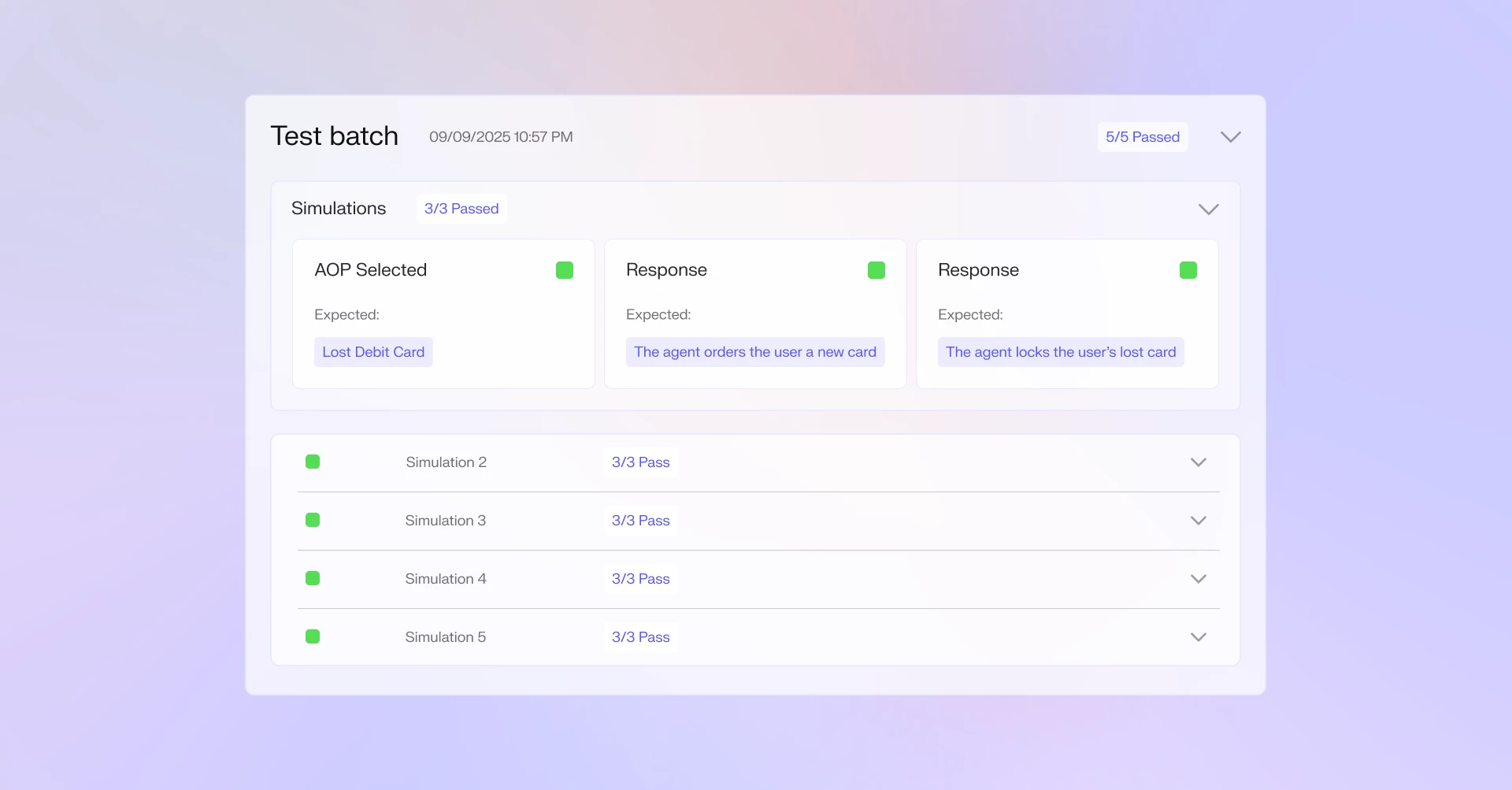
Decagon sells AI agents to consumer enterprises under the banner of the AI concierge. Its core idea is Agent Operating Procedures, plain-language workflows that let CX teams define and version agent behavior without engineering. Customers named on its site include Chime, Duolingo, and ClassPass.
Key features
Agent Operating Procedures: agent logic written in natural language, with versioning
Omnichannel agents: chat, email, SMS, and voice with shared context
Voice both ways: inbound calls plus outbound campaigns via its Missions feature
Duet and Autopilot: an agent-building copilot and a self-improving optimization loop
QA Hub and simulations: test and A/B changes before they hit production
User Memory: persistent customer memory so people never repeat themselves
Pricing
Decagon doesn't publish pricing. The company describes two models on its blog, a fixed rate per incoming conversation or a higher rate per fully resolved conversation, and says most customers choose per-conversation billing. Quotes come through enterprise sales.
Pros
CX teams control agent behavior directly, in plain language
Full omnichannel coverage including production voice in both directions
Mature lifecycle tooling with QA, simulations, and auto-optimization
Strong consumer-scale references like Duolingo and Chime
Usage-aligned billing rather than per-seat licensing
Cons
No published pricing and no self-service tier
The platform's depth implies real implementation and ramp-up effort
Best for
Consumer enterprises with high support volume whose CX teams want hands-on ownership of agent logic across chat, email, and voice.
Why choose Decagon
Decagon fits teams that want enterprise-grade agents while keeping the pen in the CX team's hand. AOPs make behavior changes auditable and fast, and the QA tooling means changes ship with evidence. It rewards organizations ready to invest in an enterprise rollout.
7. Gladly
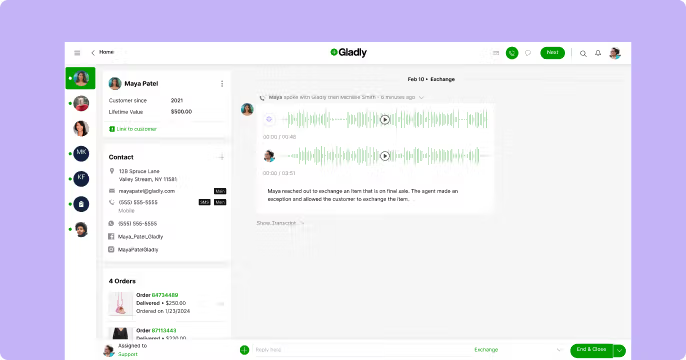
Gladly organizes service around people instead of tickets, giving every customer one lifelong conversation timeline across voice, email, chat, and SMS. Its AI (formerly called Sidekick) resolves issues and takes actions inside that timeline. Retail brands like KUHL, Tecovas, Bombas, and Breeze Airways use it.
Key features
One customer timeline: every channel flows into a single conversation per person
Action-taking AI: cancellations, returns, and recommendations executed through integrations
AI voice: answers calls with a natural, on-brand voice and no hold time
Full-context handoff: humans pick up exactly where the AI left off
Helpdesk overlay: a 2026 option runs Gladly's AI on top of an existing helpdesk
Revenue features: in-chat payments and product recommendations
Pricing
Gladly doesn't publish platform pricing; contracts are custom and seat-based, with AI priced on an outcome model it calls Resolutions and Assists. Its help center does publish usage rates, including a Voice AI fee of $0.06216 per minute on top of call charges.
Pros
The single-timeline model genuinely eliminates ticket fragmentation
AI acts inside the same record human agents use
Voice automation ships as part of the platform
Positioned to generate revenue during service conversations
Can now layer its AI over another helpdesk without replatforming
Cons
Custom pricing with seat minimums, and usage fees stack on top
Squarely aimed at B2C retail, so other use cases fit less well
The 2026 product renaming makes older reviews and docs confusing
Best for
Mid-market and enterprise retail brands that want relationship-driven service and revenue from the same conversations.
Why choose Gladly
Gladly wins when your brand's service philosophy is the differentiator. The timeline model gives agents and AI the same complete picture of every customer, which shows up in tone and speed. Commerce brands that sell through service conversations will feel the difference most.
8. Salesforce Agentforce
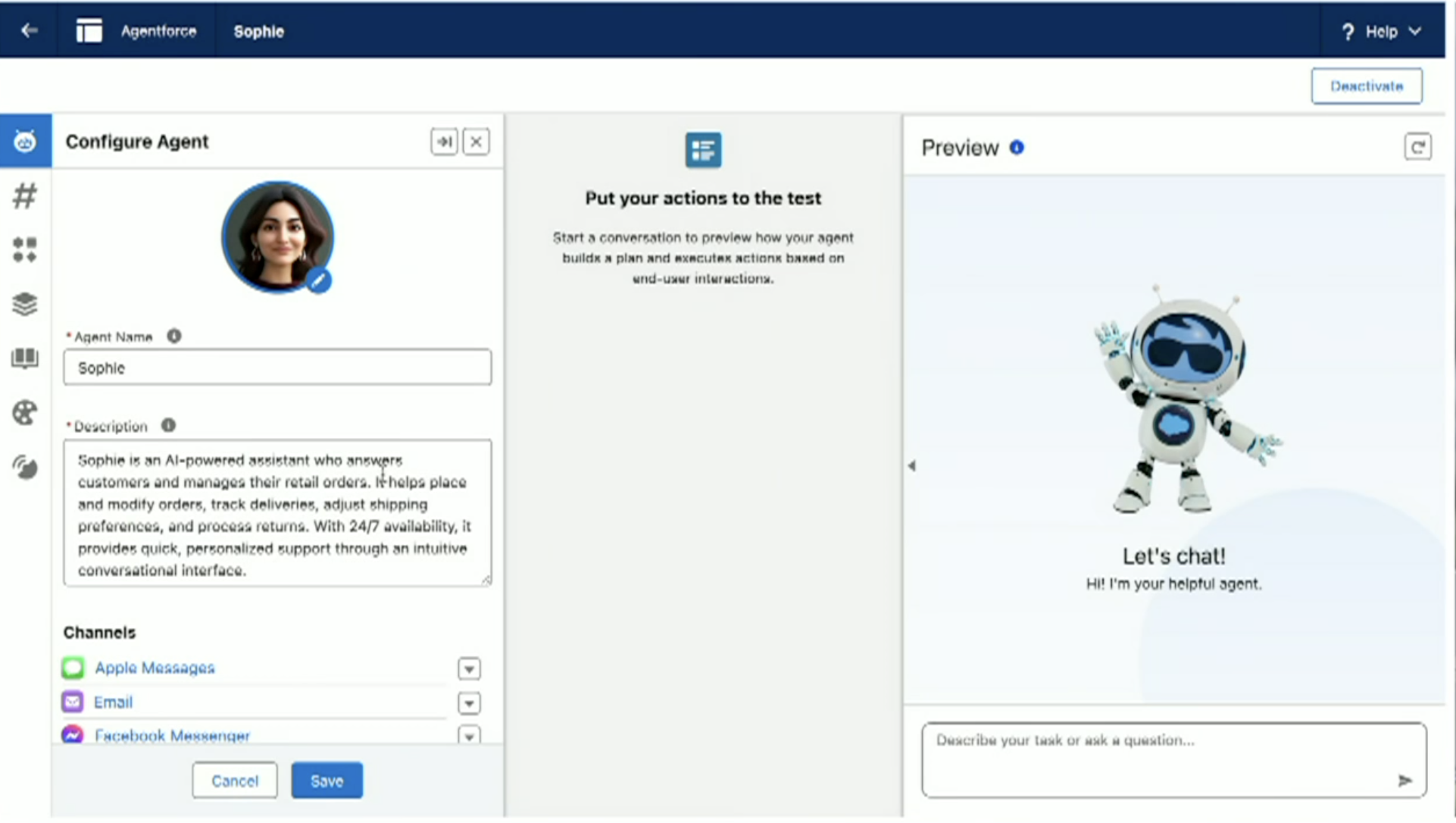
Agentforce is Salesforce's agent layer, embedded across its platform rather than sold as a standalone bot. For service teams it works inside Service Cloud, resolving cases grounded in CRM and Data Cloud records, with a native voice offering and handoff into the agent console.
Key features
Service Agent: autonomous case resolution grounded in CRM records
Atlas Reasoning Engine: multi-step reasoning over unified customer data
Agentforce Voice: native AI phone agents within Service Cloud
Omnichannel coverage: chat, SMS, WhatsApp, Messenger, and email-to-case
Low-code builder: define agent jobs, topics, and actions in natural language
Digital Wallet: real-time visibility into consumption and credit burn
Pricing
Salesforce publishes its consumption model: Flex Credits at $500 per 100,000, where a standard action consumes 20 credits ($0.10) and a voice action 30 credits ($0.15). Agentforce 1 Editions bundle unmetered usage from $550 per user per month, and a legacy $2 per conversation model still appears in Salesforce documentation.
Pros
Agents act on live CRM data with no integration project
Native voice plus digital channels from one agent definition
Enterprise governance through the Einstein Trust Layer
Flexible commercial options, from pay-as-you-go to unmetered bundles
Pro-code extensibility for deterministic flows like refunds
Cons
Requires the Salesforce ecosystem, and total cost stacks well beyond the agent
Per-action consumption is hard to forecast without active monitoring
Data quality and setup work determine results, and both take effort
Best for
Mid-market and enterprise teams running Service Cloud that want agents wired directly into their CRM data and console.
Why choose Agentforce
Agentforce makes sense when Salesforce is already your system of record. The grounding in live customer data is genuinely hard for standalone vendors to match, and voice now ships natively. Go in with a consumption model spreadsheet and someone who owns cost monitoring.
9. Forethought
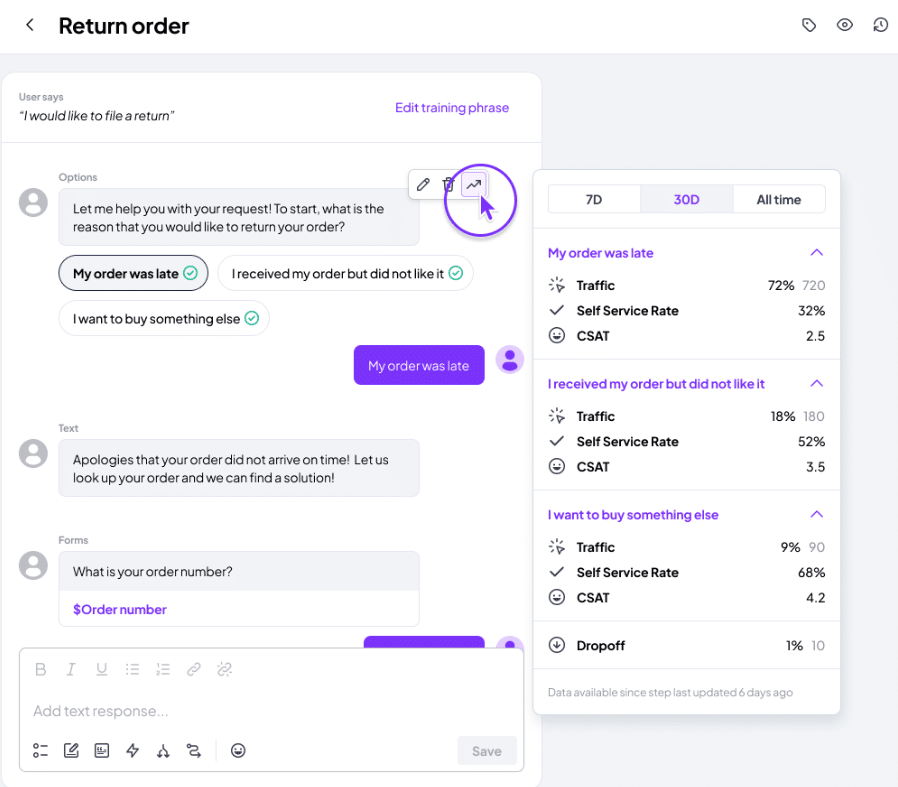
Forethought is a multi-agent support platform that Zendesk acquired in March 2026, though it still sells standalone. Five agents cover the lifecycle: Solve resolves tickets, Triage routes them, Assist drafts for humans, Discover finds gaps, and Agent QA scores performance. Customers include Grammarly, Upwork, and Acorns.
Key features
Solve: autonomous resolution across chat, email, voice, SMS, and in-app
Autoflows: natural-language workflows that act in backend systems
Triage: automatic classification, prioritization, and routing of inbound tickets
Assist: an in-helpdesk copilot that summarizes and drafts replies
Discover and Agent QA: knowledge-gap analytics and automated QA scoring
70+ integrations: helpdesks, CRMs, contact centers, and knowledge sources
Pricing
Forethought doesn't publish prices. It offers three quote-only tiers and describes its model as a blend of platform access fees and outcome-based costs. Expect a custom enterprise conversation.
Pros
Covers deflection, routing, copilot, QA, and insights in one platform
Autoflows take real actions rather than serving answers
Voice and email coverage alongside chat
Very broad integration library layers onto existing stacks
Zendesk ownership brings roadmap investment and staying power
Cons
Trains best on a large historical ticket corpus, which excludes small teams
Configuration and ongoing workflow upkeep are a real workload
The acquisition leaves some uncertainty about long-term standalone independence
Best for
Enterprises with deep ticket history that want triage, resolution, and QA handled by one connected system.
Why choose Forethought
Forethought suits buyers who see support automation as a pipeline problem, from first touch to QA score, rather than a single bot. If you have years of tickets to learn from, it converts that history into automation faster than most. Zendesk customers get an especially smooth path.
10. Zowie
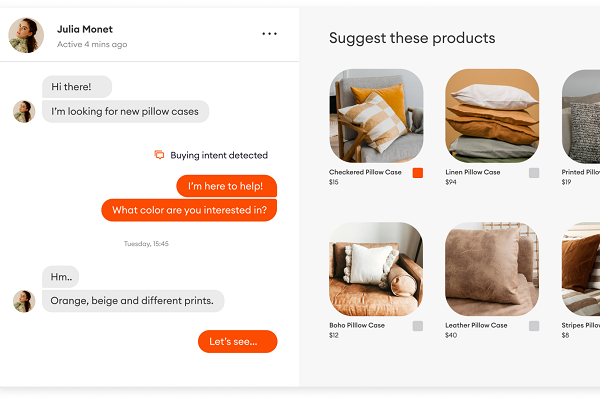
Zowie pairs a probabilistic reasoning engine with a deterministic Decision Engine, so policy-bound actions like refund eligibility follow configured rules instead of LLM judgment. Built in ecommerce and now aimed at accuracy-critical industries, it names InPost, Decathlon, Avon, and Payoneer as customers.
Key features
Dual-engine architecture: LLM reasoning for conversation, deterministic rules for decisions
Omnichannel coverage: chat, email, SMS, voice, WhatsApp, and Messenger
Agent Studio: central control of persona, intents, flows, and staging environments
Audit trails: decision and reasoning traces for compliance review
Model flexibility: runs on Claude, OpenAI, Google, Meta, or Mistral models
~175 languages: one agent serving global customer bases
Pricing
Zowie doesn't publish pricing. Deals are custom-quoted through sales, with an ROI estimator gated behind a login and private offers via the AWS Marketplace. Plan for an enterprise procurement process.
Pros
Deterministic decisioning cuts hallucination risk on high-stakes actions
Executes complete processes like refunds and reships end to end
Audit trails and staging suit regulated industries
Bring-your-own model and on-premises options offer rare flexibility
Strong verified results, including a 75% cost reduction at Monos
Cons
No pricing transparency at all, which complicates comparison shopping
Full value requires configuring flows and integrations, a heavier lift than plug-and-play bots
Best for
Mid-market and enterprise consumer brands in ecommerce or regulated sectors that need rule-bound, auditable automation.
Why choose Zowie
Zowie answers the question compliance teams always ask: how do you know the AI followed policy? The separation between conversation and decision logic gives a provable answer. That makes it a standout for fintech, insurance, and any brand where a wrong refund is a real problem.
11. Freshworks Freddy AI
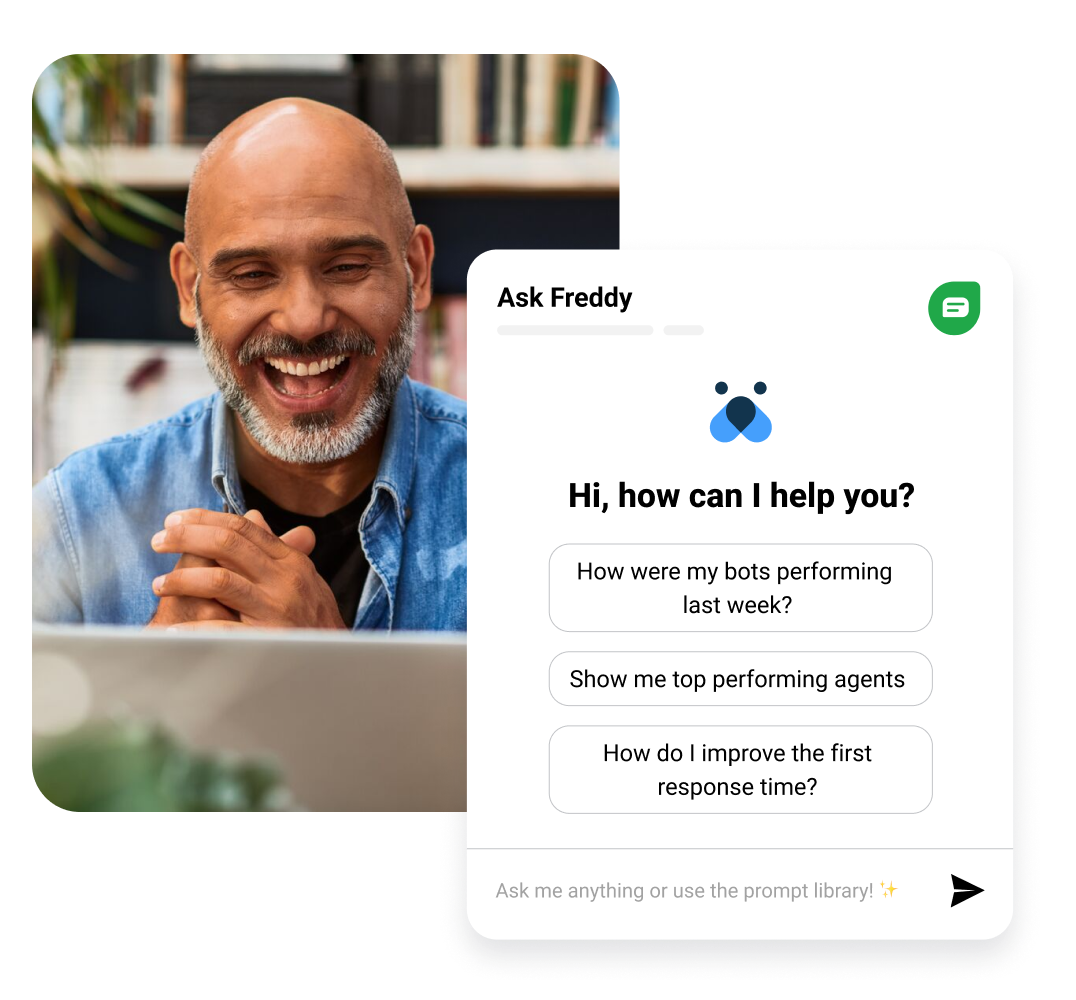
Freddy AI is the automation layer inside Freshdesk and the Freshdesk Omni suite, sold as three parts: an autonomous AI Agent, a Copilot for human agents, and an Insights analytics layer. It targets SMB and mid-market teams that want AI bundled with their helpdesk.
Key features
Autonomous AI Agent: resolves queries, processes refunds, and manages subscriptions
Bundled sessions: 500 AI Agent sessions included on every plan
Freddy Copilot: summarizes tickets, drafts replies, and translates on the fly
Freddy Insights: root-cause analysis and conversational analytics on Enterprise plans
Pre-built vertical agents: ready-made flows for Shopify, Stripe, and PayPal
Multilingual conversations: multi-turn support across languages with sentiment flagging
Pricing
Freshworks publishes everything. Freshdesk runs $19 (Growth), $55 (Pro), and $89 (Enterprise) per agent per month billed annually, with the Omni suite at $29, $79, and $119. Every plan includes 500 Freddy AI Agent sessions, then $49 per 100 sessions. Copilot is a $29 per agent per month add-on on Pro and Enterprise.
Pros
Fully published pricing for seats and AI usage
500 bundled sessions let you trial automation at no extra cost
No separate bot platform to integrate or maintain
Fast no-code deployment with pre-built vertical agents
Strong value at SMB and mid-market price points
Cons
Costs stack across seats, Copilot, and session overages
Roughly $0.49 per extra session gets pricey at high volume
Insights is locked to the top tier, and Freddy only works inside Freshworks
Best for
Small and mid-sized support teams on Freshdesk that want bundled, pay-as-you-go AI without buying a standalone platform.
Why choose Freddy AI
Freddy is the pragmatic choice for teams that want automation running this month at a published price. The bundled sessions remove the risk from experimenting, and the vertical agents shortcut common ecommerce flows. High-volume operations should model the per-session economics before scaling.
12. HubSpot Breeze
Breeze is HubSpot's AI family, and its Customer Agent works inside Service Hub's help desk, answering questions and resolving tickets from approved content and Smart CRM data. It doubles as a sales agent, qualifying leads and booking meetings from the same widget.
Key features
CRM-personalized answers: pulls order status and account details from the Smart CRM
Grounded, cited responses: answers only from approved content, with sources shown
Multi-channel coverage: chat, email, WhatsApp, and Facebook Messenger
Full-funnel work: support, lead qualification, and meeting booking in one agent
Human handoff: routes to reps in Help Desk when conversations need judgment
Resolution reporting: tracks outcomes and which knowledge sources drive them
Pricing
HubSpot publishes its model. The Customer Agent consumes 50 credits, or $0.50, when it resolves a conversation without human help (2026), with credits at $0.010 each in packs of 1,000 for $10. It requires Service Hub Professional at $90 per seat per month (annual) or Enterprise at $150, which include 3,000 and 5,000 monthly credits respectively, plus one-time onboarding fees.
Pros
Pay only for conversations resolved without a handoff
CRM context works out of the box with zero integration work
Setup takes minutes, with cited answers building trust
One agent covers service, sales, and marketing conversations
Every paid tier includes a monthly credit allowance
Cons
Only worthwhile if HubSpot is your CRM and helpdesk
Included credits cover roughly 60 to 100 resolutions a month, modest for busy teams
A resolution means no handoff within 72 hours, which takes watching
Best for
HubSpot Professional and Enterprise customers who want an AI agent with native CRM context rather than a standalone tool.
Why choose Breeze
Breeze earns its place through sheer convenience for HubSpot shops. The agent knows your customers on day one, pricing follows completed work, and there is nothing new to integrate. Teams outside the HubSpot ecosystem, or with serious phone volume, should look higher up this list.
Choose the Right AI Customer Service Agent
The right pick follows your stack and your channels. Helpdesk-native options like Fin, Zendesk, Freddy AI, and Breeze reward teams staying inside one suite, while Sierra, Decagon, Ada, Zowie, and Forethought suit enterprises buying a dedicated agent, and Agentforce belongs to Salesforce shops.
If your customers reach you by phone and text as much as by chat, most of those tools only cover part of your volume. Callers automates the calls and the messages with one agent, runs outbound campaigns like appointment confirmations and win-backs alongside support, and pairs you with a dedicated CSM from day one.