
Noisy callers: 5 tests to run before you trust an AI voice agent

Every AI voice agent sounds good in a demo. The demo is a quiet room, a good headset and someone who knows what to say.
Your customers call from cars, kitchens, shop floors and bus stops. That's where agents break, and averages like "95% accuracy" won't tell you where. A single score can't show you whether background noise is getting in, or whether your caller's voice is getting cut out.
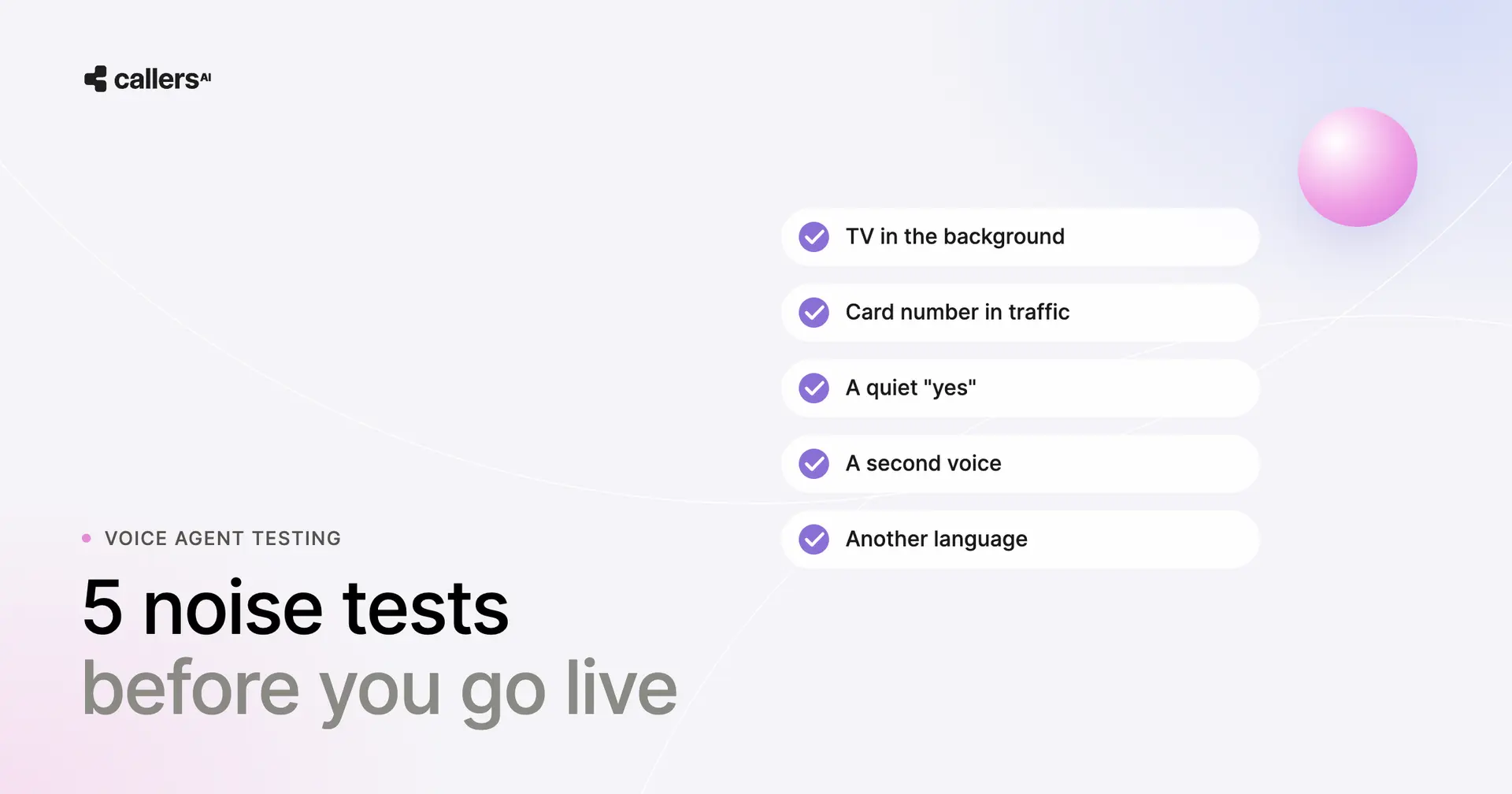
These are the five tests we run on every version of our own noise suppression model. Run them on any AI voice agent before it goes live.
1. The TV test: does background speech make the agent stop?
Call with a TV or radio on, or with someone talking nearby. Let the agent talk.
What to watch for: the agent stopping mid-sentence as if you'd spoken (a false barge-in), then starting again. Twice in one call and customers think the line is broken. This is the most common failure, and the one demos never show.
2. The card number test: do the digits survive?
With traffic or a crowd in the background, read out a card or policy number in groups, the way people actually do.
What to watch for: one wrong digit. A wrong word the agent can usually work around. A wrong digit means the agent confidently confirms a number the caller never said.
3. The quiet "yes" test: does a soft voice get through?
Step back from the phone, or speak quietly as if you're in an open office, and answer a question with a single "yes".
What to watch for: the agent waiting, or asking again. Aggressive noise cancellation removes background sound and soft voices with it. This failure is easy to miss, because a filter that over-cleans sounds impressive on noisy audio.
4. The second voice test: does the agent follow the right person?
Have someone else talk in the room while you answer.
What to watch for: words from the other person showing up in your answer, or the agent replying to them.
5. The language test: does it hold up beyond English?
If you serve customers in more than one language, repeat tests 1 to 3 in each.
What to watch for: a model that handles English well and quietly drops quality elsewhere.
The rule that matters: no test may get worse
When we compare two versions of our model, we look at every type of noise and every kind of caller separately, and a new version only ships if none of them gets worse, whatever the average says.
That rule threw out many versions that looked great on average. A typical one: much better with crowd noise and TV, much worse with quiet callers. On a call, that's a bad trade. The caller who speaks softly is still a customer.
How the Callers noise model does
Across our tests, covering 42 noise conditions and kinds of callers in 13 languages, against RNNoise, the widely used open-source noise suppression model:
RNNoise | Callers noise model | |
|---|---|---|
Card numbers and digit strings fully right | 85% | 94% |
Short replies ("yes", "no") heard | 94% | 100% |
Words recognised, across the languages our agents speak | 81.8% | 85.9% |
Word error rate | 25.9% | 24.4% |
It adds about 40 milliseconds, well below anything a caller can hear, and it's rolling out to Callers agents over the coming weeks alongside Callers Premium Voice and our own turn-taking model. See how our AI works.
Run the tests yourself
None of these tests need a lab. They need a phone and a noisy room. A first Callers agent takes minutes to build, so you can run all five this afternoon and judge for yourself. Build an agent and start testing.
FAQs
How do I test an AI voice agent for background noise?
Call it from realistic conditions: a TV or radio on, traffic, a second person talking, and a quiet voice far from the phone. Check that the agent doesn't stop mid-sentence, gets every digit of a number right, and hears short answers like "yes".
What is a false barge-in?
A false barge-in is when background sound, such as a TV voice, makes an AI voice agent think the caller started speaking, so it stops talking mid-sentence.
Can noise cancellation make speech recognition worse?
Yes. Aggressive noise cancellation can remove soft and distant voices along with the noise, so short answers and quiet callers are missed. Good noise suppression for phone calls removes noise and keeps every voice the caller makes.
How does the Callers noise model compare with RNNoise?
In our tests it gets 94% of digit strings fully right against 85%, hears 100% of short replies against 94%, and has a lower word error rate, 24.4% against 25.9%. RNNoise is lighter and adds less latency.