
10 Best Parloa Alternatives for 2026 (Key Features, Pricing, Pros & Cons)
:quality(80))
:quality(80))
Quick Summary
Callers is the best overall alternative to Parloa, while Cognigy, PolyAI, Sierra, Decagon, Synthflow, Retell AI, Vapi, CloudTalk, and Nextiva serve enterprise, voice realism, outcome-based, digital-first, and self-serve needs well.
The top 3 are:
# | Platform | Best for |
1 | Callers | Mid-market teams that want to launch fast and own the build |
2 | Cognigy | Enterprises needing omnichannel breadth in a CCaaS ecosystem |
3 | PolyAI | Enterprises prioritizing voice realism above all else |
Looking for the Right Parloa Alternative?
Parloa handles enterprise voice AI well, but "well" isn't the same as "right" for your team. Maybe the deployment timeline doesn't match your urgency, or the pricing floor doesn't match your budget. Maybe you just want to know what else is out there before you sign anything.
You're not the only one asking. Teams across lending, retail, and CX operations run into the same wall and start looking for a platform built for how they actually work.
In this Callers piece, we break down ten platforms worth considering, what each one does well, where it falls short, and who it's really built for.
But first…
Why Listen to Us?
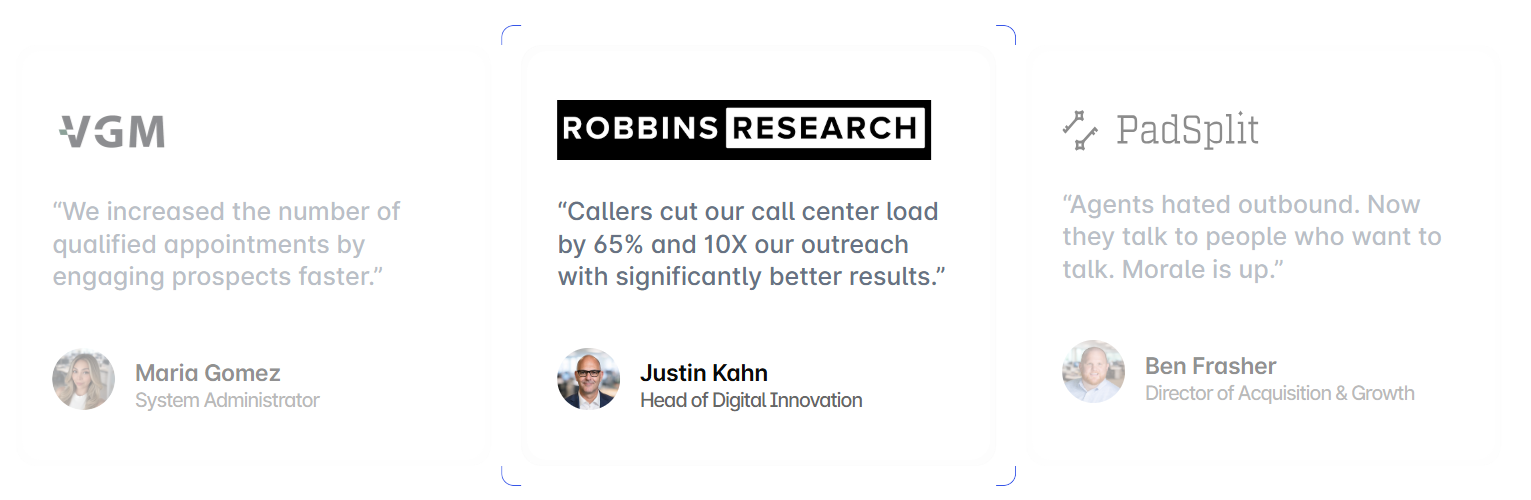
Callers has run automated calls and chats for teams like DoorDash, Einride, and PadSplit, handling millions of live customer conversations across lending, retail, and contact center operations. That hands-on experience, testing latency, integrations, and deployment speed against our own platform daily, gives us a working understanding of what actually separates a strong voice AI vendor from a well-marketed one.
What Is Parloa?
Parloa is a low-code AI Agent Management Platform, or AMP, built for contact centers. It lets businesses design, integrate, simulate, deploy, and monitor AI agents across phone, chat, messenger, and apps, with voice being the core of the product.
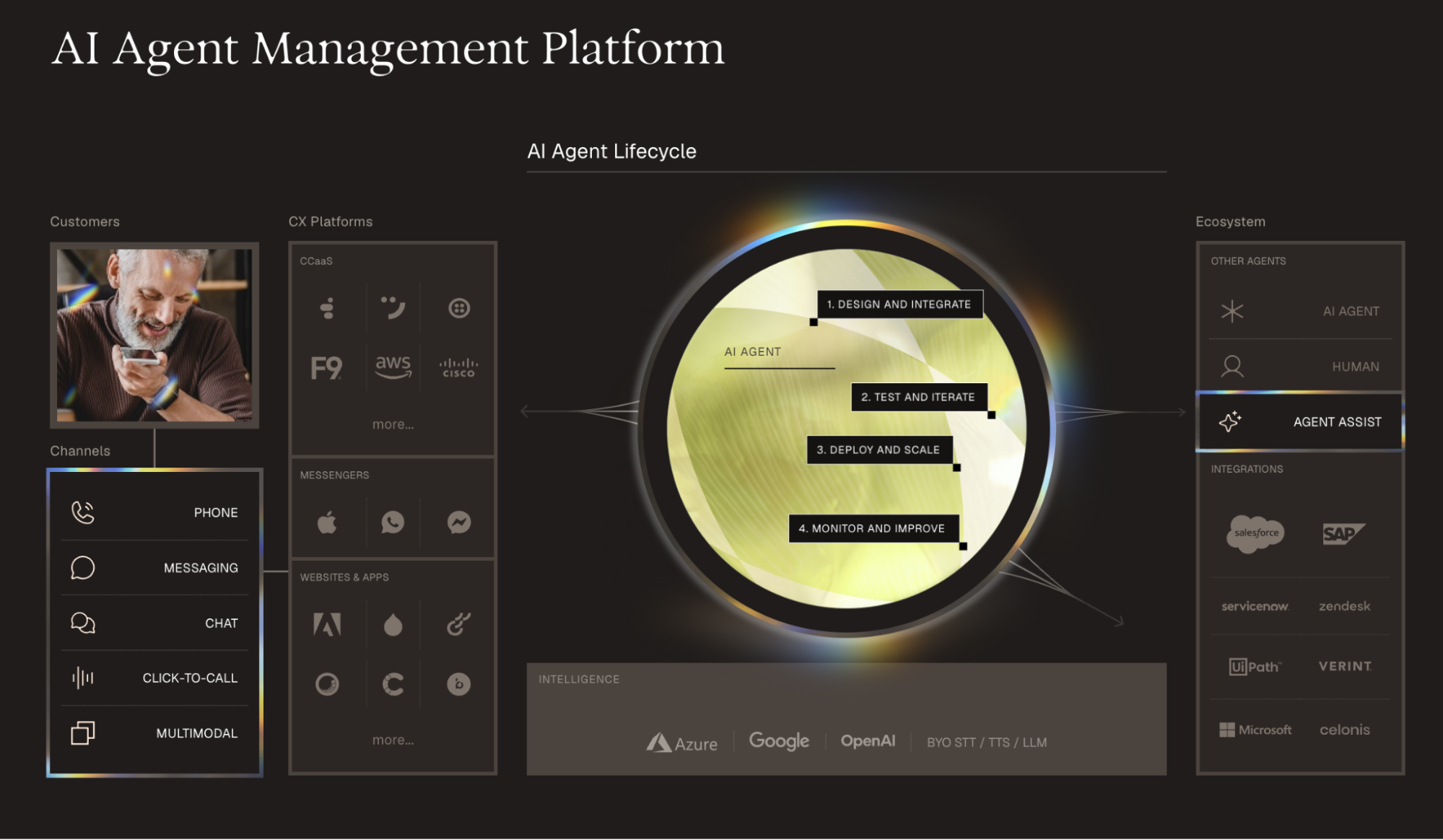
Parloa serves enterprises across finance, insurance, travel, retail, e-commerce, and telecom, operating in 100+ countries and 140+ languages. Named customers include BarmeniaGothaer, TUI, and ATU.
Parloa holds ISO 27001, SOC 2, PCI DSS, GDPR, DORA, and HIPAA compliance. It follows a consumption-based enterprise SaaS pricing model tied to task complexity, with custom quotes available through a sales demo rather than published tiers.
Why Seek an Alternative to Parloa?
The Implementation Timeline
Getting live with Parloa takes a while. A typical deployment runs 1 to 3 months and goes through a certified partner or systems integrator, not your own team. That timeline fills up fast once you count discovery, agent design, CRM mapping, testing, compliance review, and internal sign-off.
If slow speed-to-lead or after-hours gaps are already costing you revenue, a full quarter on the sidelines costs you that revenue twice over.
Voice Response Latency
Parloa's architecture runs 700 to 900 milliseconds between customer speech and agent response. Natural human turn-taking sits closer to 200 milliseconds, and telecom standards treat delays past roughly 300 milliseconds as the point where conversation stops feeling immediate.
Independent reviews call this the platform's clearest technical weak point. The lag compounds across a call, callers start talking over the agent, and exchanges feel more like a queue of turns than a conversation. Parloa frames latency as a budget tuned to context rather than a target to minimize, though we still treat the gap as real friction.
The Complexity of Running It
Parloa's builder is marketed as low-code, but running real workflows still takes technical skill. Setting up the logic and wiring integrations tends to require API familiarity and developer support, so the people who own the customer experience can't always ship a change themselves.
Add the partner-led model on top, and the team closest to your customers depends on someone else to adjust how the agents behave. When you want to move fast, that dependency slows you down.
10 Best Parloa Alternatives
Below is a summary of the alternatives we will cover in this review:
# | Tool | Best for | Main trade-off | Starting price |
1 | Callers | Mid-market B2C teams that want to launch fast and own the build | Compliance list stops short of DORA | Custom (demo) |
2 | Cognigy | Large enterprises needing omnichannel breadth inside a CCaaS ecosystem | Limited out-of-the-box components for complex workflows | Custom (demo) |
3 | PolyAI | Enterprises that prioritize voice realism above all else | Custom database integrations need PolyAI's own team | Per minute (custom) |
4 | Sierra | Teams that need agents to resolve tasks end-to-end | Limited client-side customization | Outcome-based (custom) |
5 | Decagon | Digital-native support teams in fintech, telecom, SaaS | Shallow audit logs and limited role permissions | Custom (demo) |
6 | Synthflow | Small teams needing fast, self-serve voice deployment | Limited branching and version control | From $30,000/yr |
7 | Retell AI | Engineering teams that want full code-level control | Multilingual pronunciation issues reported | $0.07–$0.31/min |
8 | Vapi | Developers who want to bring their own LLM and voice stack | Real costs run 2 to 3x the advertised rate | $0.05/min + models |
9 | CloudTalk | SMBs needing a self-serve cloud phone system | AI features cost extra as add-ons | From $34/user/mo |
10 | Nextiva | Teams wanting one platform for every channel and QA | Regulatory fees inflate final bills | From $23/user/mo |
1. Callers
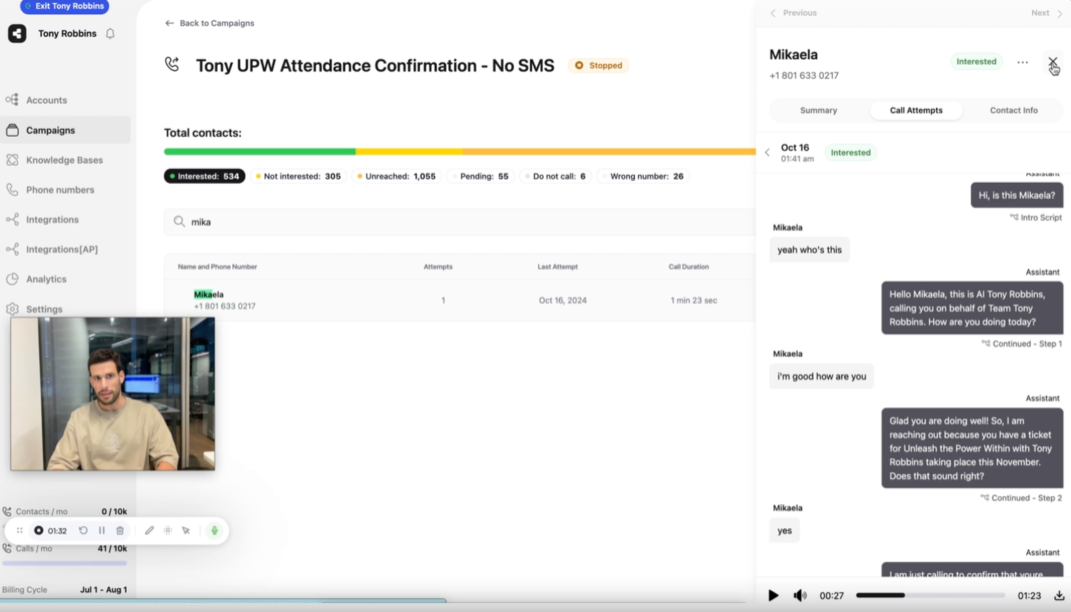
Callers is an AI voice and chat platform that automates inbound and outbound customer conversations across the full lifecycle for high-volume B2C businesses. One agent carries a single conversation across calls, text, and chat, with responses landing under 300 milliseconds and deployments live in days rather than the multi-quarter timeline typical of enterprise platforms like Parloa.
DoorDash, Einride, and PadSplit run Callers without a professional-services contract or forward-deployed engineers. CX teams build and adjust their own agents instead of routing each change through a developer, and the platform serves lending, retail, and contact-center operators who need speed without an enterprise price floor.
Key Features
No-code campaign builder: Build and edit voice and messaging agents visually, without writing code
Omnichannel context layer: Carry one shared conversation history across calls, SMS, WhatsApp, email, and chat
Campaign orchestration: Fire pre-call triggers, mid-call actions, and post-call follow-up across a full sequence
Native CRM integrations: Connect to 610+ tools, including Salesforce, HubSpot, Zendesk, and GoHighLevel
Mid-call language switching: Move between languages inside one conversation without dropping context
Human handoff: Route a live call to a human agent with the full context attached
Post-call analytics: Track outcomes and actions after every conversation to see what's working
Pricing
Our pricing is quoted per account and tied to volume. You have to book a demo to get a number. It's priced per contact rather than per minute
Pros
Dedicated Customer Success Managers come standard on every plan
Gives operators fine control over conversation trees and scripts
Keeps tone, compliance, and resolution quality consistent across high call volumes
Scales handling volume 10x without proportional growth in headcount
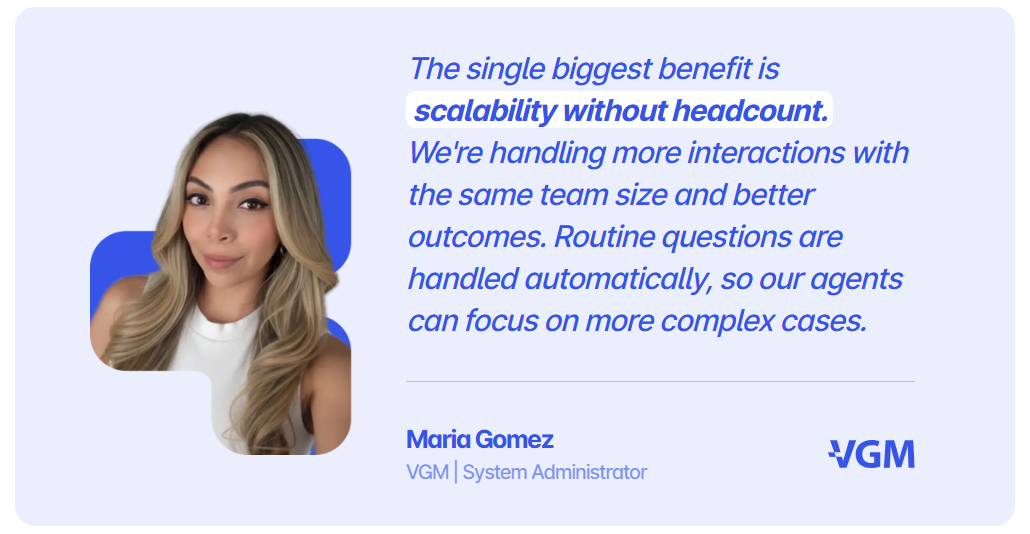
Improves agent morale by shifting cold outbound work to willing AI-qualified conversations
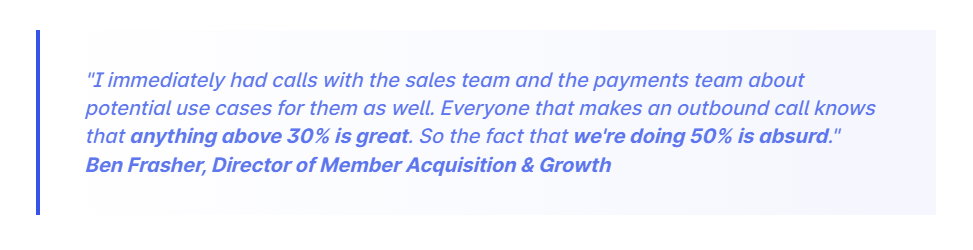
Achieved a 51% connection rate for PadSplit, five times the industry's typical 10%
Cons
Compliance list stops short of DORA, a gap for EU financial services buyers
Why Choose Callers Over Parloa
The two platforms differ most on time and ownership. Parloa deployments run one to three months through a certified partner, while Callers goes live in days and puts the build in your CX team's hands from the start, so nobody waits on an integrator to change a script.
Latency tells the same story. Responses land under 300 milliseconds against Parloa's reported 700 to 900, and there's no enterprise price floor standing between a mid-market team and a working agent.
2. Cognigy
Cognigy is an enterprise-grade agentic AI platform for contact centers, built omnichannel-first so one agent definition spans voice, chat, messaging, and digital across different languages.
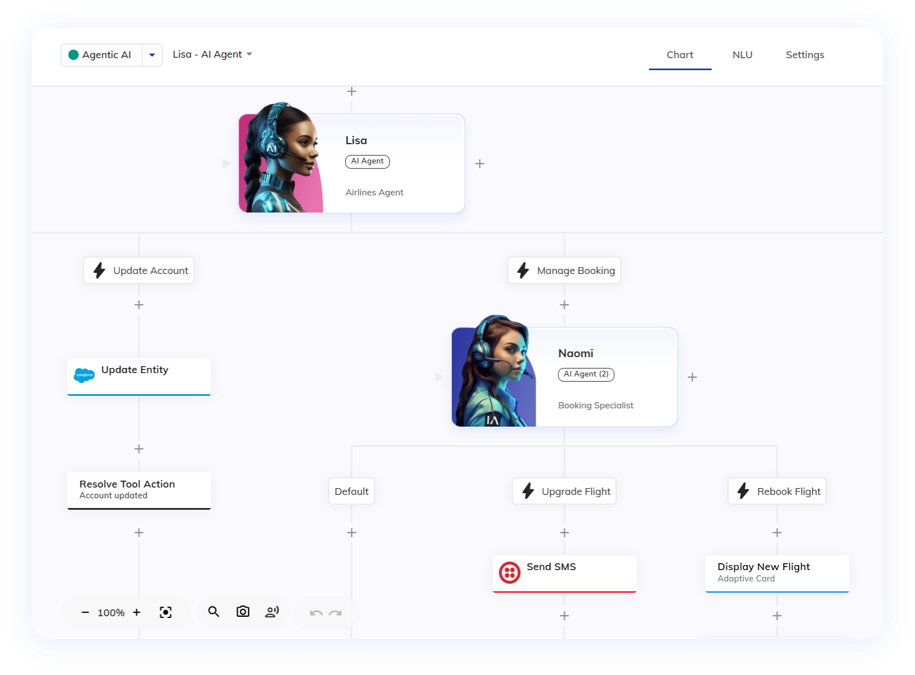
Backed by NICE's CCaaS ecosystem since 2025, it pairs conversational AI with workforce management and analytics under one roof. Enterprise adoption runs well ahead of Parloa's, as the platform is built for easier setup without a heavy IT lift.
Key Features
Agentic AI orchestration: Build and run AI agents across voice, chat, and messaging from one platform
CCaaS integrations: Connect natively into Genesys, Avaya, and NICE CXone
Agent Copilot: Assist live human agents with real-time suggestions during calls and chats
Knowledge AI: Ground agent answers in your own documentation and knowledge base
Pricing
Custom, sales-led enterprise contracts tailored to specific business requirements
Rating
G2 rating: 4.6/5 (around 13 reviews), Capterra 4.8/5 (around 23 reviews)
Pros
Non-coders can build working chatbots quickly using intents and anchors
Support is highly praised for deploying complex, sophisticated solutions
Won a 2026 Forrester Wave Leader placement for conversational AI platforms in CX
Two-way exchange of metadata with human agents enhances workflow productivity
Cons
Out-of-the-box components for common, complex business workflows are limited
Smaller customers may be too small in scale to get full value from it
Knowledge AI requires a separate license on top of the core platform subscription
Why Choose Cognigy Over Parloa
Both platforms court the enterprise contact center, but Cognigy arrives with more of the ecosystem already attached. Native Genesys, Avaya, and NICE CXone connectors, workforce management through NICE, and a copilot for live staff make it a fuller CCaaS play than Parloa's voice-centered AMP. Enterprise adoption runs well ahead of Parloa's too, and setup needs less of an IT lift.
3. PolyAI
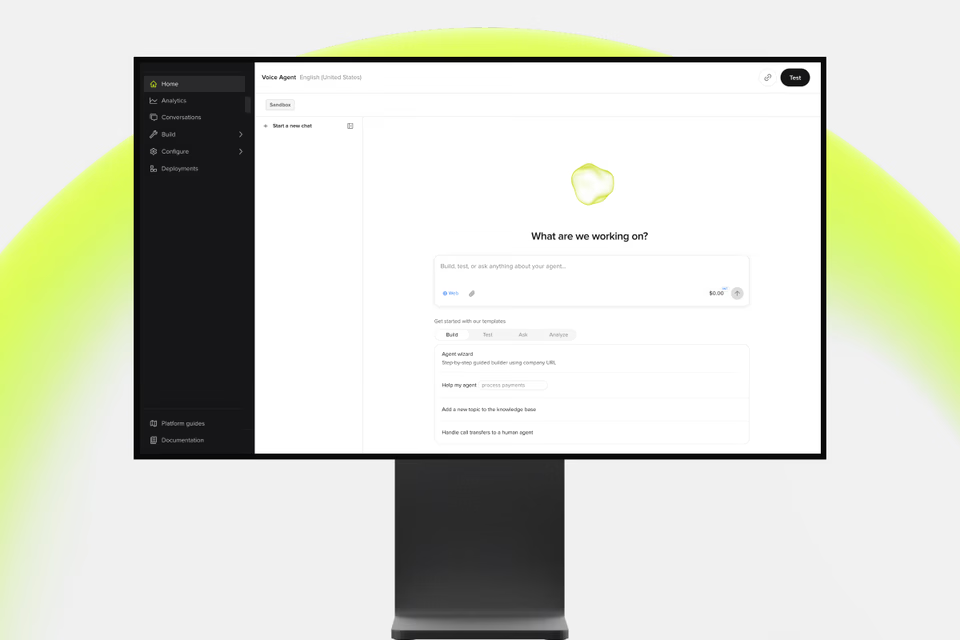
Poly AI is a voice-first conversational AI platform built around domain-ready agents for authentication, billing, order management, and reservations, cutting the custom training work most enterprise deployments require.
Real-world containment rates climb past 80%, a bar Parloa's own architecture has struggled to match given its reported latency gap. Conversational realism carries the platform too, with natural-sounding voice interactions across dozens of languages.
Key Features
Raven voice model: Handle natural, interruption-heavy calls with a model trained on real conversations
Agent Studio: Build voice agents through a no-code interface backed by a developer kit
Multilingual voice: Run customer conversations across many languages on voice
Enterprise compliance: Operate under SOC 2, HIPAA, GDPR, and PCI certifications
Pricing
Priced on a per-minute basis, which includes proactive performance improvements, maintenance, and 24/7 support. Exact figures are not available publicly
Rating
G2 rating: 5.0/5 (around 12 reviews). Gartner Peer Insights 4.5/5 (around 28 reviews).
Pros
The voice is authentic, warm, and hard to distinguish from a real person
Support is responsive, with dedicated onboarding and integration teams for setup
It integrates smoothly with a wide range of existing software systems
Most customers report lower operational costs and measurable efficiency gains after switching to it
Cons
Custom integrations with legacy databases often require PolyAI's own engineering team, unlike Callers' developer-free setup
Premium voice customization requires managed tuning rather than self-serve voice cloning tools
Post-hoc reporting that differs structurally from deterministic conversation mapping
Why Choose PolyAI Over Parloa
Voice quality is the cleanest argument. The Raven model handles interruption-heavy calls naturally and pushes containment past 80 percent in production, performance Parloa's latency gap makes hard to match.
Domain-ready agents for billing, authentication, and reservations also shrink the custom design work a Parloa rollout would spend weeks on.
4. Sierra
Sierra is an enterprise AI agent platform built to resolve customer requests end to end, not just talk through them. Its agents connect directly into CRM and order systems to process returns, update subscriptions, and close out issues without human involvement.
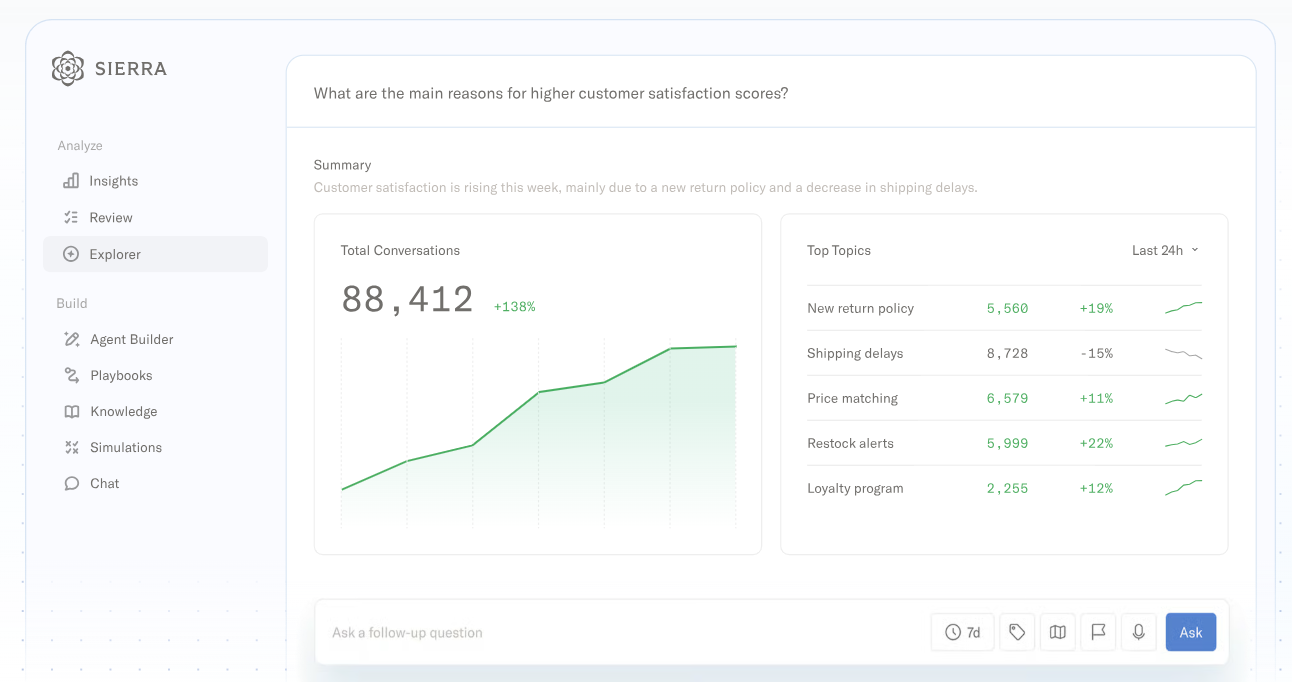
Deployments typically go live in four to ten weeks, faster than Parloa's typical one to three months. Sierra also became the first platform to run PCI-compliant payments inside the conversation itself.
Key Features
Multichannel agents: Run one AI agent across chat, voice, SMS, WhatsApp, and email
Agent Studio: Configure agent behavior and guardrails for large support operations
Supervision tooling: Monitor and correct agent responses as volume grows
Outcome tracking: Tie agent performance to resolved outcomes
Pricing
The platform is outcome-based. You pay when the AI achieves a predefined successful outcome such as a resolved conversation, saved cancellation, upsell, or cross-sell. Exact figures are not stated.
Rating
G2 rating: 4.4/5 (around 49 reviews)
Pros
Retains full conversation memory across channels, from app chat to SMS to phone
Seamless integration with existing business systems is a standout strength
Onboarding is quick, straightforward, and stress-free
Focuses on safe, supervised agents that protect brand integrity
Cons
May struggle to maintain context in longer conversations
Platform does not allow much client-side customization
Occasional bugs and slow performance during usage
Why Choose Sierra Over Parloa
Sierra gets you live in four to ten weeks against Parloa's typical quarter, and its agents close requests end to end, processing returns and subscription changes inside the conversation itself. Outcome-based billing is the other separator. You pay for resolved conversations rather than consumption, which makes the spend easier to defend internally.
5. Decagon
Decagon is built for digital support, bringing the same depth to chat and email that voice-first platforms like Parloa built for the phone channel first. Agent behavior comes from Agent Operating Procedures, natural-language instructions CX teams write and revise themselves rather than rigid flow diagrams.
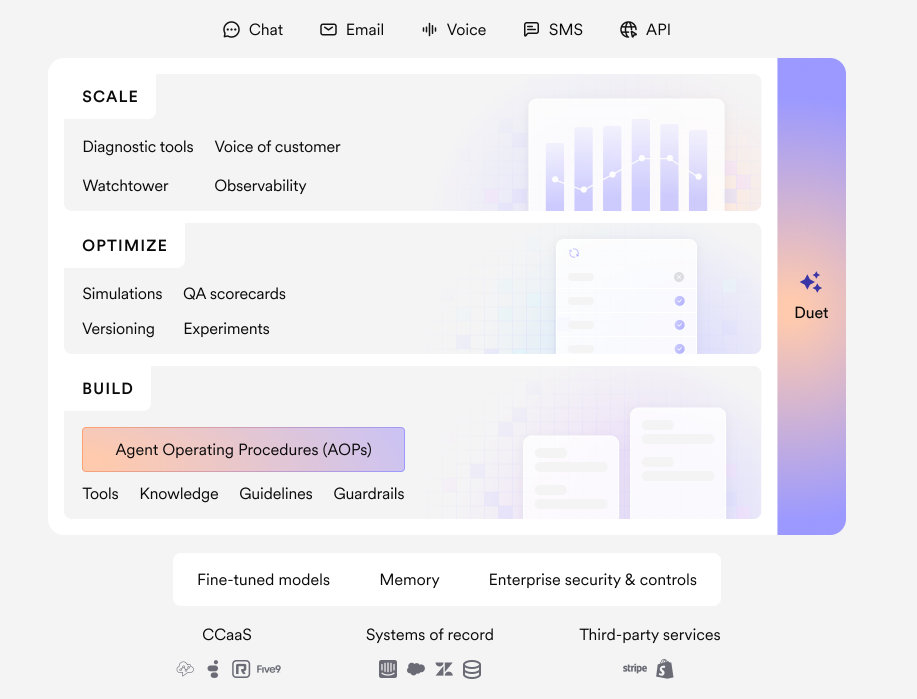
This structure gives teams real transparency into how the agent reasons, letting them evaluate and tune performance at a level deeper than simple task automation. The approach suits digital-native teams in telecom and SaaS support.
Key Features
Agent Operating Procedures: Define support workflows in natural language rather than code
Multichannel support: Handle customer issues across voice, chat, and email
Watchtower: Monitor agent behavior and quality in production
Experiments: Test agent changes before rolling them out widely
Pricing
Custom. Exact figures are quoted through a demo
Rating
G2 rating: 4.8/5 (around 25 reviews)
Pros
Allows the evaluation of support data on a deeper level
Real-time updates make collaboration with the platform feel seamless
Support team is highly responsive to feedback and feature requests
Strong AI performance is paired with a seamless onboarding process
Cons
It can be hard to see why the agent made a decision
Users may experience shallow audit logs and limited user role permissions
Agent Assist is limited to Zendesk, restricting broader use compared to Callers' 610+ native integrations
Why Choose Decagon Over Parloa
Parloa grew up around the phone channel, and Decagon grew up around chat and email, which makes it the better match for digital-native support teams. Its Agent Operating Procedures are written and revised by your own CX staff in natural language, so tuning the agent never routes through a partner the way Parloa changes do.
6. Synthflow
Synthflow is built for speed, letting teams stand up a working voice agent in minutes on a visual builder rather than waiting through a partner-led rollout. Response times run well under 500 milliseconds, a noticeably tighter exchange than the 700 to 900 millisecond lag reported on Parloa's enterprise architecture.
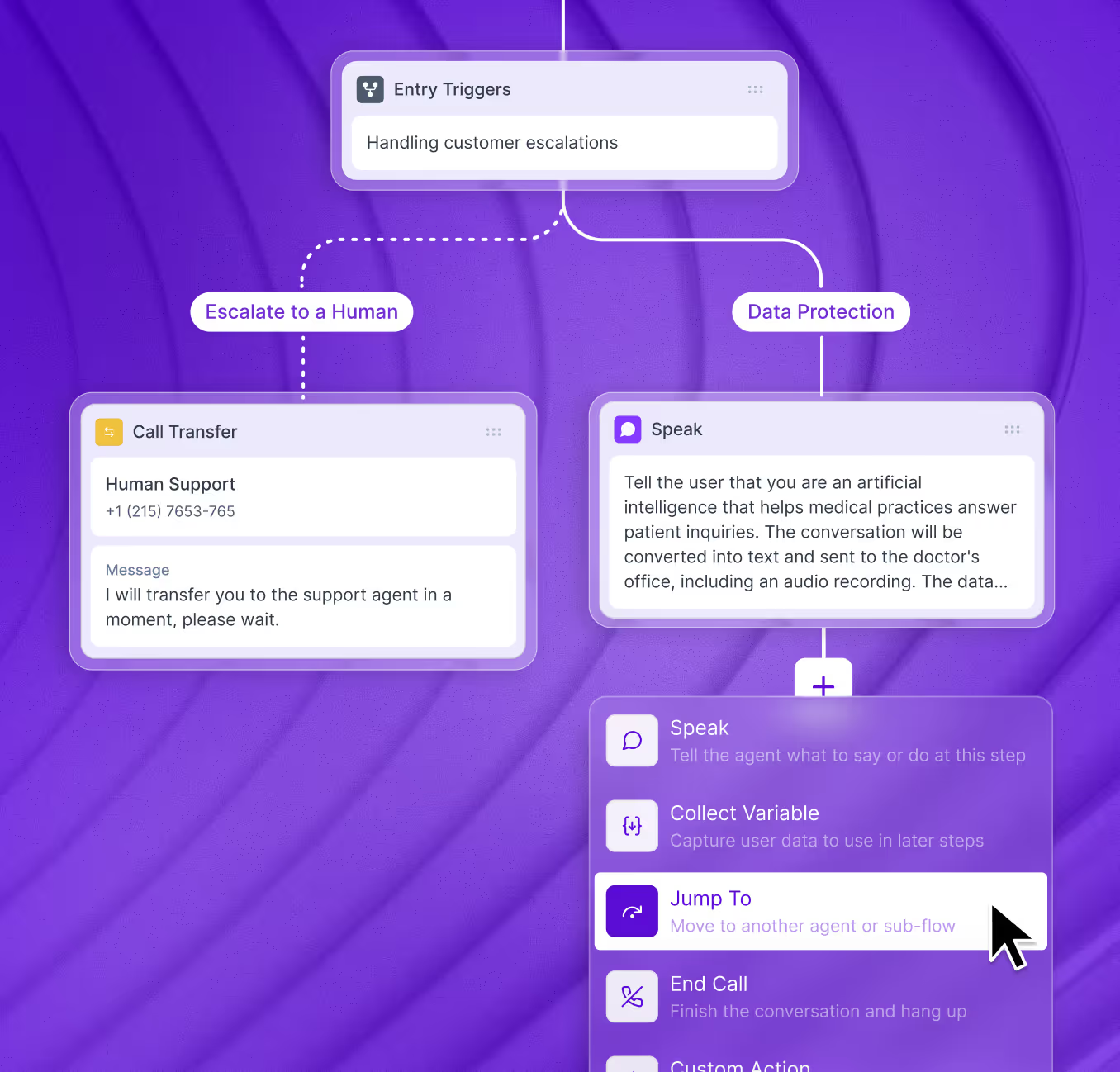
Synthflow is more tuned for appointment booking, FAQ handling, and outbound calling rather than the compliance-heavy, multi-department routing enterprise contact centers require.
Key Features
Flow Designer: Build voice agents visually through a genuinely no-code interface
In-house telephony: Run calls on Synthflow's own phone infrastructure
Omnichannel coverage: Reach customers across voice, chat, SMS, and WhatsApp
Wide integrations: Connect to 200+ external tools
Pricing
Synthflow's enterprise contracts start at $30,000 a year. Final figures are scoped around call volume, concurrency, telephony setup, integrations, security needs, and launch support
Rating
G2 rating: 4.5/5 (around 1,015 reviews)
Pros
Templates and setup wizards make implementation straightforward
Visual logs help users spot and fix issues quickly
Onboarding is fast and painless, with immediate access
Natural-sounding voices that keep conversations feeling on-brand
Cons
Occassional latency spikes and awkward phrasing during complex conversations
Difficulty handling interruptions or barge-ins mid-call
Complex branching and version control are limited, making rollbacks harder
Why Choose Synthflow Over Parloa
Synthflow operates at a speed Parloa's model can't offer. A working voice agent goes up in minutes on the visual builder, and responses come back in under 500 milliseconds, a tighter exchange than Parloa's 700 to 900. For appointment booking, FAQ handling, and outbound calling, you reach production while a Parloa project would still be in discovery.
7. Retell AI
Retell AI is built for teams that want to own the build themselves rather than hand it to a partner. Developers choose their own LLM, whether GPT, Claude, or a custom model trained on their own data, then wire conversation logic directly into the call flow and fine-tune performance for industry-specific use cases.
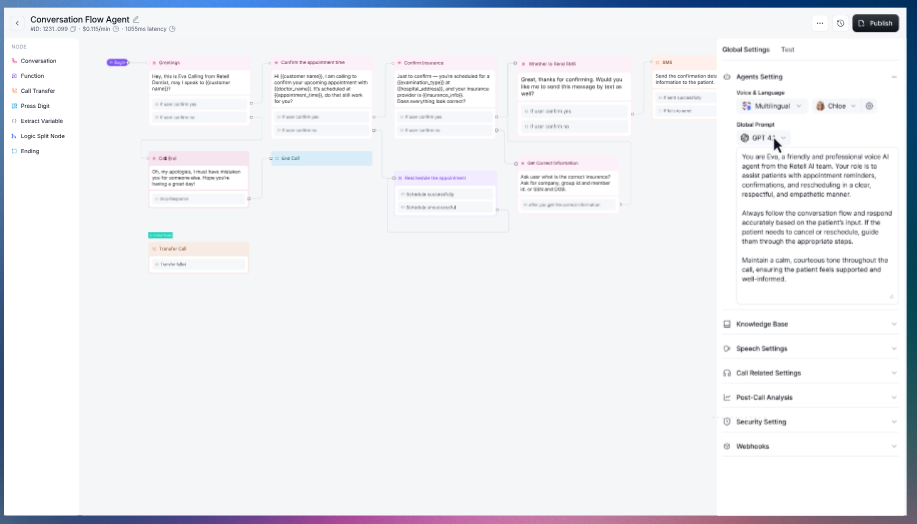
This level of hands-on control sits at the opposite end of the spectrum from Parloa's partner-led, fully managed deployment model.
Key Features
Low-latency voice: Run phone agents with roughly 600ms end-to-end response times
Drag-and-drop builder: Assemble call flows visually alongside the API
Real-time function calling: Trigger actions mid-call through connected functions
Telephony integrations: Connect to Twilio, Vonage, Telnyx, and major CCaaS systems
Pricing
Retell publishes usage-based pricing from $0.07 to $0.31 per minute, with $10 in free credits, no flat base fee, and custom Enterprise pricing
Rating
G2 rating: 4.8/5 (around 2,638 reviews)
Pros
Warm transfer lets a human agent join calls without breaking the flow
Engineering teams praise its granular API control for reliable performance at scale
User interface is intuitive and setup process is quick
Conversations can be customized per individual caller for a better fit
Cons
Fine-tuning voice agents for accuracy takes considerable extra testing time
Some multilingual prompts fail, with agents still pronouncing names in English
Voicemail interpretation still lags behind its handling of live calls
Why Choose Retell AI Over Parloa
Retell is the pick when you'd rather own the build than hire it out. Your developers choose the model, wire the logic, and tune performance themselves, the exact control Parloa's partner-led rollout takes away.
Pricing is published too, $0.07 to $0.31 per minute with free credits to start, so you can pilot without entering a sales cycle.
8. Vapi
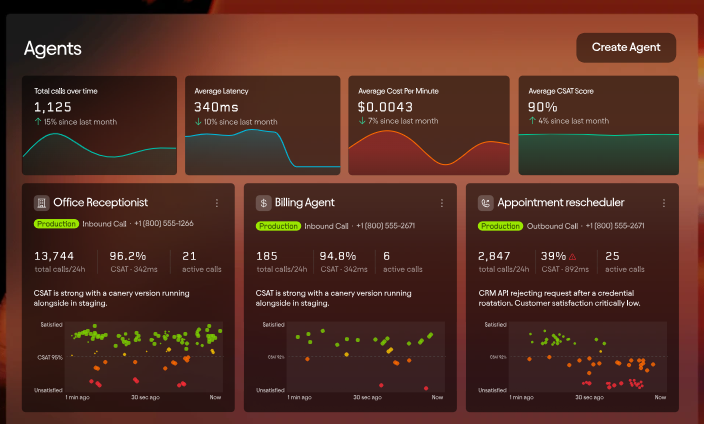
Vapi is an infrastructure layer for building voice AI agents. It lets a team plug in whichever LLM, voice, and speech recognition provider performs best for their use case instead of being tied to a single vendor's ecosystem. Hence, it stands out from the lock-in that comes with Parloa's Azure-native setup.
This flexibility, paired with solid developer documentation, has made Vapi a good choice for teams building voice AI from scratch.
Key Features
Provider-agnostic orchestration: Bring your own model, voice, and telephony and connect them together
Low-level API control: Configure call behavior at a granular, code-first level
Usage-based pricing: Pay for orchestration by the minute, with models passed through at cost
Compliance add-ons: Add HIPAA or zero data retention as paid options
Pricing
Vapi charges $0.05 per minute for orchestration, with models billed on top at cost, plus $0.005 per message. HIPAA is a $2,000 per month add-on. Zero data retention is $1,000 per month
Rating
G2 rating: 4.2/5 (under 10 reviews)
Pros
Debug interface and documentation are genuinely useful
Sub-second response times make conversations feel natural
Ability to fine-tune tone and behavior to match user’s brand
A/B testing across prompts and voices helps teams continuously improve performance
Cons
Real-world per-minute costs often run two to three times the advertised rate
Agent tuning and webhook setup require real coding skills
Multi-step logic chaining still requires raw JSON config rather than a visual tool
Why Choose Vapi Over Parloa
Parloa is Azure-native, and that lock-in is exactly what Vapi avoids. You pick the speech, language, and voice providers separately and can replace any layer without rebuilding the rest, paying Vapi only a small per-minute fee while model costs pass straight through. Engineering teams that want to assemble their own stack get a freedom Parloa's architecture rules out.
9. CloudTalk
CloudTalk is a cloud phone system built for teams that want to go live the same day rather than months into an implementation project. A small business can sign up, port numbers, and start routing calls without touching a sales team.
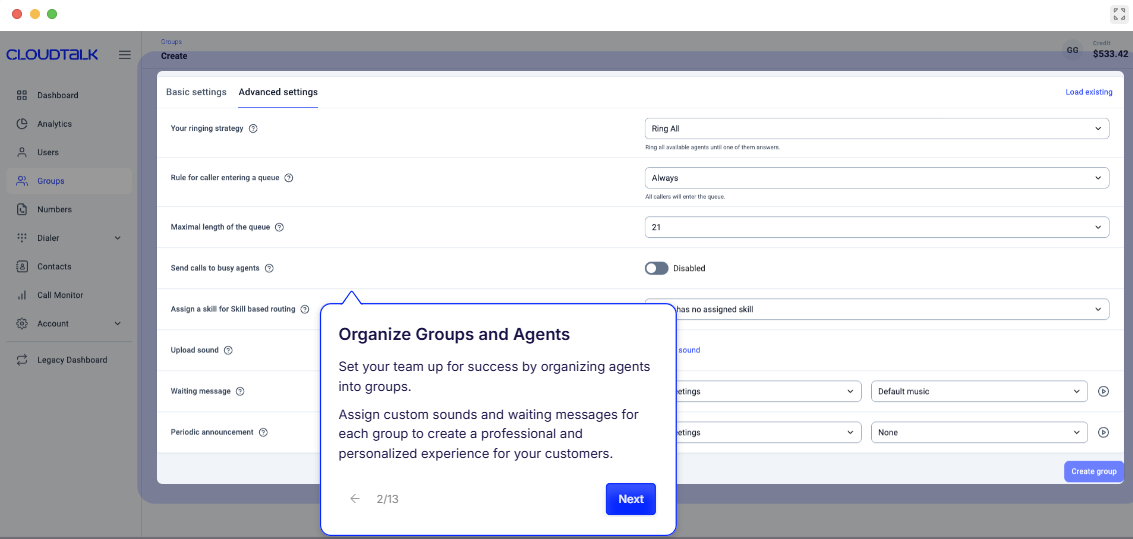
This level of self-serve access sits at the opposite end of the market when compared to Parloa's enterprise contact-center rollout. CloudTalk layers AI transcription and voice automation on top of that foundation as teams grow into needing them.
Key Features
Multiple dialers: Run smart, power, and parallel dialing modes for outbound teams
IVR routing: Route inbound calls through configurable menus and rules
AI conversation intelligence: Transcribe and analyze calls through a paid add-on
AI Voice Agents: Deploy standalone automated voice agents as an add-on
Pricing
Business Phone System: Starts at $34/user/month. Includes cloud telephony, AI voice agents, CRM integrations, call routing, analytics, and optional AI features through paid add-ons
AI Voice Agents: Starts with a free AI Receptionist (50 minutes/month). Custom enterprise pricing is available with rates starting at €0.15/minute
Rating
G2 rating: 4.4/5 (around 1,849 reviews)
Pros
Availability of local numbers across 160+ countries
Dashboard is modern, clean, and easy to navigate
Two-way sync with HubSpot, Salesforce, and Pipedrive enhances productivity
Emotion tracking on calls gives teams a unique layer of customer insight
Cons
Reporting customization is limited compared to other providers
Intermittent lag and occasional mobile app instability during calls
AI Conversation Intelligence is an add-on cost not bundled in, unlike Callers' built-in post-call analytics
Why Choose CloudTalk Over Parloa
CloudTalk is self-serve in a way Parloa structurally isn't. A team can sign up, port numbers, and route calls the same day without talking to a sales rep or hiring a systems integrator. At $34 per user per month it also costs a fraction of an enterprise AMP contract, with AI transcription and voice agents ready as add-ons once the team grows into them.
10. Nextiva
Nextiva is a full communications platform where voice, chat, messaging, email, and social calls all funnel into one place instead of separate specialized tools. Generative AI automatically transcribes, summarizes, and scores each interaction, surfacing why sentiment dropped on a given call type or which topics keep generating repeat contacts.
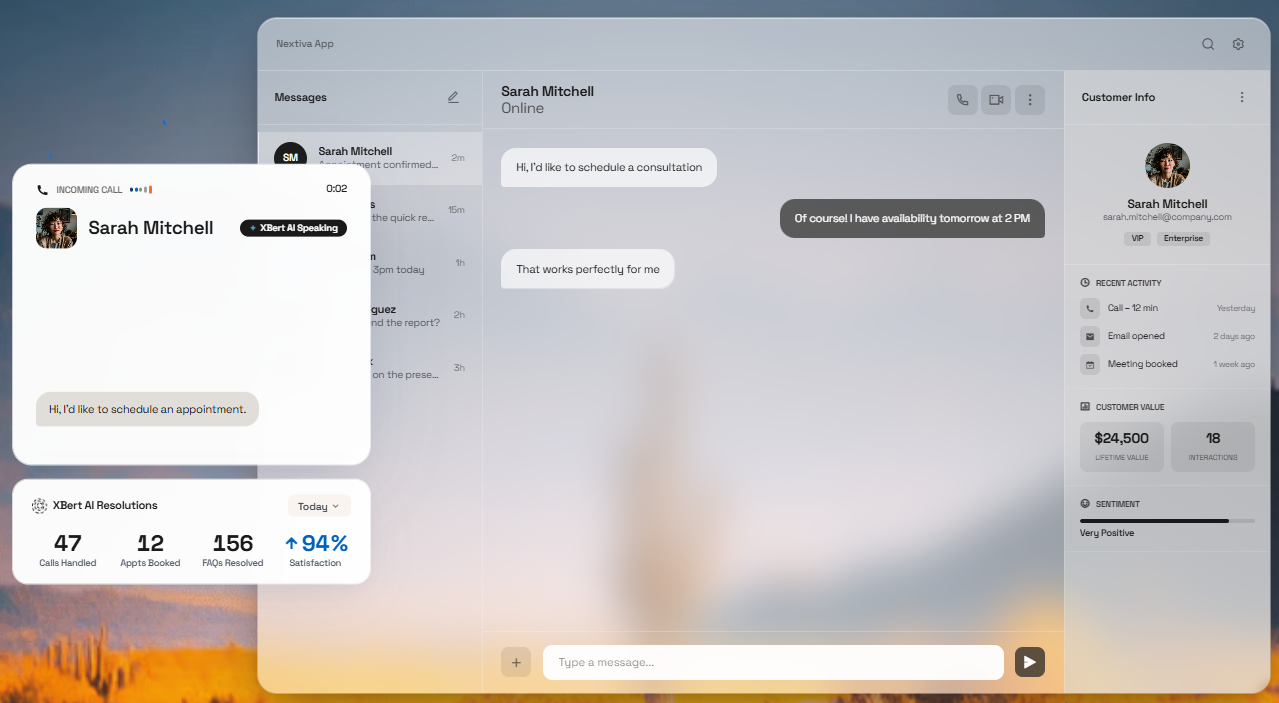
This native quality assurance is something Parloa's dialogue-focused architecture doesn't build in. Also, the analytics depth, spread across each channel rather than concentrated on the phone, is where Nextiva pulls ahead.
Key Features
Unified communications: Combine business phone, video, and messaging in one platform
Contact center: Run inbound and outbound contact-center operations at scale
XBert AI: Add AI-assisted features across the communications suite
CRM integrations: Connect to common business and CRM tools
Pricing
Plans start at $23/user/month, with XBert AI Receptionist available as an add-on across all tiers
Rating
G2 rating: 4.5/5 (around 3,604 reviews)
Pros
Setup for each new agent is quick and straightforward
Agents can work across channels from one dashboard, whether on desktop or mobile
Call recording gives small teams a practical quality assurance tool
Helps businesses create better internal processes to replace scattered calls
Cons
Regulatory fees can push final bills 20 to 40 percent above quoted rates
Some contracts run up to 36 months, with costly early termination fees
Some users report mobile app instability alongside occasional dropped calls
Why Choose Nextiva Over Parloa
Nextiva's edge shows up after the call. Every interaction across voice, chat, and messaging gets transcribed, summarized, and scored automatically, surfacing why sentiment dropped or which topics keep coming back, native quality assurance Parloa's dialogue-focused platform doesn't build in. You also get the whole communications stack, from business phone to contact center, starting at $23 per user per month.
How We Evaluated These Alternatives
We built this list by combining hands-on testing of each platform's demo or trial environment with a close read of verified user feedback on G2, Gartner Peer Insights, and Capterra. We didn't rely on vendor pitch decks.
For every platform, we looked at:
Time to live. How fast a team could realistically deploy, not just what the sales page promises.
Real pricing. What the platform actually costs once add-ons, overages, and hidden fees are counted in.
Latency and call quality. Since this single metric shapes whether a conversation feels natural or stilted. It's also where we benchmark closely since it's core to how Callers is built.
Integration and compliance depth. How well each platform connects into existing CRM, telephony, and security requirements.
Buyer fit. Whether the platform is actually built for the team using it. A tool that excels for a 500-agent enterprise contact center often frustrates a 20-person growth team, and the reverse holds true too.
How to Choose the Best Parloa Alternative
Picking the right platform comes down to matching the tool to how your team actually operates, rather than just comparing feature lists.
Match deployment speed to your urgency. If a slow speed-to-lead or after-hours gap is already costing you revenue, a platform that takes months to go live works against you no matter how capable it is on paper.
Weigh who owns changes after launch. Platforms that let CX teams build and edit agents directly avoid the developer or partner dependency loop that stalls quick fixes.
Price transparency matters as much as the number itself. Understand what's bundled versus billed separately before comparing sticker prices across vendors.
Check whether the platform was built AI-native from the start, rather than bolted onto an older phone system. This distinction separates a platform like Callers from a retrofitted dialer wearing an AI label.
Confirm compliance coverage against your specific industry, not a general checklist, since gaps in certifications like DORA or GDPR only surface once a regulator actually asks.
Frequently Asked Questions (FAQs)
How Do I Evaluate Voice Quality When Comparing These Platforms?
Run a live call, not a demo video. Listen for how it handles interruptions, pauses, and accents, since latency above 300ms is usually where conversations start feeling robotic. Callers keeps responses under 300 milliseconds, which is worth using as a benchmark against anything you test.
Can These Platforms Run On-Premise or Hybrid, or Are They All Cloud Only?
Almost all run cloud-only. On-premise setups are rare, usually reserved for banks or healthcare systems with data residency rules that block outside hosting entirely.
What’s the Difference Between Automation-Only and Unified AI Platforms?
Automation tools trigger single actions in isolation, like an IVR menu or a scripted bot. Unified platforms carry one shared context across every channel, so a conversation that starts on chat and moves to a call doesn't force the customer to repeat themselves.
How Do I Measure ROI From an AI Voice Platform?
Compare cost per resolved conversation against your current fully loaded agent cost, then track containment rate and time-to-value separately, since a platform can look cheap per minute while still needing months to show results.
Should I Build My Own Voice AI or Buy a Platform?
Building demands ongoing engineering headcount to maintain. Buying gets you live in days instead of months, which is the gap Callers is built to close.
Streamline Your Voice and Chat Operations with Callers
The ten Parloa alternatives above cover very different buyers, from developer-first infrastructure layers to fully managed enterprise rollouts, and the right fit depends on your deployment timeline, your budget, and how much control your CX team wants to keep in-house.
If speed, ownership, and pricing clarity matter most, Callers is built around exactly that gap. Deployments go live in days, not quarters. CX teams build and edit agents directly without routing every change through a developer, and one agent carries context across calls, text, and chat instead of resetting at each channel.
Book a demo to see how Callers handles your first real conversation.