
Retell vs Synthflow: Which AI Voice Platform Actually Fits Your Workflow?
:quality(80))
:quality(80))
Quick Summary
Retell offers usage-based pricing, developer flexibility, and consistent ~600-780ms latency but demands technical setup. Synthflow provides fast no-code building and intuitive flows but now starts at enterprise contracts ($30K+/year) with variable latency. Retell suits technical teams scaling complex use cases. Synthflow suits agencies needing quick, white-labeled deployment without engineering resources.
Not Sure Between Retell and Synthflow Which to Use For Your Voice Agents?
If you're weighing Retell against Synthflow, you've probably already figured out the hard part. Both can put a real AI voice agent on the phone, and both demo well. So the honest question isn't "which one is better?" it's "which one fits how your team actually works and pays?"
That's where they split. One asks you to assemble the pieces yourself and rewards you with control and usage-based pricing. The other hands you a finished builder but has moved its starting price up to enterprise deals.
This Callers guide compares Retell and Synthflow on the eight things that decide it in practice. At the end, we'll flag where a fuller platform makes more sense than either.
But first…
Why Listen to Us?
At Callers, we build AI voice and chat automation for high-volume B2C teams, from lending and logistics to retail CX. Brands like Einride, DoorDash, and PadSplit run their customer conversations on our platform, giving us a front-row seat to what actually breaks or scales across voice AI tools. That hands-on experience is what shapes our comparison of how Retell and Synthflow stack up in practice.

Retell vs Synthflow (At a Glance)
Dimension | Retell | Synthflow |
Latency | ~600–780ms, consistent | ~500ms–2s, variable |
Pricing | ~$0.07/min PAYG, $0.13–$0.31 all-in | Enterprise contracts from $30K/year |
Ease of Build | Developer-first, steeper learning curve | No-code visual builder, fast setup |
Custom LLM Support | Yes (GPT, Claude, Gemini, BYO) | No, bundled model only |
Best Fit | Technical teams scaling past prototype | Agencies/BPOs needing fast white-label launch |
What is Retell AI?
Retell AI is a platform for building and running AI phone agents. Teams design the conversation first, choosing from:
A single prompt for simple, fast setups
A multi-prompt structure for more layered conversations
A full flow builder with nodes and branching logic for tighter control
Then they connect a language model, a voice, and their own telephony. From there Retell handles the live call. It listens, responds, and calls functions mid-call to look something up or complete an action. It also extends past voice, letting the same agent handle chat, email, and SMS, and it added an automated QA layer that reviews calls without manual spot-checking.
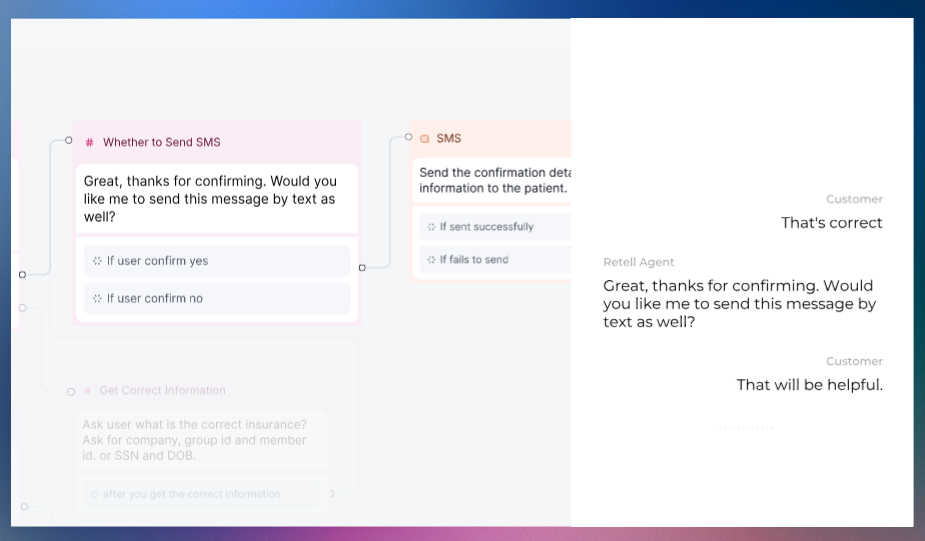
The platform leans developer-first. Full API and SDK access sit alongside a no-code builder, so technical teams get depth while less technical users can still assemble something workable. Pricing runs on usage, billed per minute across voice, model, and add-on components, so cost shifts with call volume and the pieces a team turns on.
That combination suits builders who want control over agent logic and are comfortable configuring a stack piece by piece.
What is Synthflow?
Synthflow is a no-code platform for building voice AI agents. Teams lay out the call in a visual Flow Designer, dragging and connecting blocks to define each step, or start from a single prompt for simpler agents. Synthflow also runs its own in-house telephony instead of routing calls through a third-party carrier, which keeps latency low and setup contained to one system.
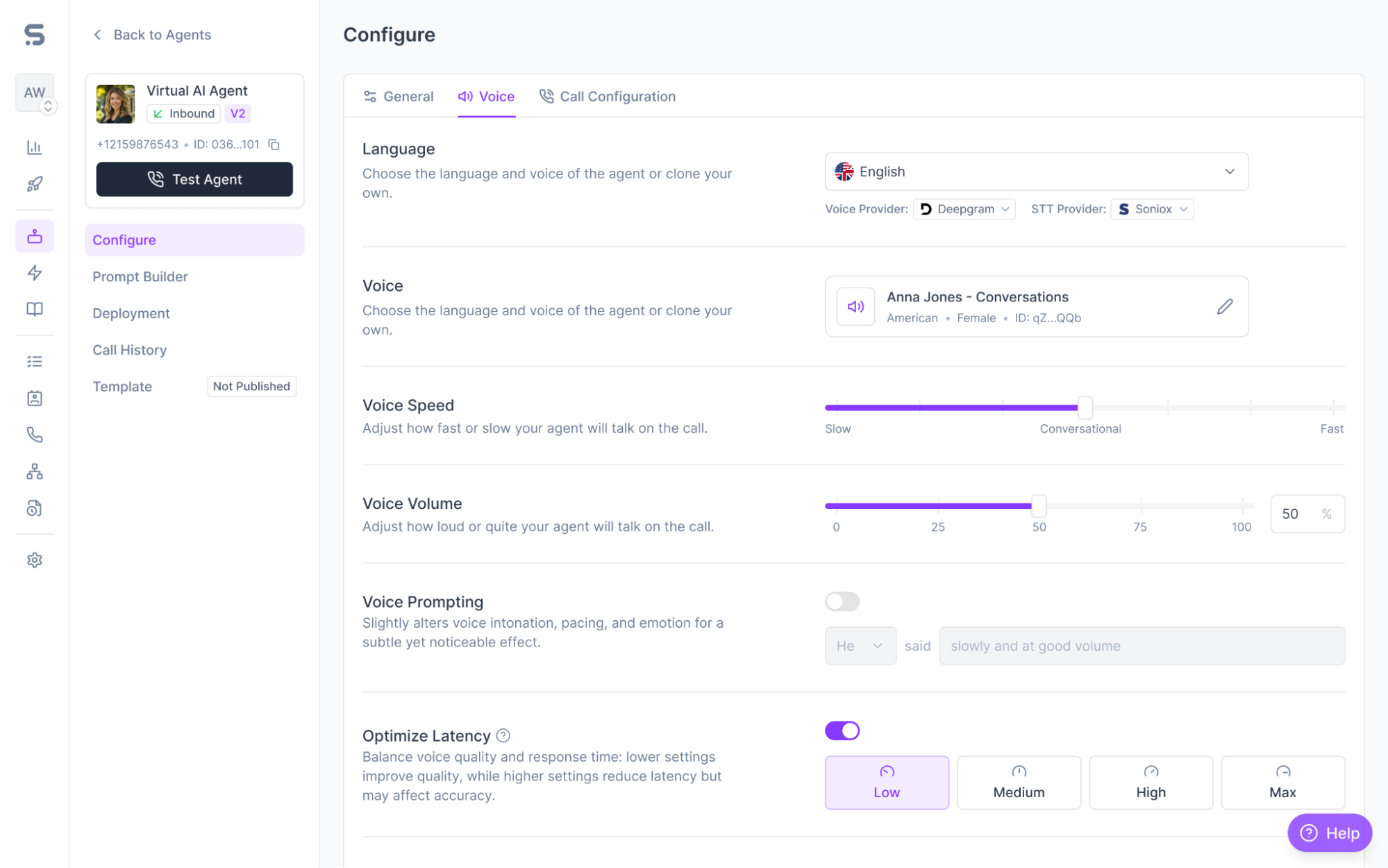
The platform extends past voice too, covering chat, SMS, and WhatsApp from the same agent. It leans toward enterprises in regulated, high-volume industries like healthcare, financial services, and BPO, with white-label options built in for agencies reselling the platform to clients. Pricing moves from a pay-as-you-go plan up through agency and enterprise contracts, scaling with volume and support needs.
Synthflow is more of a finished product built for teams that want the infrastructure decisions made for them.
Retell vs Synthflow: Side-by-Side Comparison
Voice Quality and Latency
Retell advertises response times as low as 500ms, and independent benchmarks back that up closely, with tests consistently landing Retell around 600ms to 780ms.
Synthflow markets sub-100ms telephony, but real-world results are far less consistent. Some benchmarks clock it under 500ms, others recorded latency near 2 seconds and flagged it as unsuitable for live conversation.
That range matters more than the average. A caller interrupting mid-sentence to ask about rescheduling is a different test than a scripted demo, and Synthflow's performance seems to swing with carrier and configuration in a way Retell's doesn't.
Agent Building and Conversation Design
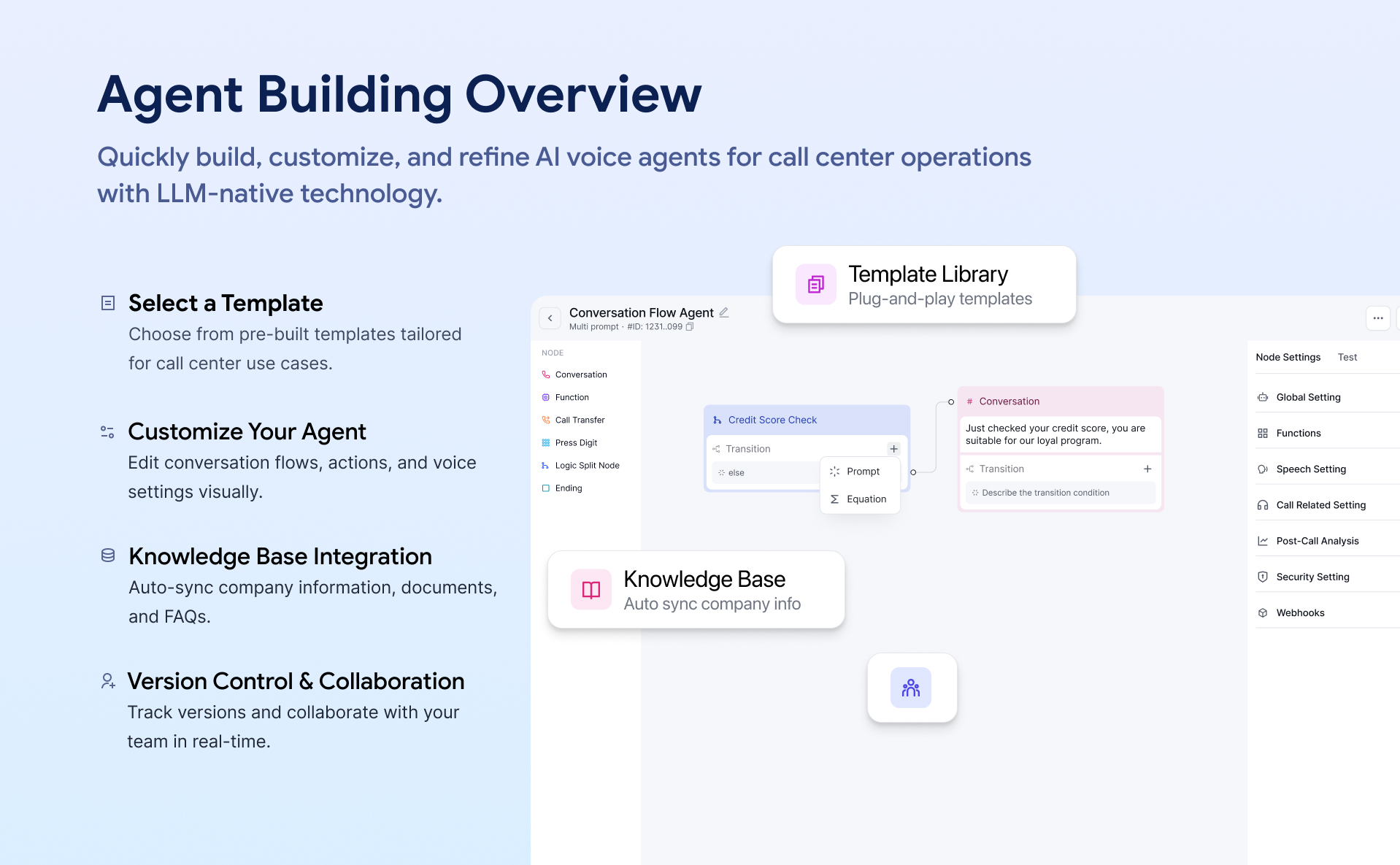
Retell offers single-prompt setups, multi-prompt structures, and a full Conversation Flow builder with nodes and branching logic. Reviewers describe the flow builder as capable of real call logic with clean transitions and predictable outcomes.
The architecture supports Global Nodes for universal intents like callbacks or human handoff, which can trigger from anywhere in the flow, so an agent can handle a caller switching topics mid-call without breaking the conversation. The tradeoff is a steeper learning curve. Multiple reviews describe Retell as built for developers first, with a lighter visual interface and no true drag-and-drop canvas.
Synthflow flips that. Its visual Flow Designer draws consistent praise for being intuitive, with well-organized nodes and branching that covers most business logic without code. Users report going from signup to a working phone number in under an hour, and some teams shipped agents in 25 to 50 minutes.
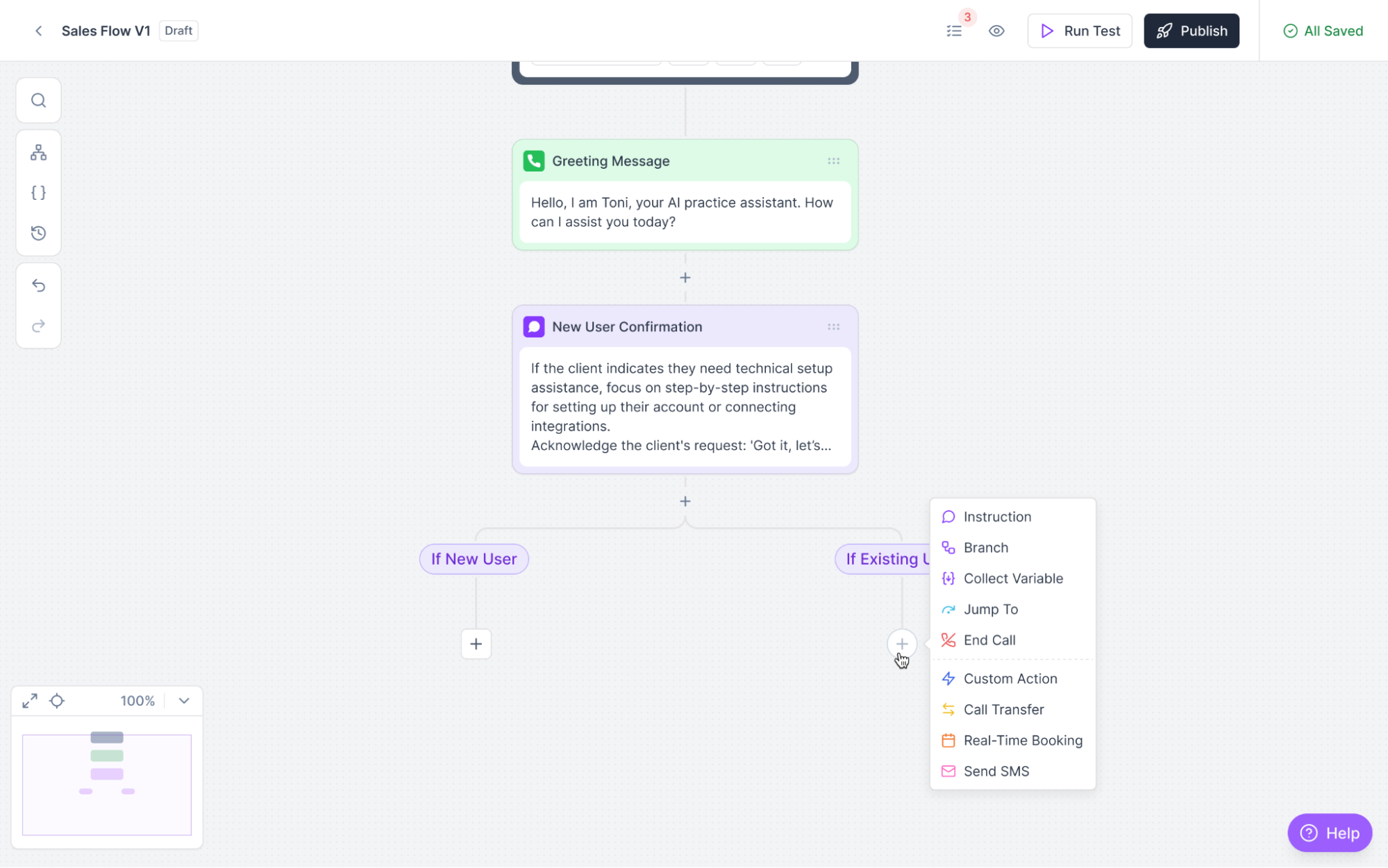
That speed comes at a cost of a ceiling. Several independent reviews note Synthflow's no-code flows are built for prototypes rather than production, and teams that grow past simple use cases run into limits around custom models and deeper analytics.
Telephony Infrastructure
Synthflow runs its own in-house infrastructure and markets it as removing carrier dependency. In practice, most users still connect a Twilio account or SIP trunk for their phone numbers, which adds roughly $0.01 to $0.02 per minute on top of platform fees.
Synthflow does offer a managed number option directly through the platform for $1.50 a month, so bringing your own carrier isn't strictly required, but reviews and documentation both point to Twilio as the more common setup.
Retell takes the opposite approach, supporting any carrier through SIP trunking or its own built-in option, which gives more flexibility to teams with existing carrier relationships but adds a configuration step Synthflow's packaged setup skips.
Pricing and True Cost
Retell's headline rate of $0.07 per minute is genuinely close to what most users pay once voice, TTS, and LLM components are added, typically landing between $0.13 and $0.31 per minute with full transparency into each line item.
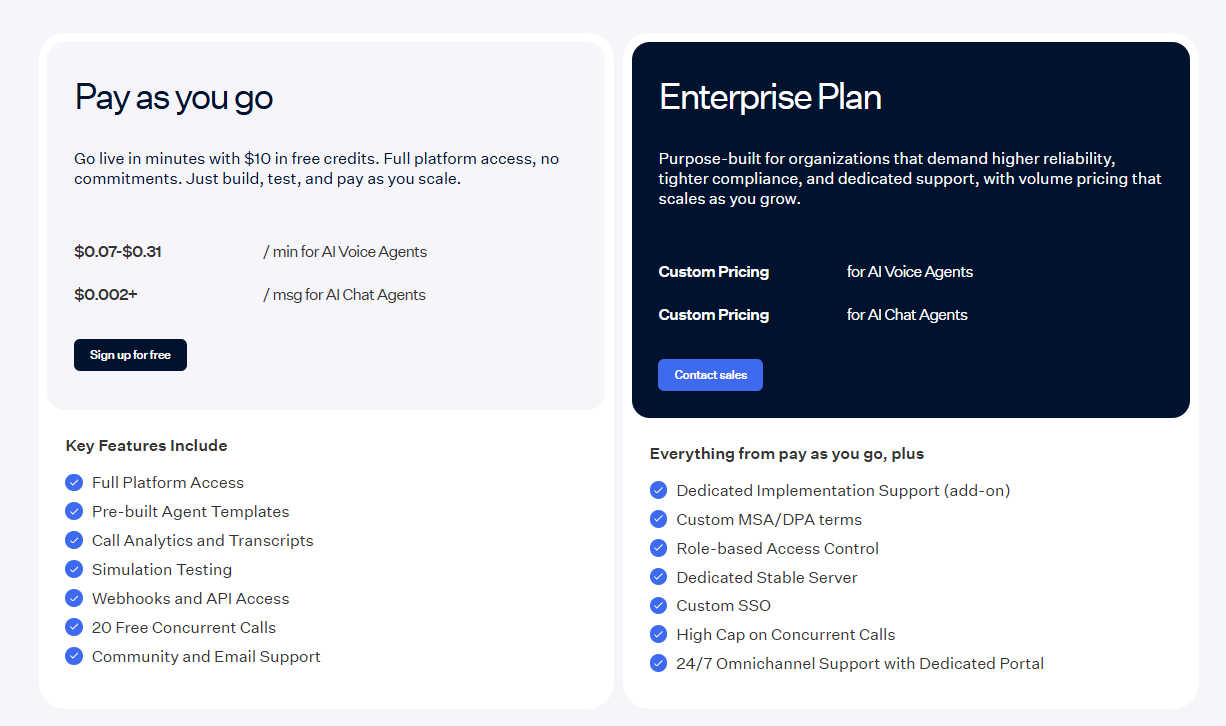
Synthflow's own pricing has shifted since most third-party reviews were written. It's now scoped entirely around Enterprise, with contracts starting roughly at $30,000 annually and final pricing set around call volume, concurrency, telephony, integrations, and launch support.
Synthflow's own materials also push back on the BYOK cost claim. In a company comparison against Vapi, Synthflow lists voice, transcription, and the LLM (GPT-4o) as included in its rate, not billed separately through outside provider accounts.
In an example, a 6,000-minute Agency plan at $1,250 a month carried an overage rate of $0.12 per minute with everything bundled in, versus a competitor charging separately for hosting, voice, transcription, and model usage on top of its base plan.
Enterprise Features and Scalability
Retell includes warm transfer with full conversation context passed to the human agent, batch calling for outbound campaigns at scale, and support for any LLM including GPT, Claude, or a custom model.
Post-call analysis is built in and structured, letting teams score calls against custom categories like purchase intent or sentiment, and simulation testing lets teams run calls against expected outcomes before anything goes live.
Synthflow's enterprise story centers on deployment speed and white-labeling. Its BELL framework structures the build, test, and launch cycle, and includes its own Simulation Center for running test calls plus real-time dashboards for tracking performance.
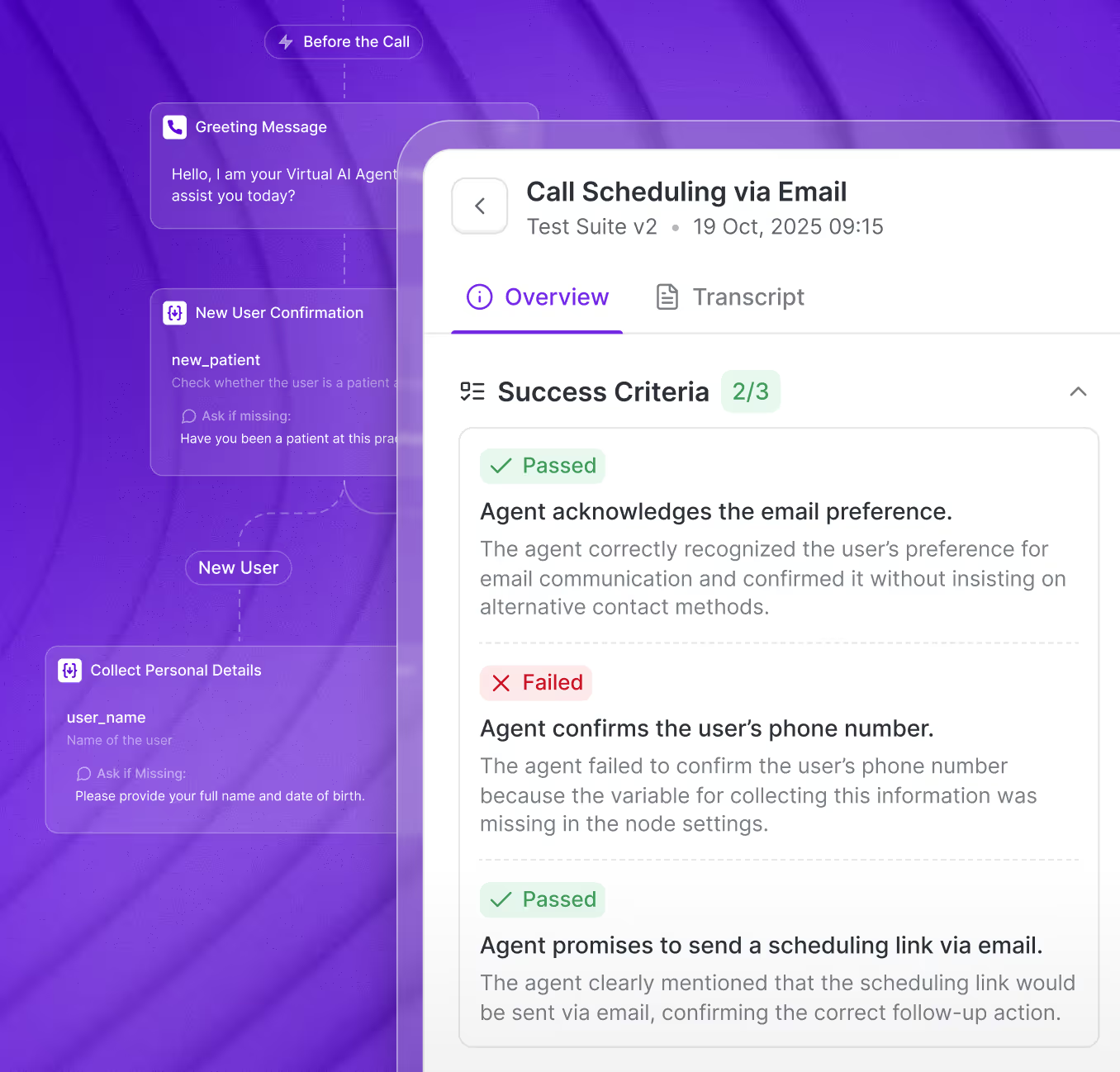
Where the gap shows up is depth. Several independent reviews describe Synthflow's post-call insight as thinner once teams move past basic transcripts and standard metrics. Platforms like Callers address this by surfacing where conversations break down and suggesting fixes directly, rather than leaving teams to read raw transcripts.
Compliance and Security
Retell holds SOC 2, HIPAA, GDPR, and CCPA certifications on every paid plan, with self-service BAAs that typically countersign within a business day. Synthflow holds the same certifications but often gates full access behind enterprise contracts, and its compliance posture is partly dependent on Twilio since the platform routes phone numbers through it.
Omnichannel Capabilities
Retell has expanded past voice as its sole channel. As of a January 2026 platform update, the company markets email and chat alongside voice and SMS, positioning itself as a single platform that can replace an IVR entirely across all four channels. How deep that email integration runs, whether it's full two-way conversation handling or lighter-touch messaging, is worth confirming directly.
Synthflow markets a wider channel list including SMS, WhatsApp, and web chat, but SMS is metered against voice minutes at a rate of five messages per minute, and WhatsApp requires connecting a separate Twilio account.
Email still isn't a native Synthflow channel, and Retell's email support is new enough that its depth is still unclear. For teams that want calls, texts, and email working together in one proven thread, that's still a gap. Callers already closes it with a shared context layer across calls, SMS, WhatsApp, email, and chat.
Best Fit
Retell suits teams with engineering resources, or at least comfort configuring a stack piece by piece, who expect call volume and complexity to grow past a first version. Custom LLM support, warm transfer, batch calling, and structured analytics matter most once a team is running production volume and needs to keep improving the agent based on real data.
Synthflow suits agencies and BPOs that need to launch client-facing agents fast, especially where white-label branding and a short time to first call matter more than deep customization. A small team can have a working agent inside an hour, which is hard to match on a developer-first platform. The limitation shows up later, when call volume grows and the no-code ceiling starts limiting how much the agent can actually do.
Introducing Callers: The Platform Built for the Full Conversation
Retell and Synthflow both solve the call. Callers solves the campaign around it, from the trigger that starts the conversation to the action that closes it out.
Where Retell asks teams to configure a stack piece by piece and Synthflow packages a fast but capped no-code builder, Callers runs the full customer lifecycle from one shared context layer. A single agent handles calls, texts, WhatsApp, email, and chat, and it carries the same conversation history across all of them.
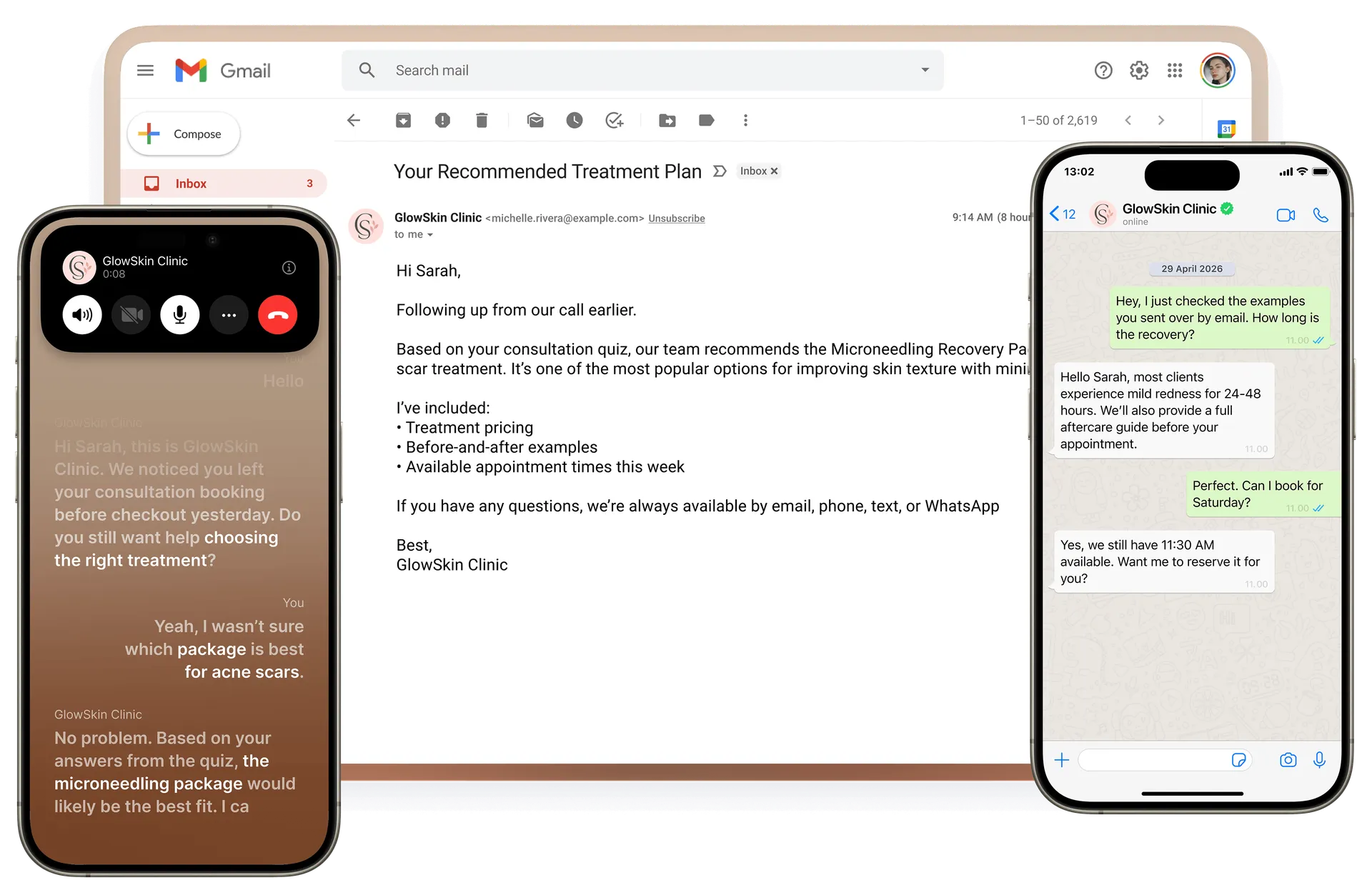
A lead who gets a missed call and texts back an hour later is still talking to the same agent, with the same context, not starting over on a different channel.
That lifecycle logic shows up in the campaign builder itself. Pre-call triggers, conditional retries, mid-call actions, and post-call updates to the CRM all run as one sequence, built by operators without a developer in the loop.
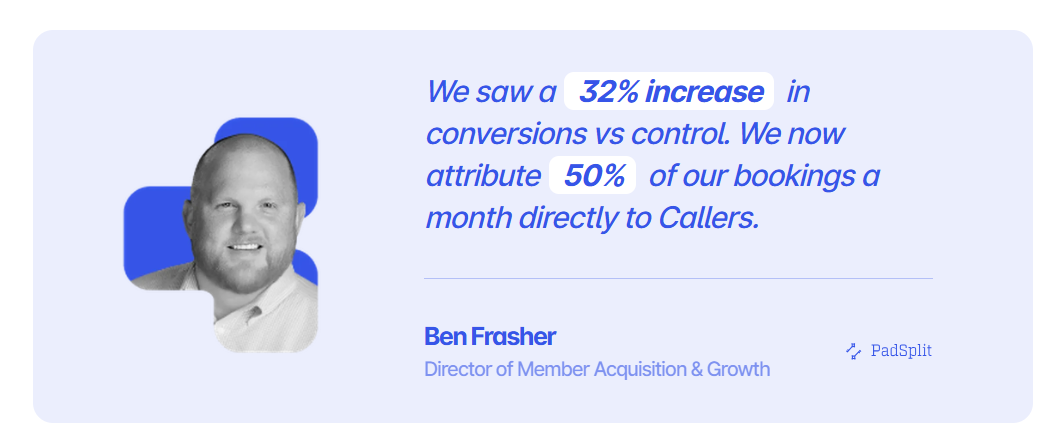
PadSplit used this to lift conversions 32% against a control group and now attributes 46% of monthly bookings directly to Callers.
What else sets it apart:
610+ native integrations with tools like Salesforce, HubSpot, and Zendesk, so CRM data flows both ways without custom API work
Compliance built in on every plan, covering SOC 2, HIPAA, GDPR, CCPA, and PCI DSS, with no enterprise tier required to unlock it
White-glove onboarding included regardless of plan, with a dedicated CSM from day one rather than gated behind a higher-priced tier
Pricing follows the same logic as the rest of the platform. Cost is tied to outcomes and volume rather than a maze of per-component add-ons or provider keys a team has to manage separately.
For teams comparing Retell and Synthflow on latency, builder type, or per-minute math, the bigger question is often which platform can run the entire customer relationship, not just the call. That's the gap Callers was built to close.
Frequently Asked Questions (FAQs)
Which Is Cheaper To Get Started With, Retell or Synthflow?
Retell, by a wide margin. It's pay-as-you-go from roughly $0.07 a minute, with $10 in free credits and no subscription needed. Synthflow's published starting point is an annual enterprise contract, so there's no low-cost entry right now.
Which Platform Has More Integrations?
It depends on how you think of integrations. Synthflow leans no-code, with pre-built connections to Salesforce, HubSpot, Zoho, calendars, and tools like Zapier. Retell's integrations are more API-driven, giving engineering teams finer control over how call data flows into a CRM, but with more setup work.
How Does Each Platform Handle Handoff to a Human Agent?
Retell treats it as part of the call flow. Warm transfer lets the AI stay on the line, detect if a human picked up, and pass along a quick summary before connecting. Synthflow uses Transfer Nodes for handoffs, plus a Zoom Phone integration where the agent takes the first pass and escalates when needed. Our approach at Callers is to natively route simple work to AI and only pull in the team for high-stakes conversations.
How Do These Platforms Handle Multiple Languages?
Retell supports 50+ languages with live mid-call switching. Synthflow claims 30 to 60 depending on the source, though quality varies by language. Platforms like Callers keep this simple with real-time language switching mid-call as a core feature rather than a configuration add-on.
Can I Clone a Custom Voice or Pick From a Library?
Both platforms support it. Retell lets you clone a voice via API or import from ElevenLabs by pasting a Voice ID or uploading a short audio sample, with automatic fallback if something fails. Synthflow's voice selector offers hundreds of pre-built voices alongside its own cloning and third-party import option.
Run Every Customer Conversation Through One AI Platform with Callers
Retell and Synthflow both solve part of the voice AI puzzle, latency, build flexibility, no-code speed, but neither was built to run the full lifecycle a growing business actually needs, from first contact to closed case.
That's what we build Callers for. A single agent carries context across calls, texts, WhatsApp, email, and chat, with campaign logic, CRM integrations, and compliance built in from day one, not bolted on as a team scales.
If you're ready to stop stitching tools together and run the whole conversation from one platform, book a demo with Callers today!