
Turn detection for voice AI agents in 200 µs, with no GPU

Every AI voice agent has to answer one question many times per call: has the caller finished, or are they just pausing? This is turn detection, also called end-of-turn detection or endpointing, and it decides how natural a conversation feels. Get it wrong one way and the agent talks over people. Get it wrong the other way and every reply comes with a beat of dead air.
For years the standard answer was voice activity detection (VAD) plus a silence timer: when the caller has been quiet long enough, the turn is over. That breaks on the pauses people make all the time, reading a card number, recalling a date, saying "um".
The newer answer is semantic turn detection with a neural network: a small speech model that listens to the last few seconds of audio, or a small language model that reads the transcript. They work. They're also tens to hundreds of megabytes, take tens of milliseconds per decision on a CPU, and often need a GPU or a separate inference service at scale.
Ours takes 200 microseconds. Here's how, and why it doesn't need the other 29.8 milliseconds.
The latency budget came first
Before we looked at accuracy, we wrote down what the model had to be:
In process. It runs inside the system that handles the call. No network hop, no extra service.
CPU only. No GPU, no inference server to deploy and keep alive.
Fast enough to disappear. Microseconds, not milliseconds, because it runs at every pause of every call.
Small. It ships with the rest of our code.
Careful. It may only act when it is very sure. When it isn't, the call goes on exactly as it would without it.
That ruled out most of the popular designs. It also forced a better question.
Why we don't need 30 milliseconds
Try this. A stranger calls you and says: "My number is four four seven one..." and stops. Are they done?
You can't tell. So you listen harder: to the tone of the last word, to whether the breath sounds final. That's what most turn detectors do. They get a snapshot, the last few seconds of audio or the last sentence of text, and they need a large neural network to squeeze an answer out of it. Squeezing takes time. That's where the 30 to 60 milliseconds go.
Now imagine it's a colleague you've been on the phone with for five minutes. You asked for their card number. You've heard how they talk: they always pause between groups of digits, a little longer than most people. You've seen how the call has gone so far. "Four four seven one..." isn't a puzzle anymore. Of course there's more coming.
That's the difference. A turn detector bolted onto a voice pipeline usually sees one moment. Ours sits inside the call, so it sees the whole conversation as it happens:
The call's history, from the first "hello": how this caller speaks, how they've paused before, how the conversation has gone.
What the agent just asked, and what kind of answer that question usually gets.
The live transcript, including how the sentence is ending.
The voice itself, and how it behaves at the end of a phrase.
More signals most models never look at, because they live in the call platform, not in the audio.
With that much context, most decisions get easy. And easy decisions don't need a big network. The heavy lifting is done by knowing the conversation, not by crunching the last two seconds of sound.
The result is a compact model of about 1 MB that decides in 200 µs on an ordinary CPU, with no machine learning runtime at all.
Smart Turn vs LiveKit turn detector vs Callers: same machine, side by side
Published latency numbers are hard to compare, because everyone measures on different hardware. So we ran ours and two popular open-source turn detectors on the same laptop CPU (Apple M2 Pro), with the same caller line and pause:
Model | Size | Median latency per decision | p99 |
|---|---|---|---|
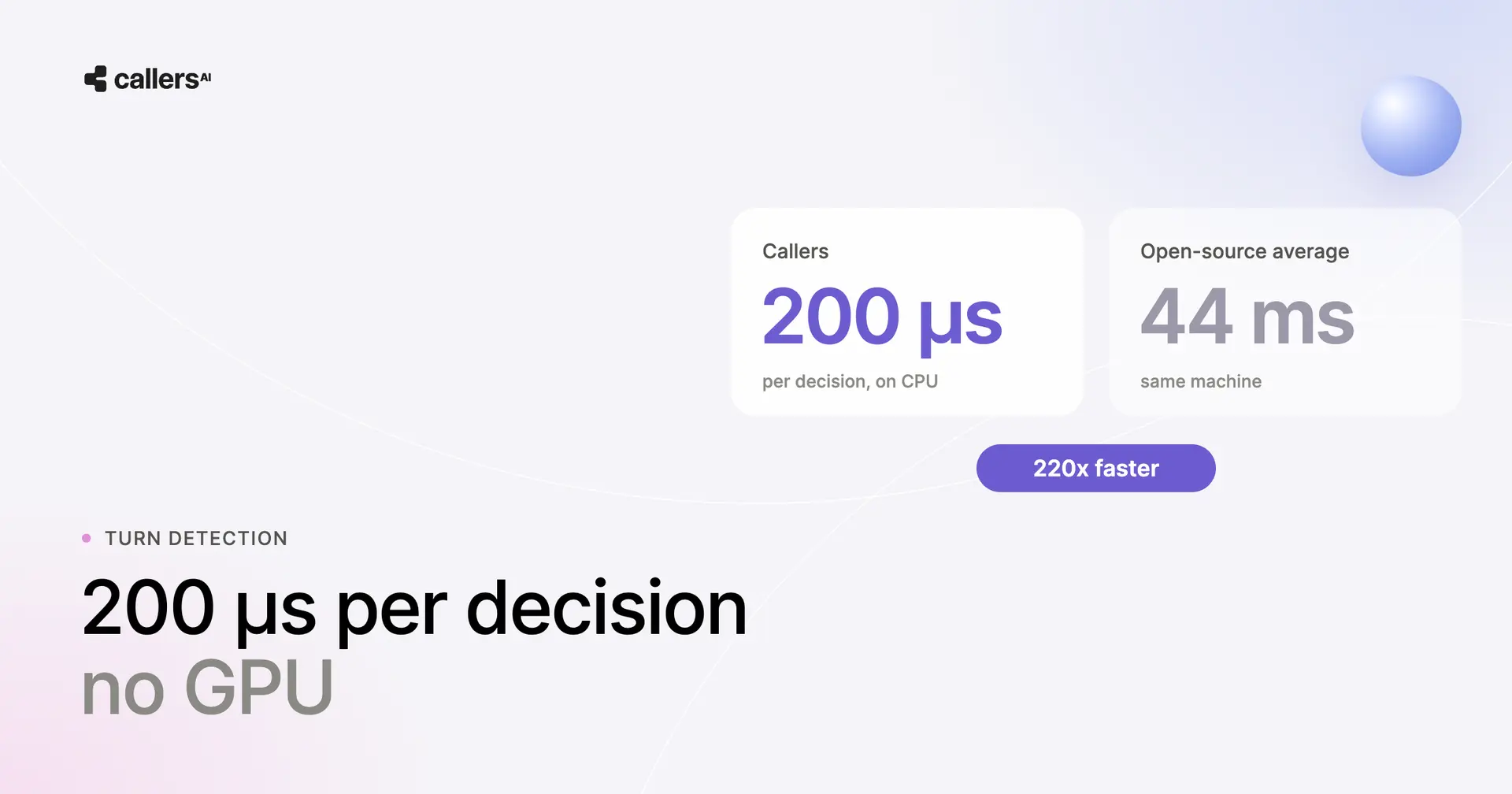
Callers turn-taking model | about 1 MB | 200 µs | 290 µs |
Pipecat Smart Turn v3.2, CPU build, with its audio feature step | 8.7 MB | 30 ms | 54 ms |
LiveKit multilingual turn detector | 396 MB | 58 ms | 128 ms |
That's 150 to 290 times faster (220 times against the open-source average of 44 ms), and 8 to 400 times smaller.
Some notes on fairness:
The open-source models ran in ONNX Runtime with default settings, which may use several CPU cores. Ours ran on a single thread.
Smart Turn's makers publish about 12 ms on a modern CPU. We measured 23 ms for the model alone and 30 ms including its audio feature step.
This compares latency and size only, not accuracy. The models also see different things: Smart Turn listens to audio, the LiveKit model reads text, and ours sees the whole call.
Both open-source projects are excellent and a good start for many teams. Our point is narrower: when you own the whole call, turn detection doesn't need a big neural network.
Careful by design
In production the model's job is narrow. At each pause the platform gets ready to reply. If the model is very sure the caller is still talking, it holds that step back and lets the caller finish. In every other case nothing changes.
We tuned it for precision, not coverage. A wrong call would make a caller who had finished wait longer for the reply, and that's the one thing it must never do.
What we learned
Write the latency budget down first. It ruled out most designs on day one and saved weeks.
Context beats size. Knowing the conversation is worth more than a bigger network.
Measure on one machine. Published latency figures vary widely. Same input, same CPU, or it isn't a comparison.
On live calls now
The turn-taking model is rolling out to Callers phone agents in English, French, Spanish, German, Italian and Greek. Read what it does for your callers. It works alongside Callers Premium Voice, our own text to speech, and our own noise model, and every Callers agent gets them with nothing extra to set up. See how our AI works for the rest of the stack.
A first agent takes minutes to build, and the most honest latency benchmark is still a real phone call. Build an agent and call it yourself.
Benchmark method: 500 warm-up and 5,000 timed decisions for our model; ONNX Runtime 1.22 with 30 warm-up and 300 timed runs for the others. Models: pipecat-ai/smart-turn-v3 file smart-turn-v3.2-cpu.onnx and livekit/turn-detector tag v0.4.1-intl, from Hugging Face.
FAQs
What is turn detection in voice AI?
Turn detection, also called end-of-turn detection or endpointing, is how an AI voice agent decides whether the caller has finished speaking or is only pausing. It controls when the agent replies, so it shapes how natural the conversation feels.
Why isn't voice activity detection (VAD) enough?
VAD tells you whether someone is speaking right now, not whether they've finished their thought. People pause mid-sentence to read numbers, recall details or think, and a silence timer on top of VAD treats those pauses as the end of the turn.
How fast is the Callers turn-taking model?
It takes 200 microseconds (µs) per decision on an ordinary CPU, with a p99 of 290 µs, measured on an Apple M2 Pro. On the same machine, Pipecat Smart Turn v3.2 took 30 ms and the LiveKit multilingual turn detector took 58 ms.
How can it be so much faster than other turn detectors?
Most turn detectors only see the last few seconds of audio or the last sentence, so they need a large neural network to make sense of it. Ours runs inside the call and uses the whole conversation, including what the agent asked and how this caller speaks, so a much smaller model is enough.
Does the turn-taking model need a GPU?
No. It runs on CPU, inside the call, with no separate inference service or machine learning runtime.
Can I use the turn-taking model outside Callers?
No. It's part of the Callers platform and runs in Callers AI voice agents. It isn't sold as a separate model or API.