
When Do People Pick Up? Data From Tens of Millions of Calls

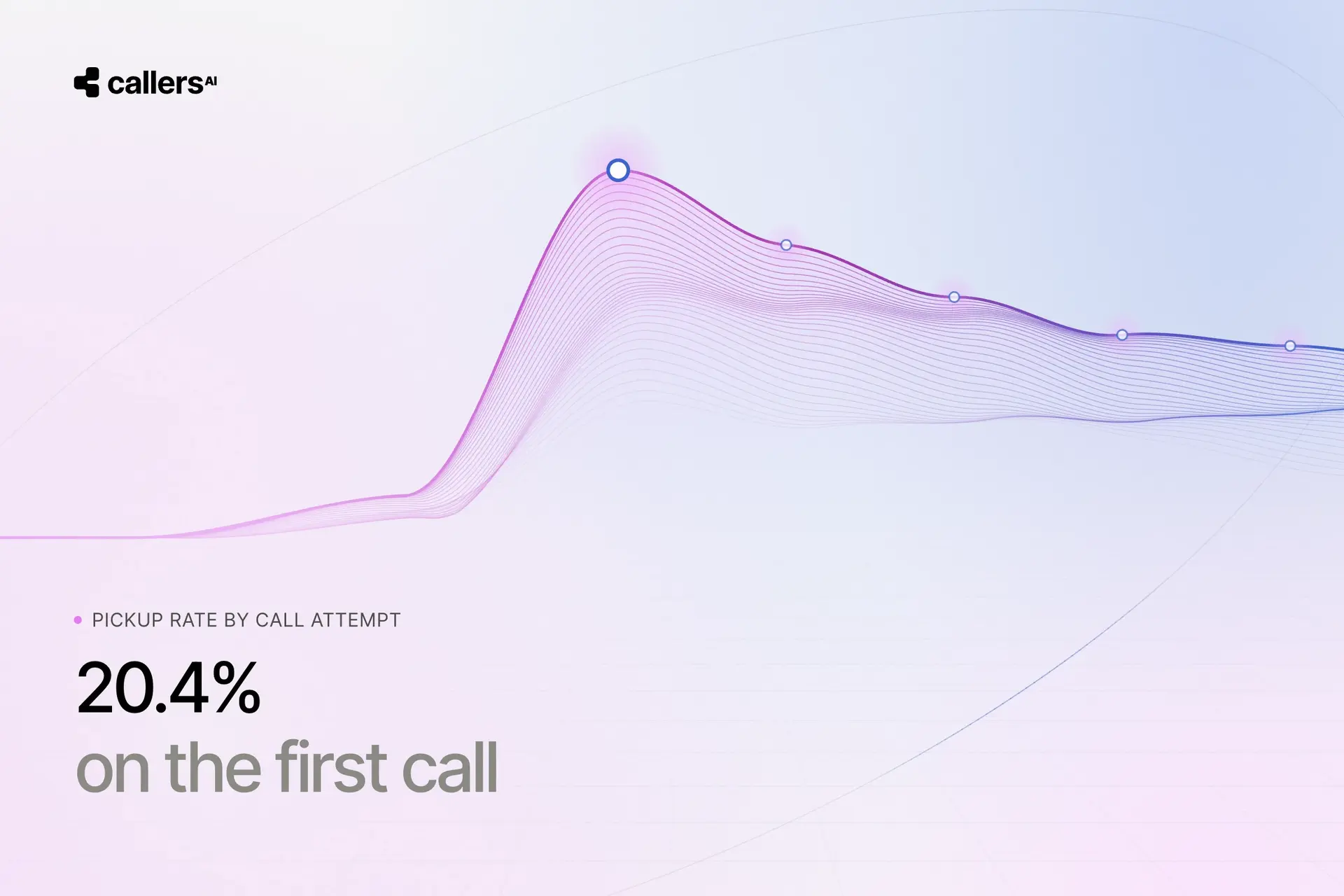
Short answer: Across tens of millions of outbound call attempts made by AI agents on the Callers AI platform over 12 months, the first call had the best pickup rate (20.4%), and 92.8% of the people reached within eight attempts were reached by the third. New leads called within one minute picked up 26.9% of the time, against 16.5% when the first call came more than a day later. Weekday late afternoon and early evening (5 to 8 pm local time) did best, and 7 to 9 am did worst.
Every business that calls its customers asks the same three questions: when to call, how many times, and how fast. We looked at 12 months of anonymized, aggregated call data from AI agents running on Callers AI to answer those questions with numbers.
About the data
Period: 23 Nov 2025 to 22 Nov 2026. The speed to lead figures use a shorter window, 1 Sep to 22 Nov 2026.
Sample: tens of millions of outbound call attempts by AI agents, plus a sample of answered inbound calls from more than 100 business accounts.
"Picked up" means a person answered and the call connected. Voicemail, no answer and busy count as not picked up. Technical failures, Do Not Call matches, test calls and simulations are left out.
Local time is the time zone set on the campaign.
Privacy: only totals were used. Every figure shown covers at least 5 business accounts, and most cover more than 50. No customer, phone number or individual record left the analytics warehouse.
How many call attempts should you make before giving up?
Three. The first attempt is the most likely to be answered, and each later attempt adds less.
Attempt | Pickup rate on that attempt | Share of all contacts reached so far |
|---|---|---|
1st | 20.4% | 20.4% |
2nd | 16.7% | 26.9% |
3rd | 14.2% | 29.1% |
4th | 11.5% | 30.0% |
5th | 10.4% | 30.6% |
8th | about 10% | 31.4% |
Going from one attempt to two adds 6.5 points of reach. The third adds 2.2 points. Attempts four to eight add 2.3 points between them. Of everyone reached within eight attempts, 92.8% were reached by the third.
What this means in practice: plan three attempts, spread across different days and times, then switch to text or email. Calling the same number a fifth or sixth time costs minutes and can raise the chance that your number gets labeled as spam.
Does calling a new lead within a minute really matter?
Yes. The biggest drop comes in the first few minutes, not over hours or days.
Time from lead created to first call | Pickup rate on the first call |
|---|---|
Under 1 minute | 26.9% |
1 to 5 minutes | 20.8% |
5 to 60 minutes | 19.7% |
1 to 24 hours | 19.4% |
Over 24 hours | 16.5% |
A lead called within a minute picked up about 29% more often than one called after one to five minutes. After that first drop, the curve is almost flat until the one day mark.
One caution: the leads in each bucket are not identical. Calls placed within a minute are mostly live web form leads, while calls placed a day later include uploaded lists. Part of the gap comes from lead type. Even so, the direction is consistent with what sales teams report, and the practical step is the same: call new leads while they are still on your website. We wrote more about this in how AI voice agents improve speed to lead.
What is the best time of day to call customers?
Late afternoon and early evening on weekdays. Early morning is the worst slot everywhere.
Weekday, local time | Pickup rate |
|---|---|
Before 9 am | 12.2% |
9 am to 12 pm | 15.4% |
12 to 2 pm | 15.7% |
2 to 5 pm | 15.9% |
5 to 8 pm | 16.4% |
After 8 pm | 15.0% |
By single hour, 7 am (9.5%) and 8 am (10.9%) were the weakest. From 9 am to 7 pm the rate held between 15% and 16.6%, with the highest values at 7 pm (16.6%) and 5 pm (16.4%). After 9 pm it fell again (13.9%).
The pattern differs by region:
UK and Europe: flat at about 19% to 20% from 8 am to 6 pm, best between 3 and 5 pm (20.4%), down to 17.1% at 8 pm.
North America: best around noon (13.8%), weakest at 6 pm (11.1%).
Asia Pacific: best between 10 and 11 am (about 15.8%).
The 7 to 8 am window was the worst slot in every region with enough data, so moving a first attempt out of it is an easy change.
What is the best day of the week to call?
Monday to Wednesday, with a slow decline toward the weekend.
Day | Pickup rate |
|---|---|
Monday | 16.0% |
Tuesday | 16.1% |
Wednesday | 15.9% |
Thursday | 15.6% |
Friday | 14.9% |
Saturday | 13.8% |
Sunday | 11.8% |
Weekend mornings before 9 am were the worst slot in the whole dataset, at 6.1%. Weekend evenings (5 to 8 pm) held up well at 16.0%, almost the same as weekdays.
Regions differ here too. In the UK and Europe, Saturday pickup fell to 10.8%, about half the weekday rate. In North America, Saturday held at 13.2%, the same as weekdays there.
How many inbound calls arrive outside business hours?
About 4 in 10. In our sample of answered inbound calls:
When the call arrived | Share of inbound calls |
|---|---|
Weekdays, 9 am to 5 pm | 58.5% |
Weekdays, outside 9 am to 5 pm | 24.7% |
Weekends | 16.8% |
So 41.5% of answered inbound calls came when a typical office is closed. The busiest single hour was 10 to 11 am (11.3% of calls), but the evening from 6 to 10 pm still carried 14%. A team that only answers during office hours sends a large share of its callers to voicemail. This is the main reason businesses put an AI agent on inbound support after hours and on weekends.
Do some kinds of calls get picked up more than others?
Yes. People pick up more often for a business they already know. Campaigns are tagged with a use case, and the labeled ones show a clear spread:
Campaign use case | Pickup rate |
|---|---|
Win back of past customers | 19.1% |
Pre-qualification of new leads | 14.8% |
Feedback surveys | 14.4% |
Cold outreach | 12.6% |
Revival of old leads | 11.3% |
Debt collection | 8.8% |
Win back calls and surveys reach existing customers, and they beat cold outreach and old leads. Best hours also vary by use case: cold outreach did best between 12 and 2 pm (14.4%) and worst before 9 am (5.8%), lead revival did best between 5 and 8 pm (13.6%), and pre-qualification did best between 12 and 2 pm (16.6%). Most campaigns have no use case set, so these numbers come from the labeled minority.
If you run win back campaigns or lead qualification, these are useful starting benchmarks.
Why is pickup lower in North America?
Pickup averaged 19.4% in the UK and Europe, 14.4% in Asia Pacific and 12.9% in North America. The data does not show the cause. One likely factor is spam labeling and call screening on US mobile networks, where unknown numbers are often flagged or silenced before the phone rings. If you call North American consumers, check whether your numbers carry a spam label. Callers AI includes spam-flag detection to help teams catch this.
A calling plan based on the data
Call new leads in under a minute. The gain is largest in the first minute.
Make three attempts, on different days and at different times, then switch to text or email.
Skip 7 to 9 am. Use late morning through early evening, and test 5 to 8 pm.
Cover after-hours and weekend inbound calls. About 4 in 10 arrive then.
Measure your own pickup by hour and day. These are averages across many businesses. Your audience may differ.
Method and limits
Rates are weighted by call volume, so a few large accounts move the totals. The direction of each finding held in every region with enough data. Exact percentages are less stable than the direction.
These are correlations. Businesses choose when to call, and lead types differ between time buckets.
The warehouse has no industry tag, so use case is used as a proxy for the type of call.
Local time comes from the campaign time zone, not the consumer's phone. For most campaigns the two match.
Related reading
FAQ
How many times should you call a lead?
Three attempts on different days and times. In our data, 92.8% of the people reached within eight attempts were reached by the third. After that, a text or email usually does more than another call.
What is the best time to call customers?
On weekdays, 5 to 8 pm local time had the highest pickup rate (16.4%), followed closely by 9 am to 5 pm. The worst slot was before 9 am, and weekend mornings before 9 am were the worst of all (6.1%).
How fast should you call a new lead?
Within one minute if you can. First calls placed in under a minute were picked up 26.9% of the time, against 20.8% at one to five minutes and 16.5% after a day.
What share of calls come in after business hours?
In our inbound sample, 41.5% of answered calls arrived outside weekday 9 am to 5 pm: 24.7% on weekday evenings and early mornings, and 16.8% on weekends.
Try it on your own calls
Callers AI runs AI agents that answer and make calls, call within the hours and schedules you set, so you can test these patterns against your own audience. Customers include DoorDash and Tony Robbins. See pricing or create a free account to build your first agent.