How Much Does an AI Voice Agent Cost? (Real Pricing Examples)
:quality(80))
:quality(80))
Quick Summary
AI voice agent pricing runs five different ways, per-seat, per-minute, per-conversation, hybrid, and enterprise, and advertised rates rarely match the final bill once components like the LLM, TTS, and telephony get added separately. Real costs land between $0.09 and $0.33 a minute depending on volume and vendor. Even at the high end, AI still costs a fraction of a human-staffed team.
Pricing here was verified in September 2026. Vendor rates change often, and custom contracts, regional terms, and volume commitments all move the final number, so confirm current pricing with each vendor before deciding.
Wondering Why AI Voice Agent Pricing Varies by Vendor?
Put two quotes for the same call volume side by side, and you could see the per-minute rates differ a ton. That doesn't necessarily mean one vendor is overcharging. They may simply be pricing different parts of the same stack, since a voice agent combines five separate services and every provider bundles them a little differently.
In this Callers article, we'll break down the pricing models you're likely to encounter, the costs that can hide behind the advertised rate, and what those numbers look like compared with a human team.
But first…
Why Listen to Us?
Callers works at the intersection of AI voice agents and high-volume customer conversations. We've helped businesses like Einride and PadSplit automate calls, reduce costs, and scale without adding headcount. That hands-on experience gives us a practical view of what AI voice agents actually cost in production, helping us break down pricing models and real-world costs beyond the advertised rates.

AI Voice Agent Pricing Models Explained
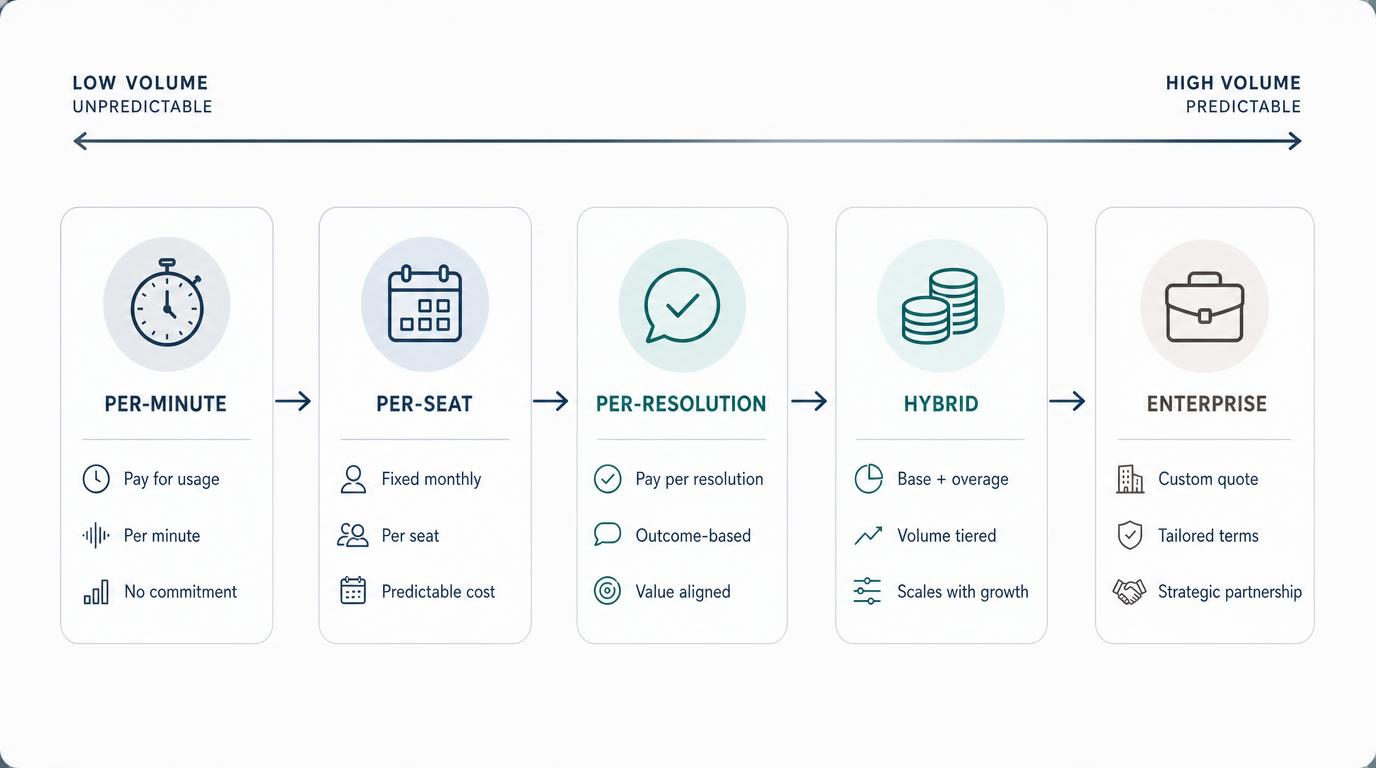
Vendors price AI voice agents five different ways, and each one can shape your final bill differently.
Per-minute Pricing
Per-minute pricing is the most common model. Advertised rates start around $0.05 to $0.07 a minute, but that number rarely covers the full stack.
For example, Vapi charges $0.05 for orchestration alone, then passes through speech-to-text, the language model, text-to-speech, and telephony separately. Real costs land between $0.15 and $0.33 a minute.
Callers prices per agent-minute, tiered by monthly volume, with custom enterprise plans. A smaller share of customers bill per contact. The speech, language model, and telephony layers sit inside that rate rather than arriving as separate line items.
Per-seat Pricing
Per-seat pricing charges a flat monthly fee per agent, usually $75 to $150, often with minimum seat counts of 20 to 50. You pay for the seat whether or not it gets used.
Per-conversation Pricing
This charges a flat fee per completed call or resolution, typically $0.62 to $2.40. A quick call and a long, complicated one cost the same flat fee. A five-minute booking confirmation and a twenty-minute troubleshooting call get priced identically, even though one takes far more effort to resolve.
Hybrid Pricing
Hybrid plans combine a recurring platform fee with per-minute usage. For instance, Bland AI's Build tier runs $299 a month plus $0.09 a minute, and Scale runs $499 a month plus $0.09 a minute.
Enterprise Pricing
Enterprise pricing most times is negotiated directly, and the floor varies widely by vendor. Synthflow's enterprise deals are quoted directly, with negotiated rates reported near $0.08 a minute. Cognigy sits at the other end, with Vendr's data putting the average contract at roughly $113,000 annually
What Actually Drives Your Per-Minute Cost
Every AI voice agent call moves through five layers, and each one adds to what you ultimately pay.
Speech-to-text: This converts the caller’s voice into text the AI can process. Deepgram Nova-2 costs around $0.004 to $0.01 per minute, making it one of the cheaper parts of the stack.
Language model: This is where the AI reads the transcript and generates a response. Costs vary the most at this layer, ranging from roughly $0.001 per minute with Groq to $0.008 or more with models such as GPT-4o.
Text-to-speech: This turns the AI’s response back into spoken audio. Premium voices from ElevenLabs cost around $0.04 to $0.10 per minute depending on tier, while Cartesia offers comparable quality at closer to $0.06. Callers includes its emotionally intelligent voice layer, including mid-call language switching, in its base rate rather than charging for it as a separate upgrade.
Telephony: This is the connection between the AI agent and the phone network. Providers such as Twilio and Telnyx typically charge around $0.01 to $0.02 per minute for this layer.
Orchestration: This is the layer that keeps everything running together, handling things such as state, memory, and session flow. It is often charged as the platform fee on top of the other components. Vapi charges $0.05 per minute for orchestration, while Retell charges $0.07.
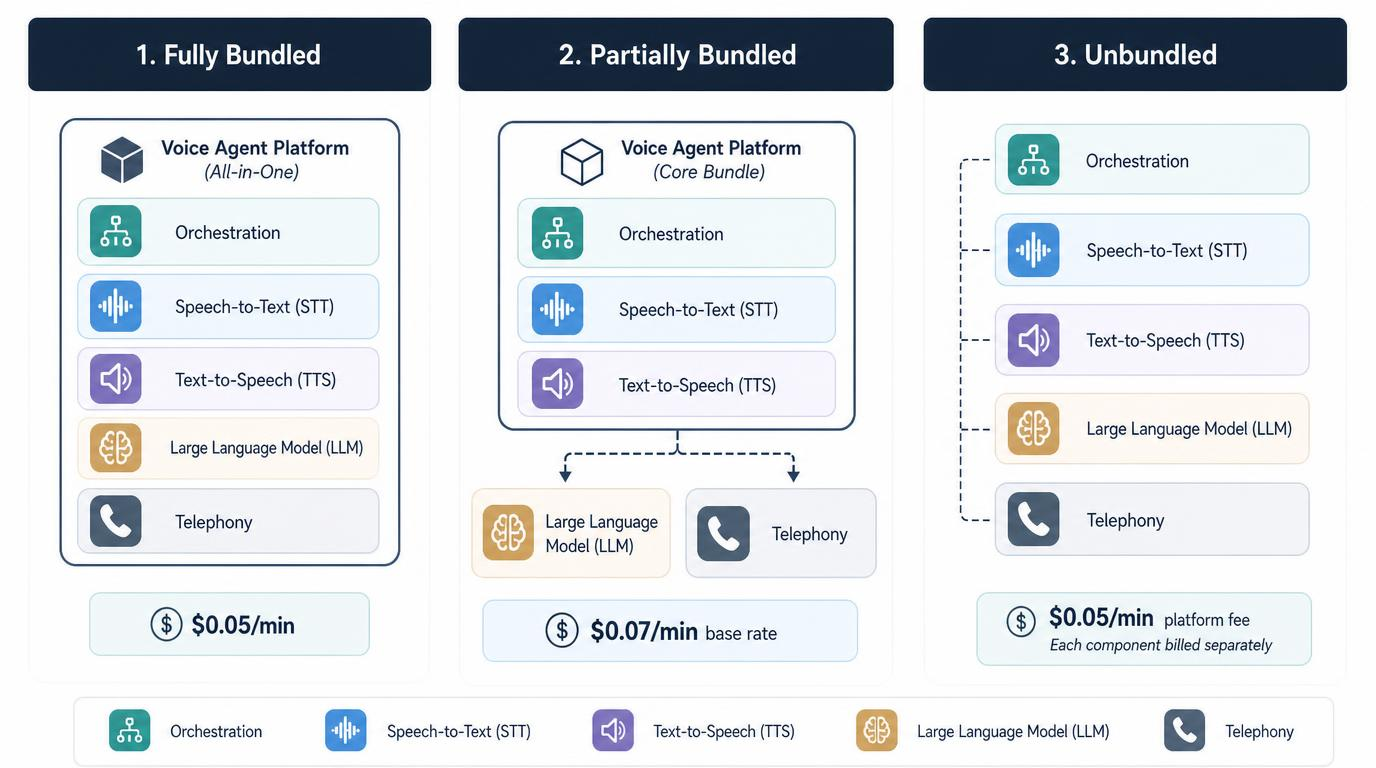
The way a vendor bundles these layers can make a big difference between the advertised rate and your actual bill. Telnyx, for example, bundles orchestration, speech-to-text, and text-to-speech into a $0.05-per-minute rate, with only the language model billed separately.
Real Pricing Examples by Call Volume
The easiest way to understand AI voice agent pricing is to see what happens when real call volumes hit those advertised rates.
1. Low Volume (500 to 1,000 Calls a Month)
At roughly 3 minutes per call, 1,000 calls runs close to 3,000 minutes.
ElevenLabs Agents charges a flat $0.08 a minute at every tier, putting a 3,000-minute month at $240
Bland's Start plan runs $0.09 a minute for connected calls with no platform fee, landing at $270
Deepgram's Voice Agent API prices at $0.075 a minute, closer to $225
A 20-seat minimum makes little sense at this stage, which is why flat per-minute plans dominate low-volume pilots.
2. Mid Volume (5,000 to 20,000 Calls a Month)
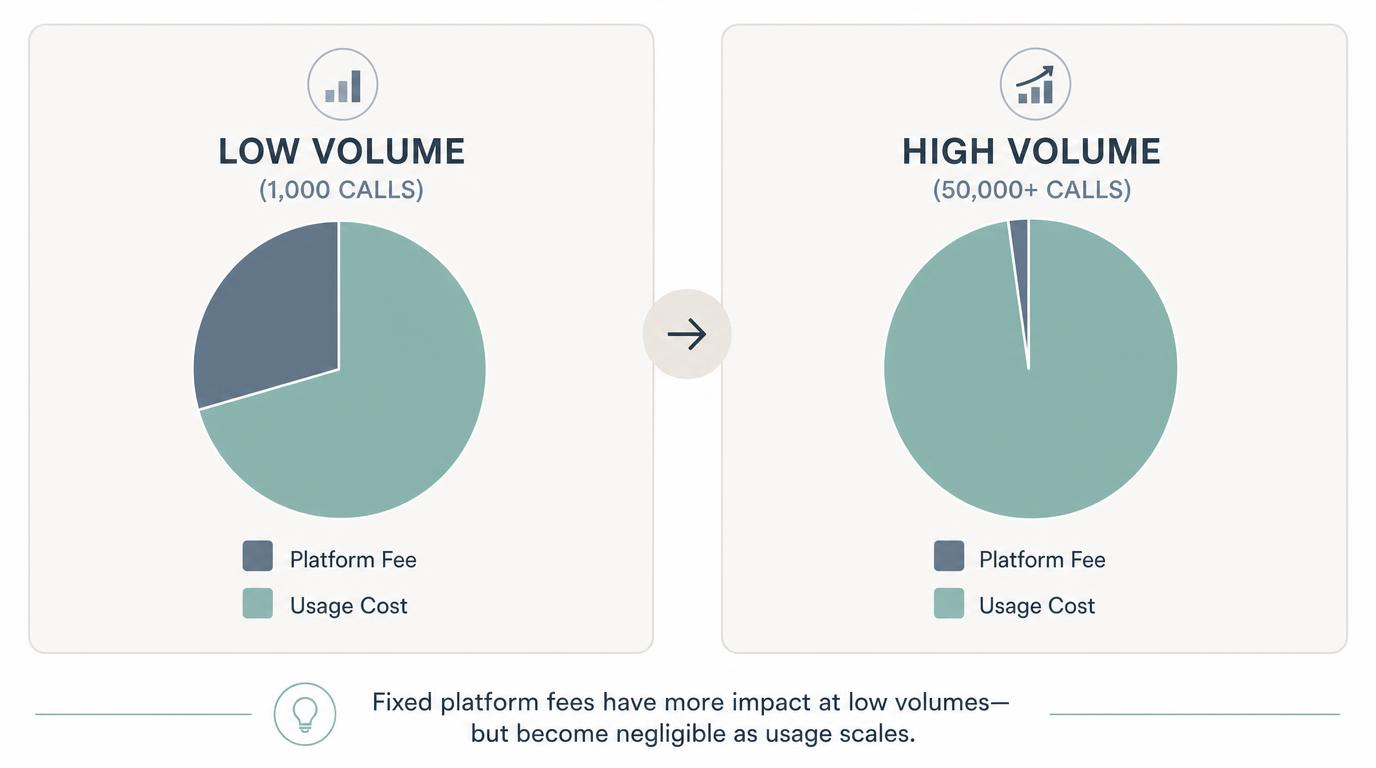
Platform fees start to matter, and unbundled pricing starts to show. At 10,000 minutes a month:
Bland's Scale tier runs $499 plus $0.09 a minute, totaling $1,399
Vapi's advertised $0.05 rate covers orchestration only. Once speech-to-text, the LLM, and text-to-speech stack on top, the real rate runs $0.15 to $0.33 a minute, or $1,500 to $3,300
Retell's pay-as-you-go rate spans $0.13 to $0.31 a minute depending on the LLM and voice chosen, so the same volume could land anywhere from $1,300 to $3,100
Double the platform fee's volume base and its per-minute impact drops by half, which is why fixed fees matter less as call counts climb.
3. High Volume (50,000+ Calls a Month)
At 100,000 minutes a month, rate differences compound fast.
Bland's Scale plan totals roughly $9,500 a month, near $114,000 a year
For Vapi, once STT, LLM, and TTS layers are added, third-party estimates put the effective rate at around $0.15 to $0.33 per minute, or roughly $15,000 to $33,000 a month.
Retell's own calculator shows one real configuration landing at $0.13 a minute, close to $13,000 a month at this volume.
Synthflow does not publish an enterprise rate card. Its subscription plans carry overage rates of $0.12 to $0.13 a minute, with enterprise deals negotiated toward $0.08 a minute on high volume.
Rate cards only tell part of the story at this scale though. Callers' deployment with Einride automated inbound driver calls without adding headcount, producing over $65,000 in annual savings, the kind of result a high-volume buyer weighs against any per-minute figure.
A custom-built stack skips platform fees entirely but costs $250,000 to $1 million upfront and takes four to nine months to deploy.
So in summary:
Volume tier | Minutes/month | Typical monthly cost |
Low | 1,500 to 3,000 | $115 to $270 |
Mid | 10,000 to 40,000 | $1,300 to $3,300 |
High | 100,000+ | $9,500 to $33,000+ |
Hidden and Pass-Through Costs to Watch For
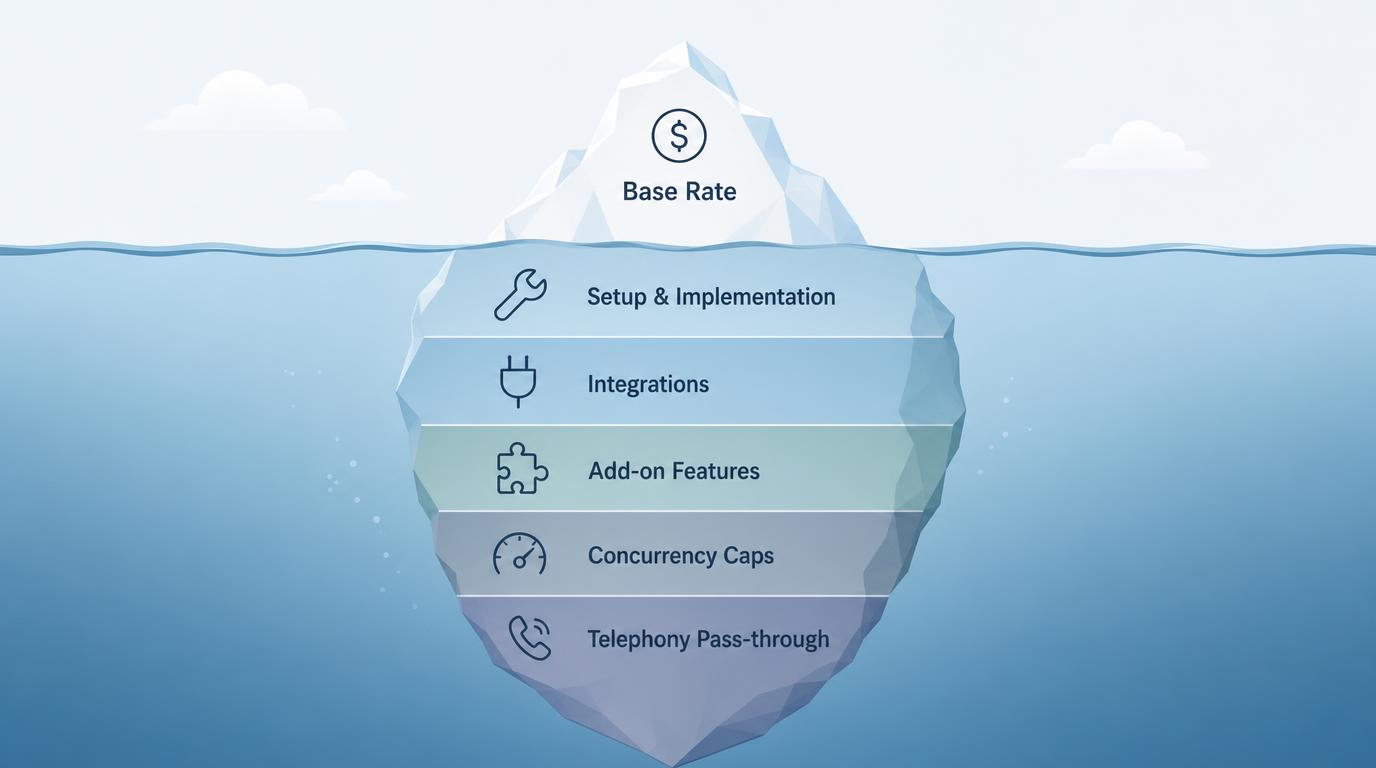
Beyond the base price, a range of additional costs can quietly increase the final bill.
Setup and Implementation
Turnkey platforms typically charge $500 to $2,000 for onboarding and initial configuration. Custom builds can cost much more, starting around $15,000 for a simple voice assistant and reaching $120,000 or more when CRM integration, compliance recording, and multi-turn memory are involved.
Callers builds white-glove implementation and ongoing customer success into the contract, so onboarding does not arrive as a separate line item.
Integrations
Native CRM and helpdesk connectors usually require little or no extra setup. API-first platforms put more of that work on the buyer, while custom integrations can add $1,000 to $5,000 in developer costs. Some vendors rely mainly on webhooks, meaning each new client account may need custom API configuration before going live.
Add-on Features
The base rate doesn't always include everything you need for production. Vapi charges $2,000 a month for HIPAA compliance and another $1,000 for zero data retention, both on top of its per-minute pricing. Retell charges $0.005 a minute for knowledge base usage after the first 10 free knowledge bases, then $8 a month for each additional one.
Callers holds SOC 2, HIPAA, GDPR, CCPA, and PCI DSS certifications, and sells additional security and control layers as add-ons. When comparing vendors, check whether important certifications and features are included from the start or added later as paid extras.
Concurrency and Overage Caps
Usage limits can also catch buyers off guard. Vapi's Build tier includes 10 concurrent calls, with each additional line costing $10 a month. Bland limits daily call volume by tier: 100 calls on Start, 2,000 on Build, and 5,000 on Scale. Going over those limits can trigger additional fees.
Telephony Pass-through
When telephony isn't included in the base rate, carriers can add another $0.005 to $0.02 per minute for call termination, plus $1 to $3 a month for each phone number. International calls often come with additional surcharges that vary by country, so businesses calling outside the US should get country-specific rates before signing.
AI Agent Pricing vs Human Agent Costs
Most cost comparisons start with a call center agent’s hourly wage and stop there, but that number leaves out a lot of the real costs behind it.
A US-based call center agent earns roughly $18 to $22 an hour on paper. Add 25% to 35% for benefits and payroll taxes, $2,000 to $5,000 in training per hire, and the cost of replacing employees at 30% to 45% annual churn, and the real hourly cost climbs to $35 to $55.
Bureau of Labor Statistics data from June 2025 put average fully loaded private-sector labor at $45.65 an hour, which fits that range. Once handle time is factored in, most businesses spend $8 to $15 on a single human-answered conversation.
AI changes that math considerably. AI voice agents cost roughly $0.13 a minute on a typical production stack, putting a four-minute call at about $0.52. A human-answered call of the same length costs around $3 to $7 once benefits, training, and turnover are included.
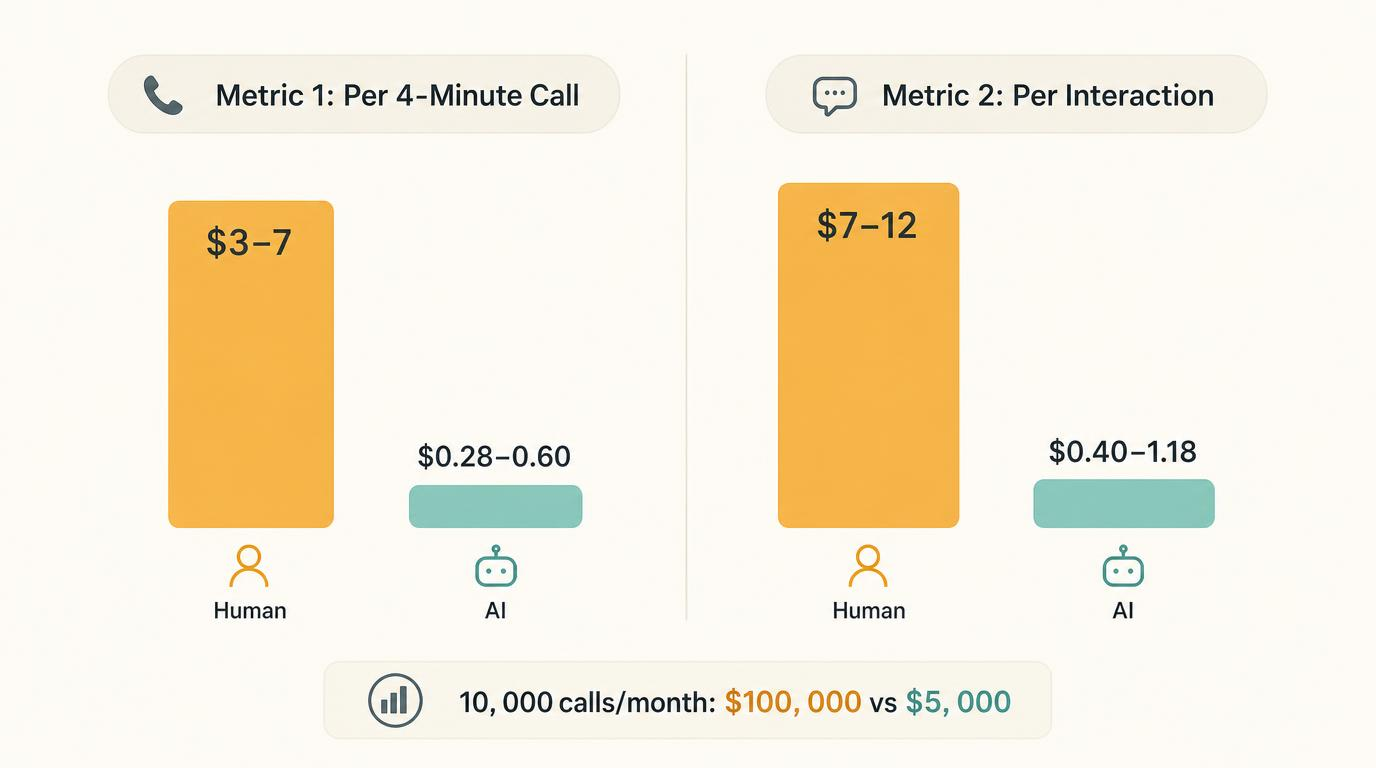
At 10,000 calls a month, human-staffed handling can run close to $100,000. The same volume handled by AI costs roughly $5,000.
The gap becomes even more noticeable at enterprise scale.
KeyBank CEO Christopher Gorman said on the bank's Q4 2025 earnings call that AI cut call center costs by 97%, with an AI-handled call costing about 35 cents compared with $9 for a human agent.
Salesforce cut support costs by 17% after moving half its customer conversations to AI agents, CEO Marc Benioff said in a podcast interview last year.
A Forrester study found that a composite enterprise saved $10.3 million in agent labor costs over three years, with payback in under six months.
There is another cost difference that gets overlooked, coverage. Staffing one seat around the clock takes roughly 4.5 to 5 full-time employees once shifts, PTO, and turnover gaps are factored in. A 50-seat 24/7 operation therefore needs 225 to 250 people on payroll, each carrying training and benefits costs. AI capacity, by comparison, scales with infrastructure rather than a hiring pipeline.
That doesn't mean the calculation should be as simple as AI versus humans. The strongest operations use AI to absorb the calls that don't need a person while leaving more complex conversations to human agents.
Voyager GM automated or triaged 25% to 30% of incoming calls, cutting agent workload by roughly 30% and freeing existing staff to handle the calls that actually need a person.
Einride used Callers to scale fleet operations without adding headcount, automating inbound driver calls while cutting more than $65,000 in annual costs.
Frequently Asked Questions (FAQs)
Am I Billed for Calls That Fail To Connect or Go to Voicemail?
Most platforms don't charge for calls that never connect. Some platforms charge a small flat fee, often around $0.015, per failed call attempt regardless of connection outcome, so it's worth confirming which model a vendor uses before signing.
Is Outbound Pricing Different From Inbound?
Often, yes. Telnyx, for example, lists separate rates for each direction. Outbound usually costs more per minute, 25 to 60% higher, due to dialer fees, lower connection rates from no-answers and voicemail, and compliance overhead like do-not-call and consent rules that inbound doesn't carry. Callers quotes one per-minute rate tiered by monthly volume, so ask how inbound and outbound are treated when you get your quote.
How Do I Estimate My Total Monthly Cost Before Signing?
Multiply expected minutes by the all-in per-minute rate, then add platform fees and add-ons like compliance or premium voices. At 10,000 minutes and $0.10/min, usage runs $1,000, but add-ons can push the real total to $2,600 to $3,600 a month.
How Quickly Can I Expect ROI?
Most businesses reach payback within three to six months. A flat-rate agent running a few hundred dollars a month often costs less than a full-time hire, and recovering even a handful of missed calls a week can offset that within weeks.
How Does AI Voice Agent Pricing Compare to Traditional IVR?
AI voice agents cost more per minute than static IVR but resolve far more calls. Gartner puts live-channel contact costs at $8.01 versus roughly $0.10 for self-service, and Peakflo's AR collections data shows AI voice cutting operational costs up to 60% versus IVR. The better comparison is cost per resolved call, not cost per minute.
Get Predictable AI Voice Agent Pricing with Callers
Every pricing model in this guide comes with the same problem. The number on the sales page rarely matches the final invoice. The difference often comes from costs buyers don't think to ask about until the bill arrives.
Callers takes a simpler approach, quoting one per-minute rate tiered by your monthly volume instead of layering separate charges for STT, LLM, TTS, and telephony. Enterprise plans are custom, and white-glove implementation is part of the contract.
If you want to see what predictable pricing looks like for your call volume, book a demo with Callers today.